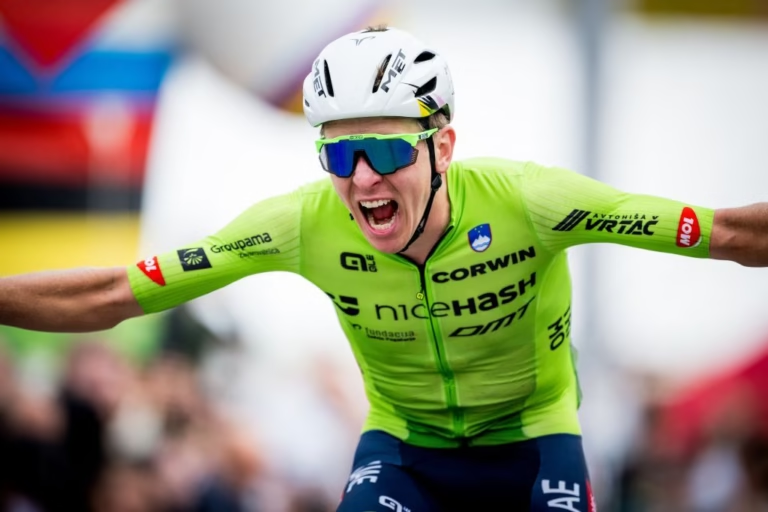
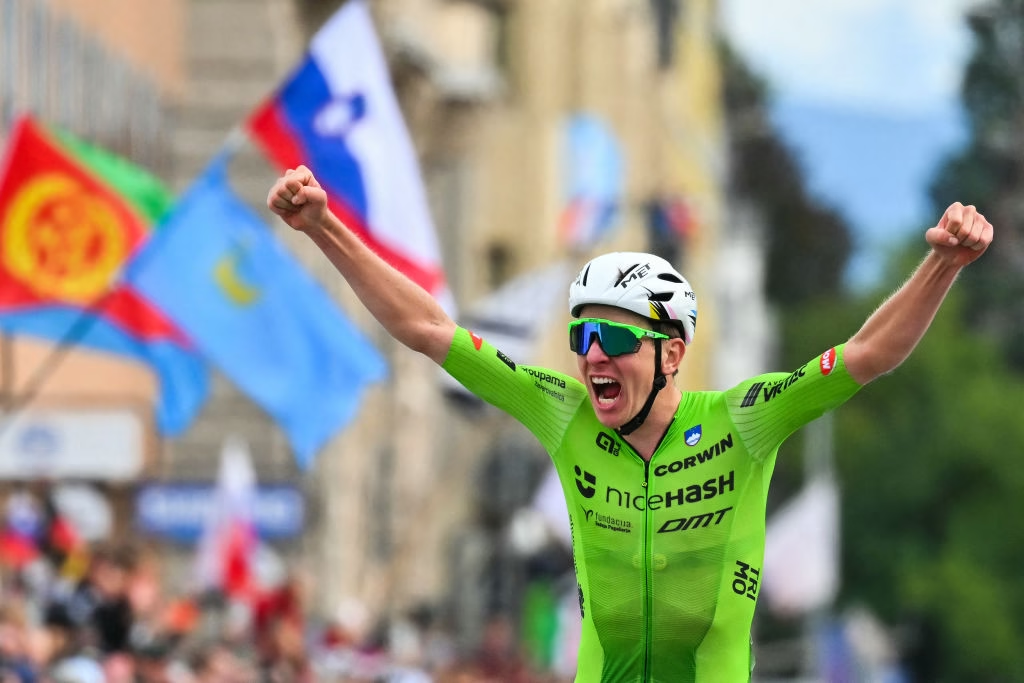
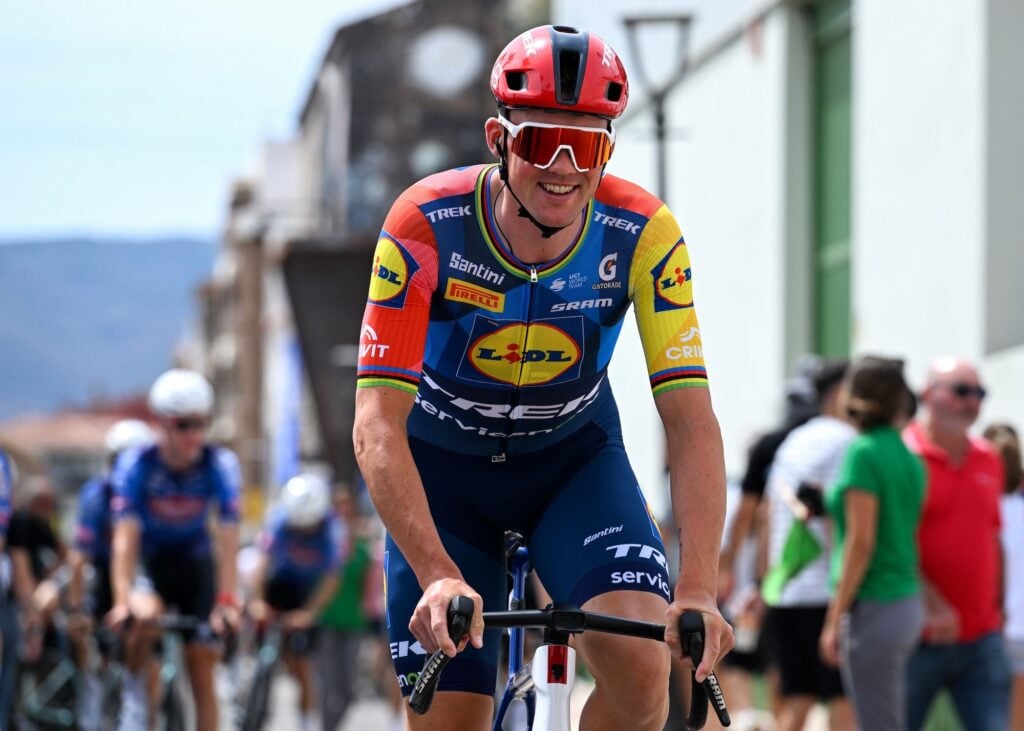
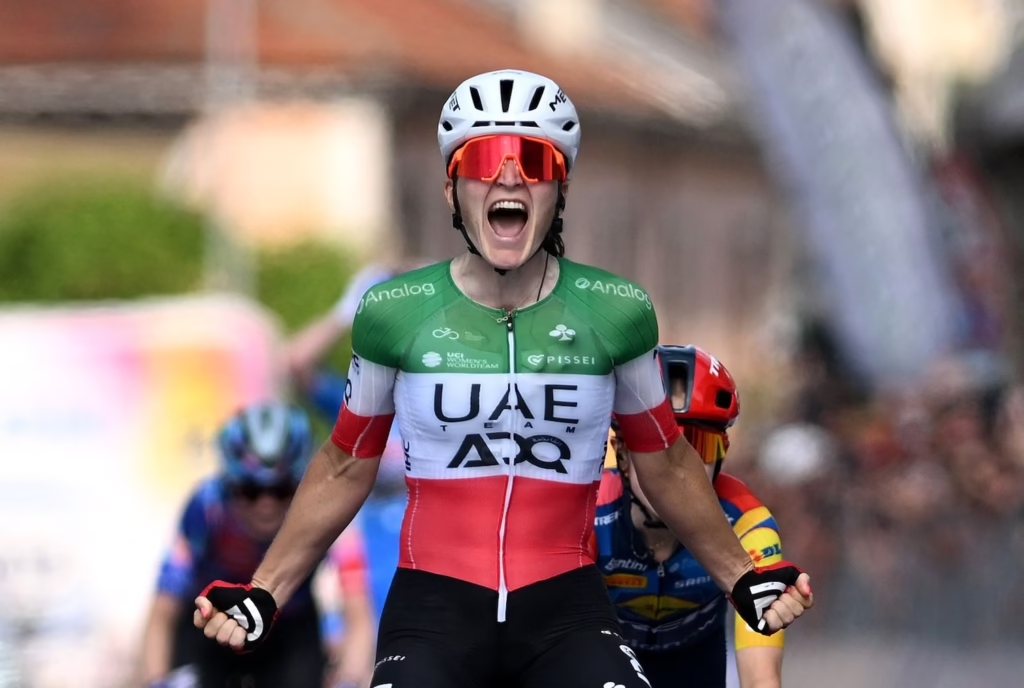
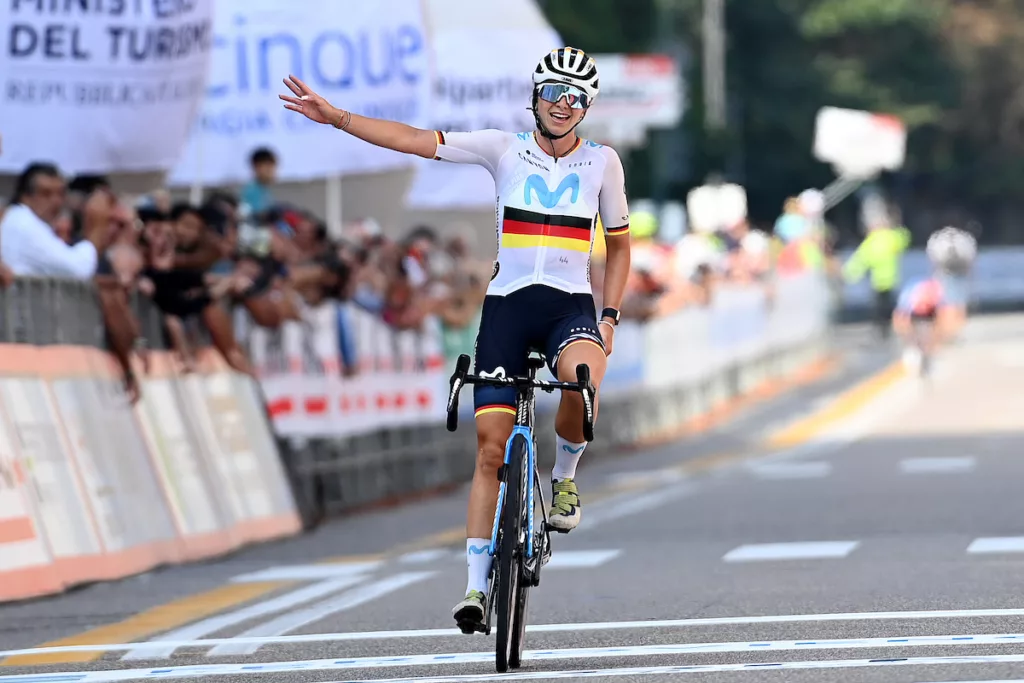
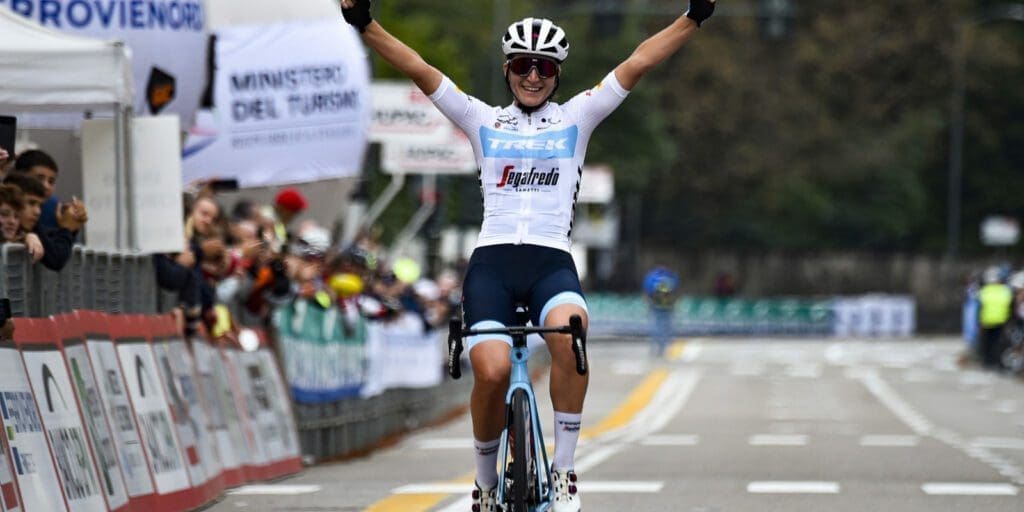
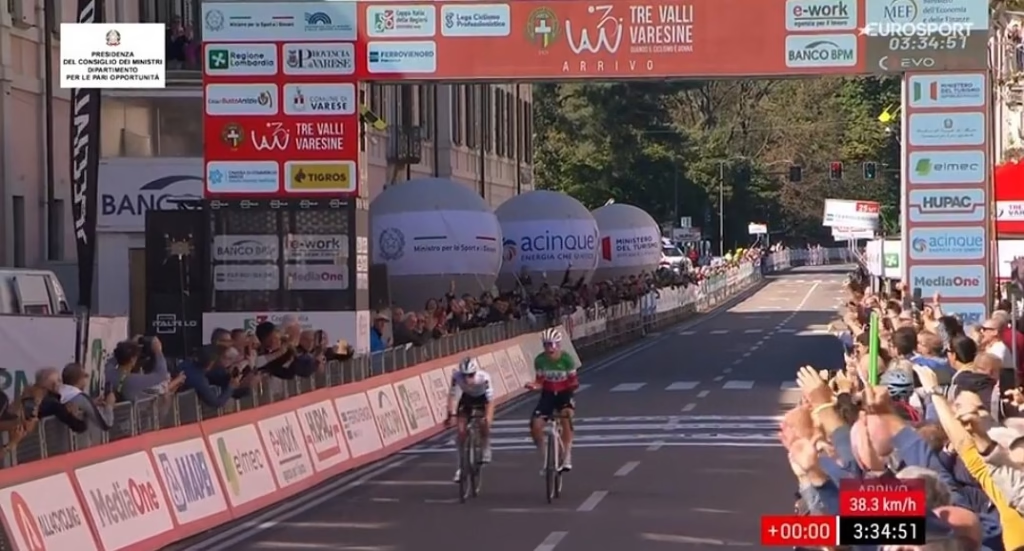
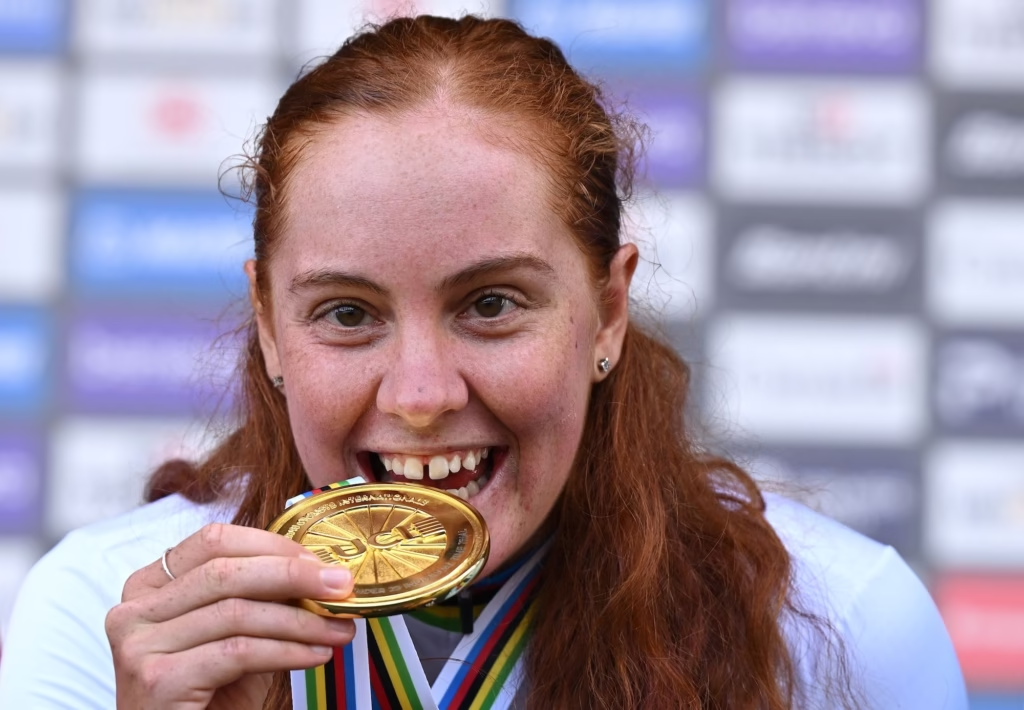
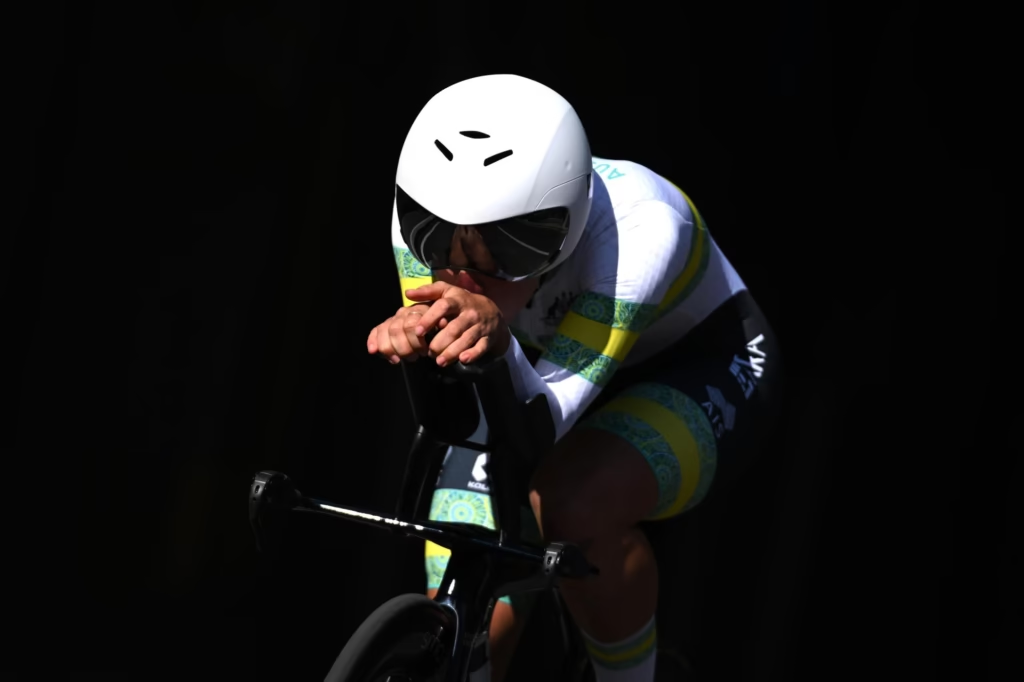
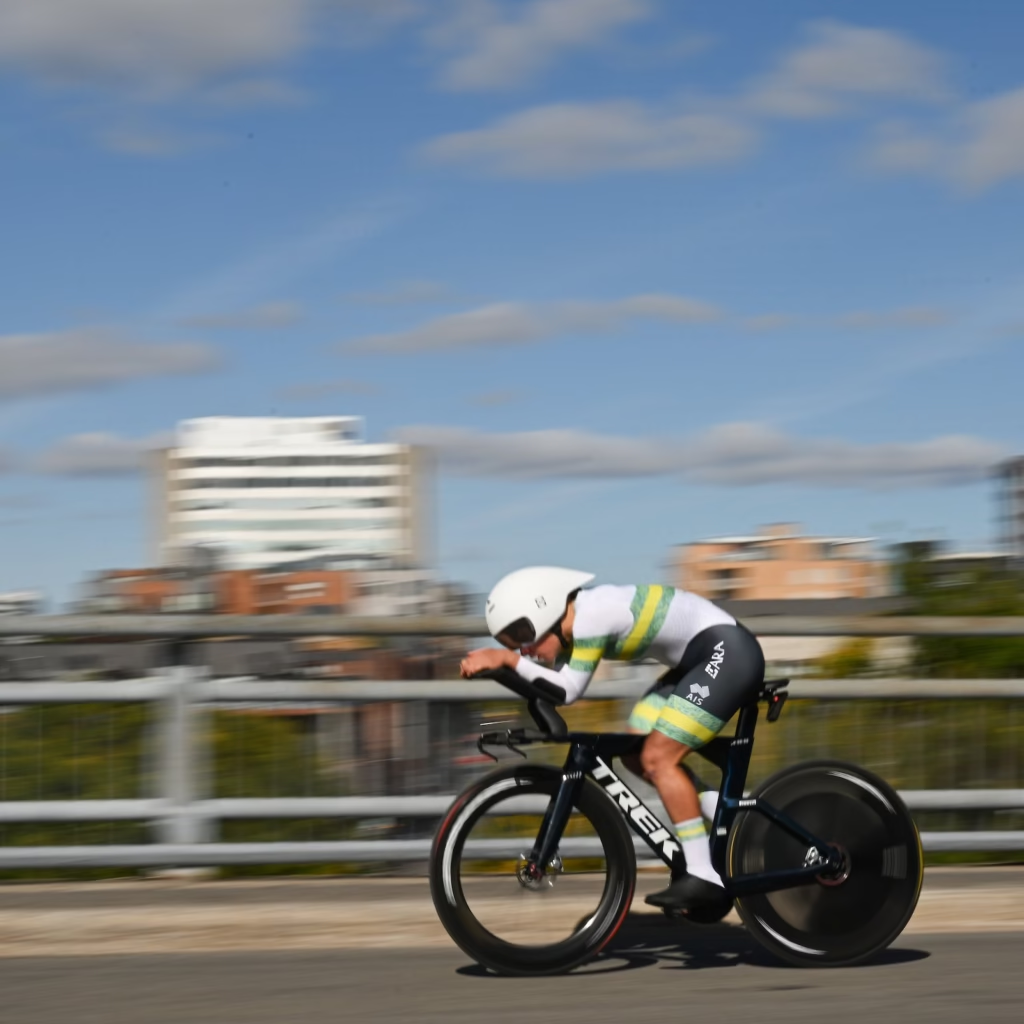
Groves will leave Alpecin-Premier Tech after four seasons and has signed with Tudor through 2029. The 27-year-old Australian gives the Swiss team another established winner for Grand Tour stages and difficult sprints, while Denz arrives from Red Bull-Bora-Hansgrohe after four years with the German WorldTour squad.
The pair strengthen Tudor in very different areas. Groves can be given outright leadership on sprint stages, while Denz has built much of his reputation working for Grand Tour contenders but has also won three Giro d’Italia stages when given freedom.
Photo Credit: LaPresse
Groves gets a new sprint opportunity at Tudor
Groves has won stages at all three Grand Tours, completing the set with an unusual solo victory at the 2025 Tour de France.
Rather than winning from a bunch sprint, he attacked from a strong breakaway with 17km remaining on stage 20 and rode alone to Pontarlier. ProCyclingUK’s report from Groves’ Tour de France stage victory showed the wider range that has always separated him from many pure sprinters.
His best Grand Tour record has come at the Vuelta a España, where he has won seven stages and previously taken the points classification.
The 2026 season has been considerably more difficult. A knee problem disrupted his spring before he returned for the Giro d’Italia, only to abandon after crashing. His Vuelta then ended on stage 9 after another difficult opening week.
The move to Tudor gives him a fresh start after a season in which he has struggled to reproduce his usual level.
Photo Credit: LaPresse
Denz adds Grand Tour strength and another breakaway threat
Denz brings a different profile.
The 32-year-old German has spent the past four seasons with Bora-Hansgrohe and Red Bull-Bora-Hansgrohe, becoming a dependable part of their Grand Tour squads.
He has also repeatedly shown what he can do when released from support duties.
Denz won twice at the 2023 Giro d’Italia before adding a third career Giro stage victory in 2025. On stage 18 to Cesano Maderno, he attacked his breakaway companions with 19km remaining and held them off alone.
His value to Tudor should extend beyond chasing individual stages. Denz can work on flat roads, survive difficult terrain and support leaders deep into Grand Tour stages, giving the team another experienced rider as its ambitions continue to grow.
Tudor continue strengthening for 2027
The two signings arrive as Tudor continue to build a roster capable of competing with WorldTour teams across a full calendar.
The team have already secured important existing riders for the longer term, including Marius Mayrhofer and Florian Stork, who recently extended their Tudor contracts through 2029.
Groves now provides a proven sprint leader who can also survive harder races, while Denz adds the sort of experienced depth required around stage-race leaders.
For Groves, the move offers a chance to re-establish himself after a disrupted 2026 and take on a prominent role in Tudor’s sprint programme. Denz arrives with a less specialised brief, but his record suggests Tudor are gaining more than a domestique.
Together, they add another layer to a team that is continuing to move beyond simply earning invitations to the biggest races and towards expecting to shape them.
The elite women’s road race at the 2026 UCI Road World Championships takes place in Montréal on Saturday 26 September, with the rainbow jersey decided after a demanding afternoon on and around Mount Royal. UK viewers have both subscription and free options: TNT Sports and HBO Max carry the full race, while BBC iPlayer is scheduled to show the elite women’s road race free.
The race starts at 14:00 BST, with TNT Sports and HBO Max coverage beginning at 13:50 BST. BBC iPlayer coverage is scheduled from 14:00 BST. The expected finish is around 19:00 to 19:15 BST, although the exact timing will depend on the speed of the race. For the wider championship schedule, including the junior and under-23 road races, see our complete 2026 World Championships TV and start-time guide.
Women’s World Championships 2026 UK TV details
TNT Sports has the most straightforward option for anyone wanting uninterrupted coverage of the whole championship. Its coverage of the elite women’s road race is due to begin at 13:50 BST, ten minutes before the 14:00 start. The race is also available through HBO Max in the UK, with TNT Sports included in the relevant subscription package.
TNT Sports can also be accessed through television packages from BT, EE, Sky and Virgin Media. The exact channel allocation can change around other live sport, but the published championship schedule places the women’s elite road race on TNT Sports 3. Streaming through HBO Max removes the need to follow any late channel switch and gives access to the same live World Championships coverage.
There is also a free UK option. BBC iPlayer is scheduled to carry the women’s elite road race from 14:00 BST. The BBC has selected the elite events rather than every race on the Montréal programme, so viewers looking for the under-23 and junior championships will still need TNT Sports or HBO Max. For Saturday, however, the BBC coverage means the women’s road race can be watched without a sports subscription.
What time does the women’s road race start?
Montréal is five hours behind the UK while British Summer Time remains in force. The official 09:00 local start therefore converts to 14:00 BST. TNT Sports and HBO Max are scheduled to go live at 13:50, giving a short build-up before the flag drops.
This is a long broadcast rather than a short late-afternoon window. The elite women race from Chambly into Montréal before completing eight laps of the Mount Royal circuit, so the decisive racing is likely to build progressively rather than begin with the final circuits. Anyone mainly interested in the medal fight should still allow plenty of time before the projected finish. Repeated climbing and the cumulative effect of the circuit give teams opportunities to make the race difficult well before the last lap.
Our women’s World Championships road race route guide goes through the approach to Montréal, the Mount Royal circuit and the sections most likely to shape the race. It is worth having alongside the broadcast because the repeated circuit can make attacks look less important than they really are until the accumulated climbing begins to separate the strongest riders.
How to stream the race in the UK
For streaming, UK viewers can use HBO Max or BBC iPlayer. HBO Max is the subscription route for the full championship feed, while BBC iPlayer provides the free option for the elite women’s road race. Both should be available on the usual range of web browsers, phones, tablets and supported smart-TV devices.
If you already receive TNT Sports through a television provider, check the streaming access included with that package rather than taking out a second subscription. Coverage arrangements differ between BT, EE, Sky and Virgin Media, and the simplest option depends on the package already attached to your account.
The UCI also streams World Championships racing on its YouTube channel in territories where it does not conflict with local broadcast rights. That feed is subject to geo-blocking, so it should not be treated as the main UK option. BBC iPlayer is the confirmed free route for UK viewers, with TNT Sports and HBO Max providing the broader paid coverage.
Watching the World Championships while abroad
Broadcast rights change by country. The UCI’s current broadcaster list includes CBC and TVA in Canada, FloSports in the United States, France TV in France, RAI in Italy, RTVE in Spain, NOS in the Netherlands, VRT and RTBF in Belgium, and Stan in Australia. Some of those broadcasters offer free domestic streams, but availability is normally restricted by location.
If you are temporarily outside the UK, check the terms of the service you normally use before travelling. Streaming platforms apply their own territorial rules, and access can differ from the UK service even when the same broadcaster group operates in another country. The UCI broadcaster list is the safest fallback for identifying the rights holder where you are staying.
Photo Credit: Getty
Why the full race is worth watching
The Montréal course makes this a difficult World Championships to reduce to the final ten kilometres. The elite women have eight Mount Royal circuits after the longer opening section, and the repeated climbing creates several different ways for the race to split. Strong nations can use numbers before the final lap, while riders without a dominant team have an incentive to anticipate the obvious favourites rather than wait for one final selection.
Demi Vollering starts among the central contenders, but the route gives aggressive climbers and Classics riders room to change the shape of the race. The ProCyclingUK women’s road race preview looks at the leading contenders, team strength and the tactical choices likely to matter on Mount Royal.
That combination is important for viewing strategy. Waiting until the final hour risks missing the move that forces one of the major nations to chase, particularly if a strong group forms during the middle circuits. World Championship road races do not have trade-team loyalties to stabilise them, and national teams vary sharply in depth. Once a dangerous combination gets clear, responsibility for closing it can become complicated very quickly.
Women’s World Championships road race 2026 viewing times
Date: Saturday 26 September 2026 Race start: 14:00 BST / 09:00 Montréal time TNT Sports / HBO Max: from 13:50 BST BBC iPlayer: from 14:00 BST Expected finish: approximately 19:00–19:15 BST
The safest approach is to be watching by 13:50 BST if using TNT Sports or HBO Max, or from 14:00 on BBC iPlayer. With eight Mount Royal laps and a world title at stake, the race has enough terrain for the important tactical decisions to begin well before the final circuit.
The Muc-Off Mobile Pressure Washer takes a familiar problem for riders and attacks it with a much more substantial solution than the usual portable cleaner. A 20-litre tank, removable 40V battery and genuinely useful pressure mean it can shift proper post-ride mud without needing a tap or mains socket nearby. That makes the basic idea particularly appealing for mountain bikers, gravel riders, cyclocross racers and anyone returning to a flat or rented home where washing a bike is awkward.
There is, however, an important catch. The integrated tank is designed to hold water while the washer is being used, but Muc-Off advises against driving with it full. Independent reviewers have reached the same conclusion more forcefully after experiencing substantial leakage in vehicles. For a product built around mobility, that changes the buying decision considerably.
The result is an unusually capable cordless bike washer whose cleaning performance is easier to recommend than its transport design. At £250 for the Starter Bundle, it needs to solve the right problem to justify the expense.
Muc-Off Mobile Pressure Washer specifications
UK price: £250 for the Starter Bundle Water capacity: 20 litres Motor: 500W brushless Battery: removable 40V lithium-ion, 2.5Ah/90Wh Pressure: 35 bar Eco, 45 bar Boost, up to 65 bar with the adjustable lance Runtime: up to 24 minutes Eco or 15 minutes Boost Charge time: around 3-4 hours Hose: 5 metres Protection: IPX5 battery enclosure Included lances: bicycle, motorcycle, adjustable and snow foam Also included: 1L Nano Tech Bike Cleaner, battery and charger Warranty: two years
Much more cleaning power than a typical portable washer
The strongest part of the case is straightforward: this is not a glorified battery-powered spray bottle. Muc-Off specifies 35 bar in Eco and 45 bar in Boost mode, while the adjustable lance can reach a maximum 65 bar. Independent testing broadly supports the claim that it has considerably more cleaning force than many compact cordless alternatives.
That matters after a muddy ride. E-MOUNTAINBIKE praised the cleaning performance and found Boost powerful enough for serious grime, while MTB-News similarly reported ample pressure even in Eco. CyclingNews’ more recent assessment also found the washer capable of tackling bikes and larger cleaning jobs convincingly. The repeated theme across the independent evidence is not a shortage of power.
For bike cleaning, more pressure is not automatically better. Muc-Off supplies a dedicated bicycle lance that produces a broader fan and is intended to reduce the risk around bearings, suspension components and paint. The adjustable and higher-pressure attachments are better reserved for suitable surfaces rather than firing the narrowest, hardest jet directly at bearing seals. Our winter bike maintenance guide covers the wider point: water is useful for shifting contamination, but where and how it is directed matters.
The 20-litre tank is both the advantage and the problem
Twenty litres is a useful amount of water for washing bikes away from home. It avoids the tiny reservoir problem of some portable cleaners, and the five-metre hose means the washer itself can stay in one place while you work around the bike. Wheels and a folding towing handle help once it is on the ground.
The problem is getting that water to the ride. The integrated tank does not have a watertight lid. Muc-Off now explicitly says it does not recommend driving with the washer full. The Loam Wolf encountered a large spill after transporting it in a car, while MBR reached much the same conclusion and regarded the inability to carry water securely inside the main unit as a major flaw. CyclingNews highlighted the same issue in its September 2026 review.
That is more than a minor irritation because it cuts across the product’s main proposition. If you finish a muddy ride somewhere without a tap, the obvious use case is arriving with the washer already carrying its water. Instead, the practical solution is a separate sealed container. Muc-Off sells an additional 20-litre water tank specifically for that purpose, and its Explorer Bundle combines the two, but it adds cost and another object to carry.
If your normal use is outside a flat, in a shared courtyard, beside a garage without plumbing or at an event where a water source is available for filling on arrival, the flaw matters much less. In those situations the integrated tank still removes the need to remain connected to a tap while cleaning.
Battery life should outlast the water supply
Muc-Off quotes 15 minutes in Boost and 24 minutes in Eco from the removable 40V battery. At the washer’s higher flow rates, the 20-litre tank is likely to become the limiting factor before the battery. Independent testing has also been positive about battery capacity, including reports of several muddy bikes being cleaned from one charge.
The removable design is useful. Charging the battery separately is easier than bringing a wet washer indoors, while a spare can extend runtime for race teams or households cleaning several bikes. The downside is that the battery system is proprietary rather than part of one of the broad power-tool ecosystems some rival washers use.
The accessories are useful, although not all are essential
The Starter Bundle includes four lances rather than making the buyer assemble a system afterwards. The bicycle lance is the obvious default, while the adjustable lance gives more concentrated pressure for suitable jobs. A motorcycle lance is included too, although cyclists buying purely for bike maintenance may rarely need it.
The snow foam attachment is more interesting. A bottle of cleaner screws directly into the lance and the washer mixes it with water. It is convenient rather than necessary, but riders who already use Muc-Off’s cleaning system may appreciate avoiding a separate foam sprayer. There is also a litre of Nano Tech Bike Cleaner in the Starter Bundle. Our broader guide to Muc-Off bike cleaning explains where cleaners, degreasers and protection products fit into a full wash.
The Kärcher OC3 Foldable takes almost the opposite approach. Its pressure is far lower and its eight-litre tank much smaller, but the collapsible design is easier to store and transport. It is a better fit where compactness matters more than shifting heavy mud quickly.
Ryobi’s 18V One+ Power Washer and the Worx Hydroshot are another route. They can draw water from a separate container, which means the transport vessel can actually be sealed, and buyers already invested in the relevant battery ecosystem may find them substantially cheaper. The compromise is that the Muc-Off feels more like an integrated bike-washing station once set up.
That distinction makes the buying decision clearer. The Muc-Off is strongest when cleaning performance, water capacity and an all-in-one setup at the point of use matter most. It is weaker when the priority is carrying a compact washer and its water inside a car with minimal fuss.
Who should buy the Muc-Off Mobile Pressure Washer?
Mountain bikers, gravel riders and cyclocross racers are the most obvious audience because they can generate enough mud to make a low-pressure portable cleaner frustrating. It also makes sense for riders without an outside tap, particularly if there is somewhere convenient to fill the tank shortly before use. Multi-bike households can benefit from the larger reservoir and battery capacity too.
Road riders who mainly want to rinse light dirt from one bike have less reason to spend £250. A conventional hose, pump sprayer or cheaper portable cleaner can cover that job. The same applies if boot space is tight or if the whole reason for buying a cordless washer is to transport a ready-filled unit to remote rides.
For riders who clean frequently, it is also worth treating the washer as one part of the maintenance process. Removing mud is only the start. Drivetrain cleaning and lubrication still matter, particularly through winter, and our Park Tool CM-5.3 chain scrubber review looks at a more targeted option for dealing with contaminated chains.
Verdict
The Muc-Off Mobile Pressure Washer gets the difficult part right. It has enough pressure to make cleaning a properly muddy bike quick, carries a useful volume of water, runs from a removable battery and includes bike-specific attachments rather than adapting a generic pressure washer as an afterthought. Multiple independent tests agree that cleaning performance is one of its strengths.
The non-sealing integrated tank is nevertheless a substantial design compromise. Calling a washer mobile naturally suggests filling it at home, putting it in the car and cleaning at the trailhead. Muc-Off’s own advice not to drive with the tank full means that particular job requires another water container, undermining some of the neatness of the all-in-one concept.
For £250, that limitation should be considered before the impressive pressure figures. Riders who can fill it where they clean, or who are happy to transport water separately, get a powerful and well-equipped cordless washing system. Those specifically seeking a sealed, ready-filled washer for the back of the car should look elsewhere or budget for Muc-Off’s separate water tank.
The 28-year-old, currently racing for Ma Petite Entreprise, becomes Mayenne Monbana My Pie’s third recruit for next season. The team see Asencio as an addition to their climbing group, but also intend to give her opportunities to target results as a leader.
“I’m joining Mayenne Monbana My Pie because I want to continue progressing and performing at a high level,” Asencio said. “I hope to bring some good results to the team.”
Asencio brings WorldTour experience to Mayenne
Asencio has produced a solid 2026 season, beginning with second place at the Pionera Race-SCV in February. She survived the climbing before finishing behind Arianna Fidanza in the uphill sprint in Cocentaina, a result covered in ProCyclingUK’s Pionera Race-SCV report.
She was also 11th at the French road championships before returning to the Tour de France Femmes this summer.
Asencio finished 32nd overall at the Tour, with her best result coming on stage 3 from Geneva to Poligny, where she took 17th. It was her second Tour appearance after previously racing the event in 2022.
Mayenne Monbana My Pie manager Jean-Christophe Barbotin said Asencio’s experience and approach to racing were important parts of the signing.
“Laura is an athlete who is recognised in French cycling, with considerable experience,” he said. “She has the maturity to prepare objectives and fully deliver on them as a leader.”
Barbotin added that he had wanted to bring Asencio into the team for some time and believes she can combine leadership with helping a relatively young squad develop.
A new opportunity after several seasons at the top level
Asencio has spent much of her career racing at the highest level, including six seasons with the WNT/Ceratizit structure before returning to a French team.
Her current Laura Asencio rider profile includes results such as fifth at the Vuelta CV Feminas in 2020, 12th overall at Itzulia Women in 2024 and 13th at the Tour of Guangxi.
Mayenne Monbana My Pie now want to use that experience while giving her more clearly defined objectives of her own.
The two-year agreement keeps Asencio with the team through the end of 2028. After a 2026 season which has included second at the Pionera Race and another Tour de France Femmes appearance, the move gives her a fresh opportunity to turn regular placings into bigger results.
Italy won the 2026 World Championship Mixed Relay in Montréal after building the decisive advantage during the first half of the race and then holding off a late French challenge to take the rainbow jerseys by 8.63 seconds.
The winning time of 51:32.28 only tells part of the story. Italy were not the fastest team out of the blocks and sat fourth at the opening checkpoint, but moved into the lead before the relay and never gave it back. France came closest to changing the result, while Switzerland recovered from a difficult end to the opening half to take bronze.
Australia finished fourth after remaining firmly in the medal fight until the latter stages, with Germany fifth and Spain sixth.
How it unfolded
The mixed relay rewards something slightly different from an individual time trial. A fast opening section is useful, but the race is ultimately about balance across two separate efforts and getting both halves of the team through the course without giving away a decisive chunk of time.
That made the opening checkpoint interesting rather than conclusive. Switzerland were fastest there in 7:04.98, with Germany 1.89 seconds behind and Spain at three seconds. Italy were only fourth, 3.14 seconds down, while Australia and France were fifth and sixth.
For Italy, there was little reason to panic. The differences were small and the longer middle section offered much more opportunity to establish the true order.
That is exactly what happened.
Italy turn an ordinary start into control of the race
By the second intermediate checkpoint Italy had moved from fourth to first, reaching it in 16:53.65. Australia were now their closest challengers at 2.20 seconds, with France another 2.46 seconds further back.
The bigger change concerned Switzerland. The early leaders slipped to sixth and were already 19.43 seconds behind Italy. Germany and Spain had also lost the positions they held through the opening kilometres.
It showed why reading too much into the first split of a team time trial can be misleading. The opening kilometres measure speed, but they do not yet show which teams have paced the effort well enough to maintain it or how effectively three riders are sharing the work.
Italy continued to increase the pressure before the relay. By the time the first half of the team had completed its work, the advantage had grown substantially.
Italy reached the relay point in 24:23.86, with France now second at 11.30 seconds and Australia third at 12.21. Spain were more than 25 seconds behind, while Germany had slipped to 28.72 and Switzerland to 35.14.
That was the foundation of Italy’s victory. They had taken a race that was separated by just over five seconds across the leading six nations at the first checkpoint and turned it into an advantage of more than 11 seconds before the second half began.
France and Australia fight over the chase
The second half initially looked as though it might develop into a three-team contest for the podium rather than a direct challenge to Italy.
At the first checkpoint after the relay, Italy remained comfortably ahead in 32:05.66. Australia had moved back into second at 13.83 seconds, but France were only 0.46 seconds behind them.
That tiny difference between Australia and France mattered because the two teams were beginning to move in opposite directions. France strengthened as the second half developed, while Australia’s challenge began to fade.
By the next checkpoint France had reclaimed second and were 16.18 seconds behind Italy. Australia had fallen to 25.75 seconds, leaving them increasingly vulnerable to Switzerland behind.
Italy’s advantage had grown slightly rather than contracted, but there was still one final section remaining and France had enough speed to make the margin less comfortable than it appeared.
France close late but Italy have already done enough
France produced their strongest relative section on the run to the finish. Having been 16.18 seconds behind at the final intermediate checkpoint, they reduced the deficit to 8.63 seconds by the line.
It was an impressive finish, but the damage from the first half of the race proved decisive. France had begun the second part 11.30 seconds behind and, despite eventually taking time back from Italy, never managed to erase the buffer that had already been created.
Italy stopped the clock at 51:32.28, with France finishing in 51:40.91.
The winning margin therefore came down to less than nine seconds over more than 51 minutes of racing. It was close enough to make France’s late acceleration meaningful, but Italy had led from the second checkpoint onwards and had left themselves enough room to absorb it.
Switzerland rescue bronze with a strong second half
Switzerland’s route to the podium was almost the reverse of Italy’s.
They had started fastest but reached the relay point 35.14 seconds behind. At that stage they were only sixth and were closer to Germany and Spain than to the teams fighting over the first two places. They lost Stefan Kung early due to a broken handlebar, a setback that may have made all the difference.
From there, the gap began to come down. Switzerland were 32.61 seconds behind Italy at the first checkpoint of the second half and 31.56 seconds down at the next. Their strongest gains arrived over the final section, bringing them home at 19.90 seconds and lifting them onto the podium.
That recovery was enough to overhaul Australia, whose deficit moved in the opposite direction. The Australians had been only 12.21 seconds down at the relay and remained second at the next checkpoint, but slipped to 25.75 seconds and eventually finished fourth at 40.48.
It gave the race three very different patterns among the medal contenders. Italy built their victory before the relay and protected it. France stayed consistently close before producing a fast finish. Switzerland lost ground early and recovered it late.
A result decided by balance rather than one dominant split
That contrast is what made Italy’s victory more interesting than a simple reading of the final standings suggests.
They were never required to produce one huge, race-breaking split. Instead, after giving away three seconds at the opening checkpoint, they were fastest when the race began to stretch out and created enough separation before the relay to put every other nation on the defensive.
France were able to take time back at the end and Switzerland finished their race strongly, but neither could undo what Italy had gained through the middle of the opening half.
Further down the standings, Germany finished fifth at 48.74 seconds and Spain sixth at 1:10.77. The closest finish came between Norway and Poland, separated by just 0.08 seconds in seventh and eighth. Canada took ninth and Estonia completed the top 10.
For Italy, the rainbow jerseys came from the most complete ride across both sides of the relay. They were not quickest at the first opportunity to measure them, and France were faster relative to them over the closing kilometres. In between, however, Italy created the gap that mattered.
Tadej Pogačar remains on the current start list for the 2026 European Road Championships in Slovenia, despite UAE Team Emirates-XRG confirming earlier this month that the defending champion will not race again this season following his Vuelta a España crash.
His name is the biggest talking point from the first men’s and women’s lists for the championships, which take place in Slovenia from 2-7 October. They remain provisional and include reserve riders, so appearing now is not a guarantee that somebody will actually start the road race.
That qualification is particularly important for Pogačar. His European title defence on home roads had been one of the major objectives of his autumn before he crashed out of the Vuelta on stage 8, suffering a concussion, a displaced left collarbone fracture and a stable C7 cervical fracture.
UAE subsequently confirmed that his 2026 season was over, as covered in ProCyclingUK’s report on Pogačar’s Vuelta injuries and extended UAE contract. His continuing presence on the European Championships list therefore looks much more like a remnant of Slovenia’s original plans than evidence of an imminent comeback.
Even without him, the current men’s and women’s fields contain several of the strongest riders in Europe. They also contain some notable gaps, with Wout van Aert, Mathieu van der Poel, Lotte Kopecky and a large part of Great Britain’s usual road-racing core among those currently missing.
Pogačar had wanted to defend his European title at home
Before the Vuelta, the European Championships had unusual personal importance for Pogačar.
He would have arrived as defending champion with the race taking place in Slovenia, giving him a rare opportunity to defend a major championship jersey in front of a home crowd.
The course and event had been discussed throughout the year with Pogačar as the obvious centrepiece of the host nation’s plans.
He has since returned to some indoor riding during his rehabilitation, but there has been no suggestion from his team that the decision to end his season has been reversed.
His name should therefore be treated cautiously until the final European Championships start list appears.
If it disappears, that will simply bring the list into line with what has already been announced.
Slovenia still have Roglič, Mohorič and Tratnik available
Pogačar’s expected absence does not leave the home nation without options.
Primož Roglič is on the current list after finishing second to Enric Mas at the Vuelta a España, while Matej Mohorič and Jan Tratnik give Slovenia two experienced championship riders.
Luka Mezgec, Domen Novak, Gal Glivar and Matevž Govekar also appear among a much broader preliminary group.
Roglič would be the obvious headline name if Pogačar is removed, although his racing style creates a different tactical problem for Slovenia.
With Pogačar, the simplest option is often to make the race extremely hard and trust that he can eventually ride everyone else off his wheel. Roglič is more likely to benefit from arriving later in the race with numbers around him.
Mohorič is especially useful in that situation. He can attack, descend aggressively and force other nations to use riders before the finale rather than asking Roglič to cover every move himself.
Evenepoel gives Belgium a clear reference point
Belgium’s current list includes Remco Evenepoel, who comes out of Montréal having just become the first man to win four consecutive elite World Championships time trial titles.
His progression from Stirling in 2023 through Zürich, Kigali and Montréal is covered in ProCyclingUK’s feature on Evenepoel’s record four-title run.
Quinten Hermans, Maxim Van Gils, Lennert Van Eetvelt, Ilan Van Wilder and Louis Vervaeke are among the other Belgian options.
Wout van Aert is the obvious absentee.
That removes one of Belgium’s most versatile championship riders, but they still have enough strength to approach the race in several ways. Van Gils and Hermans can handle an explosive finish, Van Eetvelt adds climbing ability and Evenepoel remains capable of forcing the race from much further out.
Van der Poel is missing from a lighter Dutch men’s list
The Netherlands do not currently have Mathieu van der Poel on their list.
Their options include Wouter Poels, Tijmen Graat, Sjoerd Bax, Gijs Leemreize and Jardi van der Lee, but there is no equivalent headline Classics leader.
Van der Poel’s absence is one of the biggest differences between the European Championships and the World Championships field.
It also changes the balance between the traditional major nations. Belgium can currently build around Evenepoel, Denmark have Mads Pedersen and Slovenia should still have Roglič, while the Dutch would need a much more collective race.
Pedersen heads a deep Danish group
Denmark have entered one of the strongest preliminary groups.
Mads Pedersen is joined by Kasper Asgreen, Mikkel Bjerg, Andreas Kron, Mikkel Honoré and Søren Kragh Andersen among a long list of options.
There is no Mattias Skjelmose, who withdrew from the World Championships after the fatigue that followed his Vuelta campaign.
Pedersen’s presence gives Denmark a relatively simple reference point if he starts. He is difficult to remove from a hard one-day race and considerably faster than most climbers if a reduced group reaches the finish together.
Asgreen, Honoré and Kron also give Denmark enough riders to attack before the race reaches that point.
France have Grégoire and Vauquelin but no Seixas
France’s current selection includes Romain Grégoire, Kévin Vauquelin, Pavel Sivakov, Bruno Armirail and Clément Berthet.
Paul Seixas is not listed.
That stands out after his bronze medal in the elite World Championships time trial in Montréal and his continued rise through 2026.
France still have a strong road-racing group, particularly for a selective course, but Seixas has increasingly looked like a rider capable of playing a role in these championships rather than simply one for the future.
His absence is therefore more notable than it would have been even six months ago.
Italy omit Ganna but still have plenty of road options
Filippo Ganna is another prominent absentee.
Italy’s current men’s list instead includes Alberto Bettiol, Giulio Pellizzari, Marco Frigo, Christian Scaroni and Diego Ulissi.
Ganna has just taken silver behind Evenepoel in the Montréal World Championships time trial, but his absence from the European list means Italy are currently leaning much more towards their road-race options.
Bettiol gives them experience in hard one-day races, while Pellizzari provides a younger climbing option if the course proves particularly selective.
Photo Credit: Getty
Spain have Ayuso but no Vuelta winner Mas
Juan Ayuso is the leading name in Spain’s provisional group, with Iván Romeo also included.
That makes his absence understandable at this point in the season, but it leaves Spain without the rider who currently has the strongest Grand Tour form in the country.
Ayuso’s presence still gives them a high-level climbing leader capable of handling a difficult championship race.
Portugal bring Almeida and Morgado
Portugal’s current list includes João Almeida, António Morgado and Nelson Oliveira.
That is a useful combination.
Almeida offers stage-racing strength and durability, Morgado has the power for a more aggressive one-day race and Oliveira adds years of championship experience.
Switzerland have Marc Hirschi and Jan Christen among their entries, although Stefan Küng is absent after another major autumn built heavily around time trialling.
Ireland and Norway are notable men’s absences
Some countries are not merely missing one star.
Ireland do not currently appear in the elite men’s list, which means no Ben Healy or Ryan Mullen.
Norway are also absent from the men’s field, despite Tobias Foss and Andreas Leknessund racing at the World Championships.
That does not mean neither nation can change its plans before the final lists are confirmed, but at present they are among the clearest national omissions.
Photo Credit: Wout Beel
Great Britain are present, but with only Hayter and Thornley
Great Britain are not completely absent.
Ethan Hayter and Callum Thornley are both on the current men’s list.
What is missing is almost everyone who would normally form the core of a major British road-race team. There is no Tom Pidcock, Oscar Onley, A Yates, Fred Wright, Mark Donovan or Finlay Pickering.
That makes Britain’s intentions difficult to read.
Hayter and Thornley are both obvious time trial options, so their presence does not necessarily mean Britain will field a conventional men’s road squad. The final race-specific start lists will tell us whether they contest the road race as well.
For now, the important correction is that Britain have not skipped the championships entirely.
The Dutch women have Vollering, Wiebes and Pieterse
If the Dutch men’s list looks relatively understated, the women’s list is the opposite.
Vollering covers the hardest race scenario. Pieterse offers another rider capable of attacking on repeated short climbs. Wiebes creates a completely different tactical threat if the race stays together.
Marianne Vos is the most obvious missing Dutch name.
Longo Borghini remains an obvious leader for a selective course, but Italy rarely rely entirely on one rider in championship racing. Persico and Paladin in particular give them enough flexibility to race before the finale rather than simply control for Longo Borghini.
Reusser could carry two rainbow jerseys into Slovenia
Marlen Reusser is included for Switzerland only days after winning her second consecutive elite World Championships time trial title.
The victory in Montréal moved her to two world titles, two silvers and a bronze in the discipline. Her place in the historical standings is covered in ProCyclingUK’s look at Reusser’s World Championships time trial record.
Reusser’s value now extends well beyond time trials. Her development as a stage racer means Switzerland can use her as a genuine road leader rather than simply saving her for the race against the clock.
Photo Credit: Getty
Spain bring Blasi, Ostolaza and Benito
Spain have one of the more interesting women’s groups.
Paula Blasi, Usoa Ostolaza and Mireia Benito are all listed, alongside Mavi García, Sara Martín and Alicia González.
Blasi has emerged as one of the defining Spanish riders of 2026 after winning La Vuelta Femenina and establishing herself as a Grand Tour contender.
Ostolaza gives Spain another strong climber, while Benito brings considerably more time trial strength and all-round experience.
It is the sort of selection which can attack in several different ways rather than simply waiting for one leader.
That removes the rider around whom almost any Belgian championship strategy would normally be built.
Without Kopecky, Belgium are more likely to need an attacking race, using numbers and trying to get riders ahead of the biggest Dutch, Italian and French favourites.
France list Ferrand-Prévot, but her participation is doubtful
Pauline Ferrand-Prévot remains on the current French list alongside Juliette Berthet, Cédrine Kerbaol, Maëva Squiban, Marion Bunel and Evita Muzic.
Her presence requires the same caution as Pogačar’s.
Ferrand-Prévot’s 2026 road season was brought to an early end after illness during the Tour de France Femmes, and there has been no indication that she is preparing for an October comeback.
The rest of the French group is strong enough without her. Kerbaol, Berthet, Squiban and Muzic all provide options for a difficult road race.
Žigart also remains listed despite her jaw fracture
Urška Žigart appears among Slovenia’s women alongside Nika Bobnar, Špela Kern and Tjaša Sušnik.
Again, Henderson’s inclusion makes sense for the individual time trial, while the small size of the British group leaves open the question of whether Britain intends to contest the women’s road race with a reduced team.
What the current lists do establish is that Britain will be represented at elite level.
The idea that Great Britain are missing the championships completely is therefore incorrect.
Who is missing from the European Championships start lists?
The gaps are substantial enough to influence both elite races.
Among the men, there is currently no Van Aert, Van der Poel, Ganna, Seixas, Skjelmose, Pidcock, Onley, A Yates, Vingegaard or Mas.
Among the women, Kopecky, Vos, Balsamo, Bäckstedt and Van der Breggen are among the major names not currently listed.
Ireland have no elite representation on either list, while Norway are represented in the women’s event but not the men’s.
Some of those absences will be deliberate. Others reflect injury, fatigue or teams and riders choosing to end their seasons after the World Championships.
The late date matters. By early October, many riders have already built their season around the spring Classics, one or more Grand Tours and the World Championships. A European title remains valuable, but not everyone is willing or able to stretch peak form for another week.
The final start lists could look quite different
The current names are best treated as an indication of national plans rather than the final field.
Pogačar is the clearest example. He remains listed because defending the European title at home had been a major target, yet his team have already confirmed that he will not race again in 2026.
Žigart and Ferrand-Prévot raise similar questions on the women’s side.
There are also large preliminary groups from countries such as Belgium, Denmark, France, Italy and the Netherlands which will have to be cut down before the road races.
What is already clear is that the European Championships will not simply reproduce the World Championships field one week later.
Evenepoel, Roglič, Pedersen, Ayuso, Almeida and Mohorič currently give the men’s race substantial depth, while Vollering, Wiebes, Pieterse, Longo Borghini, Reusser, Niewiadoma-Phinney, Blasi and Ostolaza headline the women’s side.
The biggest name on either list is also the least likely to make the start.
Pogačar had wanted to defend his European title on Slovenian roads. His name is still there for now. After the injuries which ended his Vuelta and his season, the final list is expected to tell a different story.
The Magene C706 is the point where Magene stops looking like a budget-bike-computer brand and starts taking aim at the established premium names. It has a 3.3-inch colour touchscreen, dual-band satellite positioning, full mapping, ClimbPro, Strava Segments, power-meter and radar support, smart-trainer control and enough connectivity to sit at the centre of a fairly complicated bike setup. At £239, it costs far less than the most expensive Garmin and Wahoo head units while covering most of the functions many riders actually use.
The hardware is the strongest part of the package. The C706 feels closer to a flagship computer than its price suggests, with a metal mounting boss, five physical buttons alongside the touchscreen and a compact body despite the large display. The compromises appear further down the stack. Navigation works particularly well when following an imported route, but route creation and re-routing have produced less consistent results in independent testing, while Magene’s OnelapFit software still lacks the depth of Garmin’s training ecosystem.
This article contains affiliate links. ProCyclingUK may earn a commission if you buy through them, at no extra cost to you. The C706 is currently available from several UK retailers, and you can check the current Magene C706 price and availability at Tredz.
Magene C706 specifications
UK list price
£239
Screen
3.3-inch TFT colour touchscreen
Dimensions
97 × 55 × 14.8mm
Weight
111g
Controls
Touchscreen plus five physical buttons
Battery life
17–25 hours claimed
Storage
8GB
Water resistance
IPX7
Charging
USB-C
Positioning
Dual-band GPS plus Beidou, GLONASS, Galileo and QZSS
Connectivity
Wi-Fi, Bluetooth 5.0 and ANT+
Ride profiles
12 maximum, with two supplied and 10 customisable
Data fields
110+ across 14 categories
Third-party services
Strava, TrainingPeaks and Komoot
The C706 uses a 3.3-inch colour touchscreen alongside five physical buttons. Photo credit: Magene
The C706 hardware is much closer to premium territory
Magene’s cheaper computers have always made a strong case on specifications, but the C706 is more convincing because the physical product has moved with the feature list. At 111g it is not especially light, yet the 97 × 55mm footprint keeps it compact enough for normal road-bike cockpits. The metal quarter-turn mounting boss is a reassuring touch, particularly on a device intended to spend years being clipped in and out of mounts.
The five buttons are equally useful. Touchscreens work well for maps and menus, but rain, winter gloves and rough surfaces are exactly the moments when physical controls earn their place. Magene has kept both, rather than forcing the rider to choose one interface. The supplied TPU case and tempered-glass screen protector also add some value, although the basic rubber-band stem mount in the box feels less sophisticated than the computer itself.
The 3.3-inch display is large enough for maps without making the C706 enormous, and independent testing has generally praised its responsiveness and clarity. There is one notable caveat. Cycling Weekly reported that its test unit became effectively black when viewed through polarised sunglasses, although the UK distributor said visibility varies between units and viewing angles. Riders who regularly use polarised lenses should therefore check the display in person if possible rather than assuming every pair of glasses will behave the same way.
Magene also adds a narrow 12-colour light strip around the front edge, voice alerts and an electronic bell. The light can be tied to conditions such as heart-rate warnings through the Smart Assistant, although it is more novelty than essential cycling-computer function. The speaker has a more practical job, handling navigation and radar alerts, but its position inside the mounting boss has drawn criticism because the mount can muffle the sound in traffic and wind.
Navigation is good when the route is already planned
Navigation is where the C706 becomes more interesting than Magene’s cheaper models. The dual-band receiver works with GPS, Beidou, GLONASS, Galileo and QZSS, while offline maps are downloaded through the OnelapFit app and stored on the computer. GPX files can be imported, routes can sync from services including Komoot and Strava, and the map can switch between heading-up and north-up views.
For riders who normally plan a route elsewhere and send it to the head unit, the experience appears strong. Independent testers have consistently described imported-route guidance as clear and easy to follow, helped by the large display and straightforward turn prompts. ClimbPro can also identify climbs on a loaded route and, in FreeRide mode, detect nearby climbs without one. The information covers gradient, distance remaining, ascent remaining and the profile of the climb.
Creating and changing routes is less settled. One detailed UK test found that routes generated through the Magene ecosystem could favour major roads in one situation and bridleways in another, while automatic re-routing occasionally failed. A destination address also has to be entered through OnelapFit rather than typed directly into the computer. For riders already using Komoot or another route planner, that is more inconvenience than deal-breaker. Anyone expecting Garmin-level route intelligence entirely on the head unit should adjust expectations.
Offline mapping, GPX routes and dual-band GNSS make navigation a major step up from Magene’s cheaper computers. Photo credit: Magene
If navigation is your main reason for upgrading, the C706 is a substantial step beyond the Magene C606. It is also worth comparing with the iGPSPORT BiNavi, another lower-cost computer trying to offer large-screen mapping without Garmin pricing.
Sensor support is broad, but Garmin still has the deeper ecosystem
The C706 supports the equipment most performance-focused riders are likely to connect. ANT+ and Bluetooth cover heart-rate monitors, cadence and speed sensors, power meters, smart trainers, radar tail lights and smart lights. Shimano Di2 and SRAM eTap are supported, while compatible Garmin Rally and Favero Assioma pedals can provide cycling-dynamics information such as power phase and seated-versus-standing time.
There is also unusually deep integration with selected DJI and Insta360 cameras. The C706 can display camera status and trigger recording, while compatible footage can use ride data for overlays afterwards. That will be a niche feature for most buyers, but it illustrates how much Magene has tried to pack into one computer.
Radar support is less polished. The computer can show approaching vehicles and work with Magene’s own L508 as well as compatible radar systems, but independent testing has criticised the visual implementation. The vehicle lane uses pale chevrons at the edge of the display rather than the high-contrast strip seen on several rival computers, making it easy to miss on busy data pages or maps. Given that radar alerts are supposed to demand attention quickly, this is exactly the sort of detail firmware needs to improve.
The broader software gap is harder to fix overnight. OnelapFit handles setup, mapping, ride syncing, workouts and basic analysis competently, and the C706 can import structured sessions from TrainingPeaks. Garmin Connect still goes much further with training-readiness tools, adaptive suggestions, recovery interpretation and a much larger collection of proprietary metrics. Riders who mainly want speed, heart rate, power, navigation and sensor connectivity may barely care. Those who use their head unit as part of a full training-and-recovery platform will notice the difference.
E-bike integration is another current omission. The C706 can see a power meter on an e-bike, but independent testing found no support for information such as motor mode, remaining battery or assisted range. A separate long-term test also highlighted the lack of a LiveTrack-style location-sharing feature. Neither matters to every rider, but both are areas where the established brands remain ahead.
Battery life looks genuinely competitive
Magene quotes 17 to 25 hours from a charge, depending on settings and conditions. That figure is unusually believable because a recent independent test exhausted the C706 after roughly 20 hours while running a radar and power meters in warm conditions. Charging from 20% to full took around an hour and 40 minutes in the same test.
That is enough for ordinary training weeks, sportives and most long one-day events without turning battery management into a concern. The Resume Later function also lets riders pause a recording and continue it on a subsequent day, which makes sense for touring and bikepacking. It is not trying to match the extreme runtime of specialist ultra-endurance computers, but it is competitive with mainstream performance head units.
How the C706 compares with Garmin and Magene’s cheaper computers
The obvious comparison is Garmin, but the most expensive Edge models are not necessarily the right benchmark. The C706 has flagship-style hardware at a price that sits much closer to the middle of the market. Our Garmin Edge 850 review shows why Garmin still commands a premium: the software ecosystem, routing maturity and training analysis are part of what buyers are paying for, not simply the screen and satellite chip.
The question is therefore less about whether the C706 matches every Garmin feature and more about which missing features matter to you. If imported navigation, power data, radar, smart-trainer control and a large screen cover the essentials, paying substantially more for a deeper wellness ecosystem can be hard to justify. If sophisticated route generation, mature re-routing, e-bike integration and detailed training interpretation are central to how you ride, the cheaper price comes with compromises.
The C706 makes the most sense for road, gravel and endurance riders who want a large mapped display and broad sensor compatibility but do not need Garmin’s entire training ecosystem. It also suits riders already comfortable planning routes in Komoot or another service, because that sidesteps one of the weaker parts of Magene’s own routing experience.
It is less convincing for riders who rely on on-device destination search and automatic route generation, want strong e-bike data support, or use advanced training-readiness and recovery features every day. Polarised-glasses users should also check screen compatibility before buying if possible, because the issue reported in independent testing is too significant to ignore even though it does not appear identical on every unit.
Verdict
The Magene C706 succeeds because the headline specification is backed by hardware that feels appropriate for the job. The large touchscreen, five-button control layout, metal mount interface, broad sensor support and credible battery life make it much easier to take seriously than a head unit that simply competes on a long feature list.
Its weaknesses are mostly software and interface details. Native routing and re-routing need more consistency, the radar display deserves a redesign, the speaker placement is questionable and OnelapFit cannot yet match the depth of Garmin Connect. Those compromises become easier to accept when the core navigation works well with imported routes and the computer costs £239 rather than approaching the price of a premium smartphone.
For riders who want premium-style hardware without paying premium-brand prices, the C706 is one of Magene’s most convincing computers so far. The strongest case is for someone who already plans routes elsewhere and wants mapping, power, radar and training support in a single unit. If that sounds close to your use case, you can check the current Magene C706 price and stock at Tredz.
The Tre Valli Varesine Women returns on Tuesday 6 October 2026 with the same basic formula that produced an aggressive race last year: an opening run from Busto Arsizio, followed by six laps of a demanding circuit through Varese and a finish in Via Sacco.
The organisers describe the race as 137km, while the Italian federation’s technical listing gives a more precise distance of 133.86km. Whichever figure is used, almost three-quarters of the race comes once the peloton reaches Varese. Each lap takes the riders over Montello before dropping towards Lake Varese and climbing back towards the city on the Ronchi.
There is no long mountain and no single climb severe enough to guarantee a selection on its own. Instead, the difficulty comes from repeating the same short climbs, technical descents and changes of direction until the group begins to break apart.
That formula worked particularly well in 2025. Elisa Longo Borghini and Demi Vollering finally escaped together on the last ascent of Montello before Longo Borghini won the two-rider sprint in Via Sacco. ProCyclingUK’s 2025 Tre Valli Varesine Women race report shows how the circuit gradually reduced the field before the decisive attack.
Tre Valli Varesine Women 2026 route at a glance
Date: Tuesday 6 October 2026 Start: Museo del Tessile, Busto Arsizio Finish: Via Sacco, Varese Distance: 133.86km on the FCI technical listing, rounded to 137km in organiser material Classification: UCI 1.Pro Start time: 09:15 local time Expected finish: around 12:00-12:30 local time Final section: six laps of the Varese circuit Key climbs: Montello and Ronchi Defending champion: Elisa Longo Borghini
The race starts from Via Volta beside the Museo del Tessile before travelling north towards Varese. Around 40km of the route is completed before the repeated city circuit begins.
Longo Borghini is the only rider to have won the women’s race twice, taking her first victory in 2022 before returning to the top step last season. The history of Tre Valli Varesine Women covers the development of a race which only began in 2021 but has already progressed into the UCI Women’s ProSeries.
Photo Credit: Getty
The opening 40km from Busto Arsizio
The opening section gives teams time to establish the shape of the race before the repeated climbing begins.
From Busto Arsizio, the route heads north through the province towards Varese. Compared with the circuit that follows, these roads offer much more scope for an early break to form without immediately putting the favourites under pressure.
A small group getting away here should not worry the main teams unless it contains somebody capable of surviving the Varese circuit.
The bigger concern is positioning.
Once the race approaches the city, the character changes quickly. The roads become more technical, the climbs start arriving repeatedly and moving from the back of the peloton becomes increasingly expensive.
Teams with a genuine contender will want to reach the first passage through Via Sacco with several riders still available around their leader.
Six laps around Varese decide the race
After reaching the finish area for the first time, the riders begin six laps of a circuit of roughly 16km.
The loop starts in central Varese before heading towards Via Montello. From there it drops through the western side of the city towards Schiranna and Lake Varese, before turning uphill again for the return towards the centre.
It is a route without much dead road.
The climbs are relatively short, but the sections between them include descents, corners and repeated changes of direction. Riders who lose ten or 15 positions can spend a surprising amount of energy correcting the mistake before the next acceleration.
By the fourth or fifth lap, that accumulation usually begins to show.
Montello is the obvious place to attack
Montello provides the sharpest climbing effort on each circuit.
Depending on exactly where the climb is measured from, the main uphill section is a little over a kilometre at roughly 6-7%, with sections approaching 10%. The wider approach can be treated as a longer climb at a slightly lower average.
The important feature is not the precise average gradient. It is the way the road encourages an acceleration.
The climb is short enough for punchier riders to attack hard rather than settle into a steady climbing rhythm. On the early laps that can simply stretch the peloton. Late in the race, the same acceleration can create a gap which is difficult to close on the descent.
The six passages also make it an attritional climb. A rider who handles Montello comfortably the first three times can still be exposed once the pace rises on laps five and six.
That was exactly where the winning move formed last year.
Vollering attacked on the final ascent, Longo Borghini went with her and the rest of the contenders could not make contact again before the finish.
The descent towards Schiranna keeps the pressure on
The road after Montello is important because there is no simple descent followed by a long period of recovery.
The course heads through the Campigli area and drops towards the lower part of Varese before reaching Schiranna and the lakeside.
A small gap over Montello can therefore be carried into a fast section where hesitation in the chase becomes costly.
The opposite is also true. A lone attacker who has used too much energy on the climb can quickly find herself exposed if several teams organise behind.
That gives teams with numbers an advantage. Rather than committing their strongest rider immediately, they can send somebody clear and force their rivals to decide whether to chase before the road turns uphill again.
Ronchi provides the second test on every lap
The return from Lake Varese brings the riders back towards the centre on the Ronchi side of the circuit.
It is a different climb from Montello. The ascent is longer, roughly 2km, and generally sits around 5% before reaching steeper sections which move into double figures.
That makes it harder to attack explosively from bottom to top, but particularly effective at punishing riders who have already gone too deep on Montello.
The approach from the lakeside also means the speed changes abruptly. Riders come from relatively quick roads into a sustained climb back towards the higher part of Varese.
On the early circuits it is likely to be ridden as part of the general rhythm of the race.
On the final lap, it becomes a second chance.
Anyone who misses the decisive attack on Montello can still try to close the gap or launch a counter-move on Ronchi. An attacker already clear has to judge how much energy to spend defending the advantage before the flatter run into Via Sacco.
Why the two climbs work so well together
Neither Montello nor Ronchi would make Tre Valli Varesine Women especially selective if ridden once.
Six repetitions change the race.
Montello repeatedly asks for acceleration. The descent demands concentration and positioning. Ronchi then requires another sustained effort before the riders return towards the finish.
There is enough time between the climbs for small groups to reorganise, but not enough for riders repeatedly dropped from the back to recover comfortably.
The result tends to be gradual elimination rather than one enormous split.
That suits riders who can repeat hard efforts for several hours: Classics specialists with good climbing legs, punchy stage racers and climbers who retain enough speed to win from a reduced group.
The recent winners reflect that range. Longo Borghini, Kerbaol and Lippert have very different strengths, but all are comfortable attacking rather than waiting for a conventional bunch finish.
The final lap begins before Montello
Positioning for the last circuit is likely to be almost as important as the climb itself.
A large group crossing Via Sacco together has only a limited amount of road before Montello. Riders caught too far back risk being forced to respond after the strongest contenders have already accelerated.
The final approach is therefore likely to become increasingly nervous even if nobody has escaped.
Teams with several riders left can make that difficult for isolated favourites. One rider can attack before Montello, another can follow moves on the climb and the leader can wait for the closing kilometres.
A rider without teammates has to decide which moves are worth following.
That is where a circuit race can become more tactically complicated than its profile suggests.
The final Montello was decisive in 2025
The 2025 edition is the clearest guide to how the closing lap might unfold.
The race had already been whittled down by repeated attacks when Vollering accelerated on Montello. Longo Borghini was able to follow, while the group behind could no longer respond quickly enough.
The pair then had to manage the remaining kilometres rather than simply sprint from the summit.
Vollering did much of the work while Longo Borghini waited, knowing she had the stronger finish. Once they reached Via Sacco together, the Italian used that advantage to win.
It was a good example of why the final Montello does not settle every part of the race.
Creating the winning group and actually winning from it are two different jobs.
Ronchi can still change the race after Montello
A rider who survives Montello with the leaders cannot assume the hardest work is finished.
Ronchi comes late enough for tired legs to turn small differences into meaningful gaps. It is also long enough for somebody to make a more sustained move rather than relying entirely on acceleration.
An isolated leader may try to defend whatever advantage she has already created. A small group can use the climb to remove faster riders before the finish. Chasers have one final opportunity to bring an attack back.
If several favourites crest Ronchi together, the balance then moves towards the riders with the better sprint.
Via Sacco means the sprinters cannot be dismissed
The finish itself is one reason Tre Valli Varesine Women remains open to more than pure climbers.
There is no summit finish after the final climbing. Riders return towards central Varese and finish on Via Sacco, leaving enough road for a small group to look at one another and think about the sprint.
That changes how the strongest climbers have to race.
Anyone who does not trust her finish needs to create separation before reaching Via Sacco. Riders with more speed can afford to defend and let others make the harder attacks.
Longo Borghini exploited that situation perfectly against Vollering last year.
If a group of five or ten reaches the closing streets together in 2026, the tactical battle could be completely different from a race decided by a pair of climbers.
Bad weather would make the Varese circuit much harder
October weather has already played a major part in the short history of the women’s race.
The 2024 edition was hit by exceptionally heavy rain. The women’s route was shortened and the wet roads made every descent, corner and braking zone more difficult.
Cédrine Kerbaol eventually escaped to win alone, with the race becoming as much about handling and committing in the conditions as pure climbing strength. The 2024 Tre Valli Varesine Women race report covers a day when the same roads produced a very different contest.
The men’s race later that afternoon was abandoned because conditions deteriorated further.
A dry 2026 edition should favour repeated attacking and small-group racing. Heavy rain would place far more emphasis on the descents towards the lake and the ability to stay near the front without taking unnecessary risks.
What will decide Tre Valli Varesine Women 2026?
The route gives riders six opportunities to test one another on the same roads, but the final two laps should be where those efforts begin to count.
An early break can survive into Varese, but holding off a peloton containing several strong Classics teams through six circuits is a much harder task. The favourites are more likely to begin exposing one another as fatigue builds on Montello.
The penultimate lap offers the first realistic opportunity for a longer-range winning move. Waiting until the final Montello is safer, but increases the chance of taking several quick finishers into the closing kilometres.
Then there is Ronchi, where anyone who has misjudged the first attack gets one final chance to alter the race.
Tre Valli Varesine Women does not need a major mountain to create separation. Six repetitions of Montello, the drop to Lake Varese and the climb back into town provide enough opportunities.
The rider who wins in Via Sacco will need more than one hard acceleration. She will need to keep producing them after more than 130 kilometres of a race designed to make each lap feel a little harder than the one before.
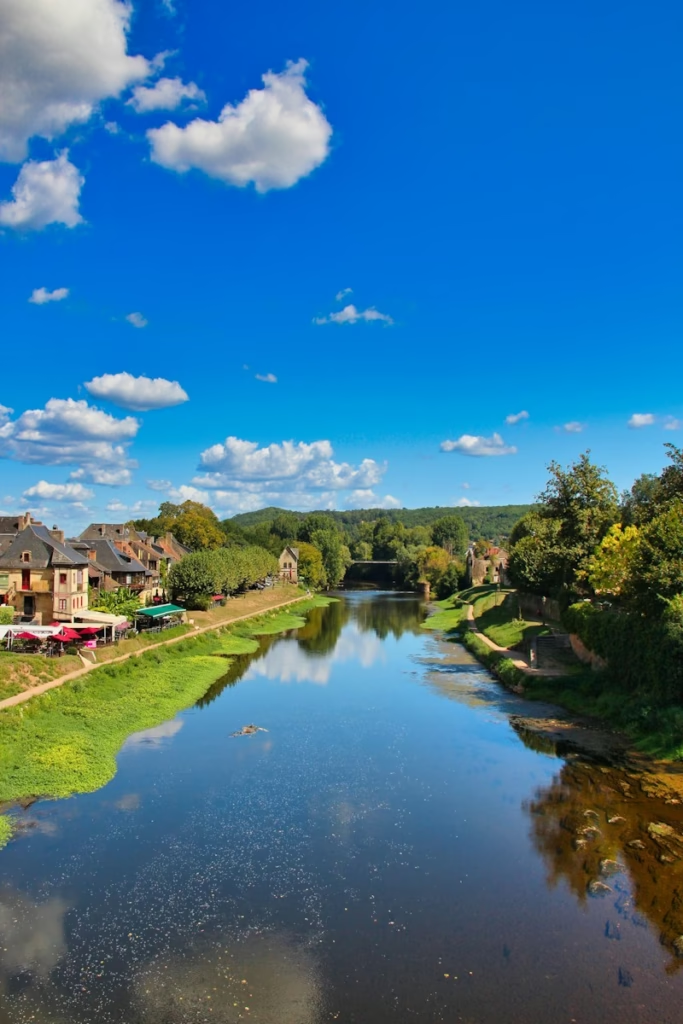
Dordogne and Lot sit in a useful middle ground for cyclists who want proper terrain without building an entire holiday around famous cols. The roads rise and fall almost constantly, but the climbing is usually measured in minutes rather than hours. Traffic thins quickly away from the larger towns, limestone valleys provide natural route corridors and the concentration of villages means a long ride can be broken up without turning every stop into a logistical exercise.
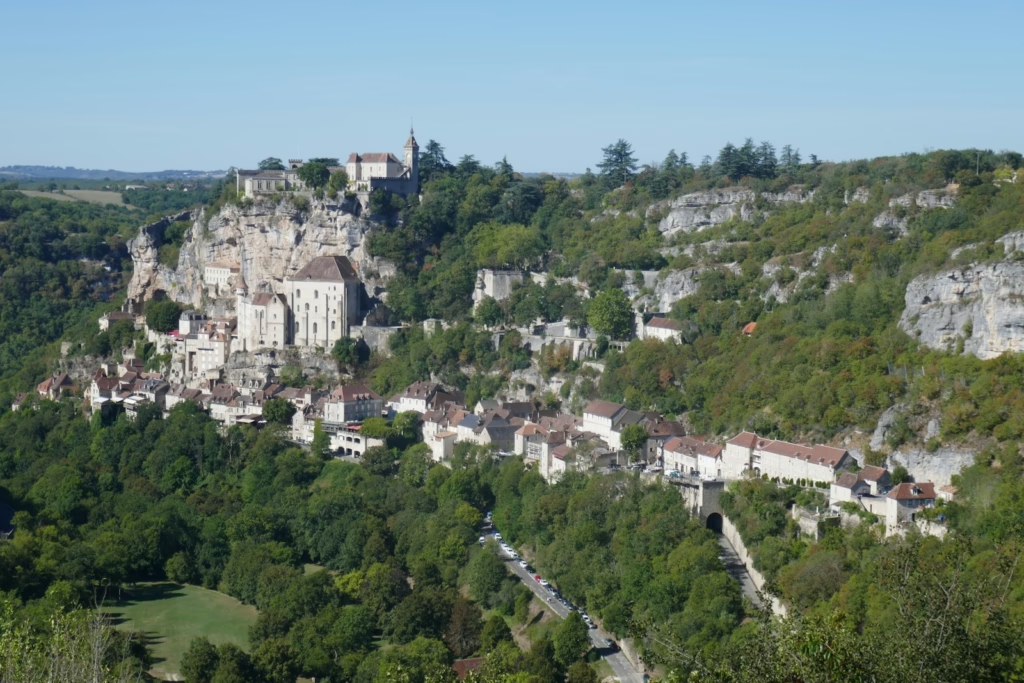
It is also a part of France where choosing the right base matters. Sarlat-la-Canéda gives access to the Dordogne and Vézère valleys, Souillac works well for rides towards Rocamadour and the northern Lot, while Cahors puts the Lot valley and the Causses du Quercy within easy reach. Riders looking at a wider French trip can use our Cycling in France guide alongside this regional guide.
What the riding is really like
The defining feature is repetition. A route may never contain a climb that looks intimidating on paper, yet 80 or 100 kilometres can accumulate a substantial amount of climbing because the road repeatedly leaves one river valley, crosses a plateau and drops into the next. The gradients are generally more forgiving than the Alps or Pyrenees, although short ramps into hilltop villages can become unexpectedly sharp.
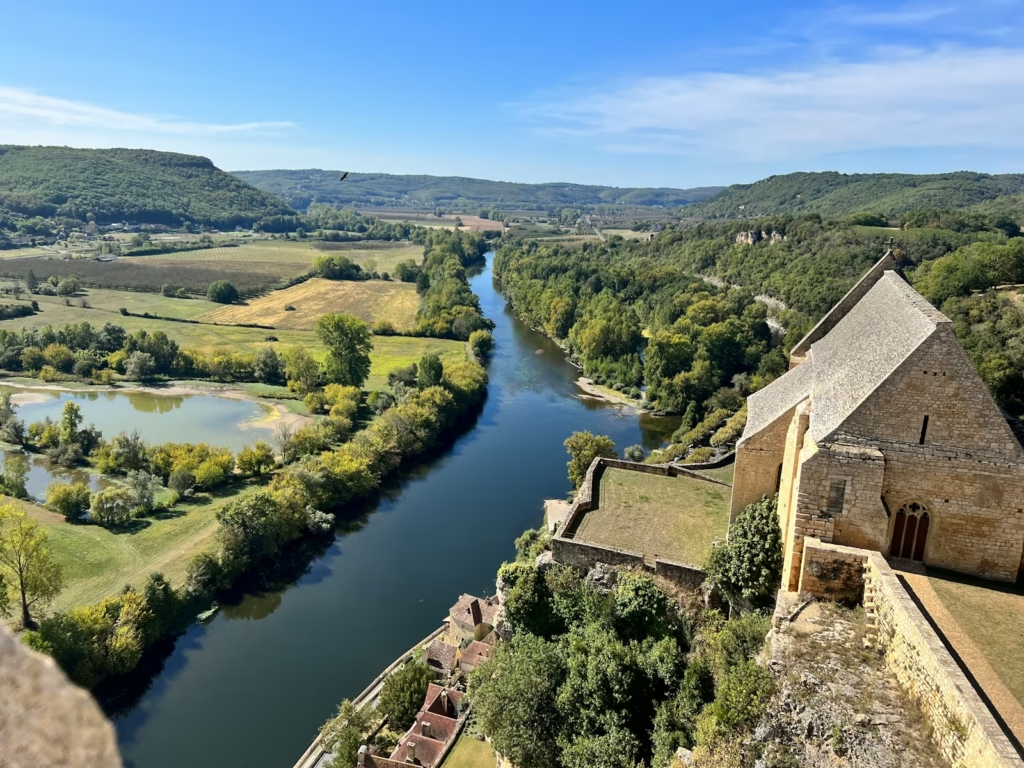
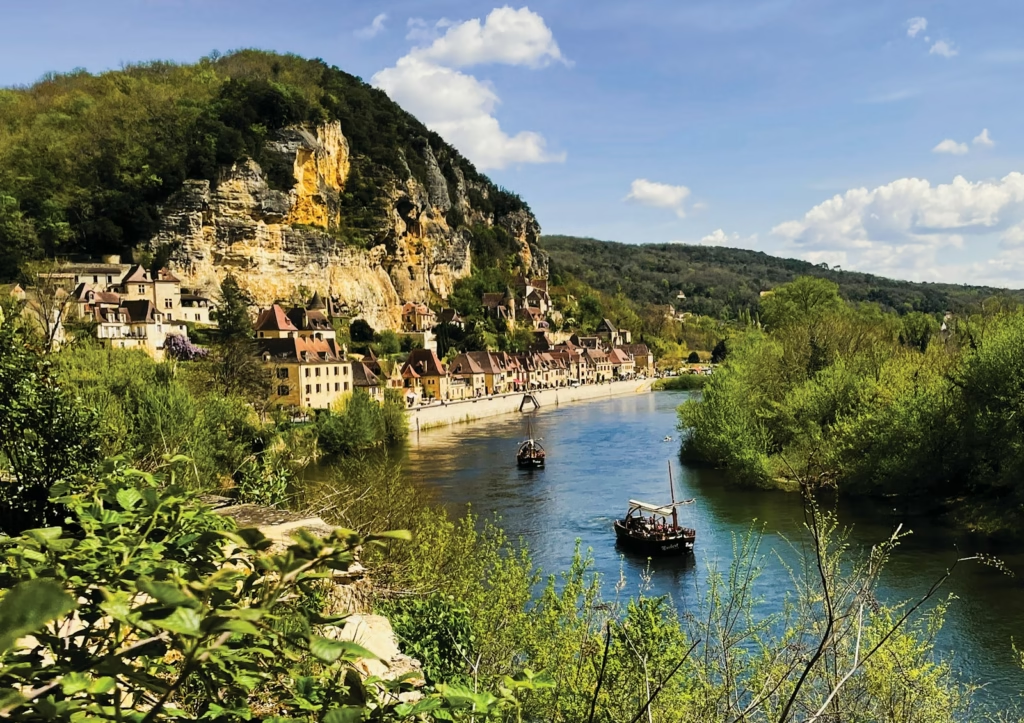
The Dordogne itself creates some of the easiest riding. Roads following the river can be gently rolling or close to flat, particularly around the established cycle routes and greenways. Move away from the water and the character changes quickly. The limestone landscape is cut by tributaries and dry valleys, so roads climb through woodland and farmland before opening onto the causse. The Lot around Cahors has a similar pattern, with the river twisting between steep slopes and vineyards.
This makes the region unusually flexible. A recovery day can follow a river or converted railway, while the following day can be built around repeated climbs to places such as Domme, Rocamadour or the villages above the Lot. Gravel riders have even more options because farm tracks, forest roads and unsealed links can be used to join otherwise separate road loops.
Sarlat and the Dordogne valley
Sarlat is the obvious base on the Dordogne side. The town sits north of the river rather than directly on it, which means most rides begin with some rolling terrain, but the reward is access to a dense network of minor roads around La Roque-Gageac, Beynac-et-Cazenac, Castelnaud and Domme. These are popular visitor destinations, so the quietest riding comes from using them as waypoints rather than spending the whole day on the principal connecting roads.
The Cazoulès-Sarlat greenway is particularly useful. Built largely on a former railway alignment, the surfaced route runs for roughly 25 kilometres towards the Souillac side of the valley. It is suitable for an easy spin, but it is also a practical traffic-free spine for a bigger loop. A rider can use the greenway in one direction, leave it for the smaller roads around the Dordogne and return through the hills.
For a harder day, cross the river and climb towards Domme before continuing south through the quieter lanes. Domme’s position above the Dordogne explains the work required to reach it, but the climb is short enough to include in a longer route. Linking several of these elevated villages produces a much more demanding ride than the individual climbs suggest.
The area also featured prominently in the 2026 Tour de France, with the race travelling from Périgueux to Bergerac. Our Tour de France stage 8 guide gives another look at the roads and geography farther west in the Dordogne département.
Souillac, Rocamadour and the Causses du Quercy
Souillac is a strong alternative for riders who want to split their time between Dordogne and Lot. It has rail access, bike services and a position close to both the river and the hills leading south towards Rocamadour. The riding becomes drier and more exposed as the route enters the Causses du Quercy, with limestone walls, scrub and open plateaux replacing some of the greener Dordogne scenery.
La Vagabonde, signed as the V87, provides a useful framework. The full route runs for about 500 kilometres from Montluçon to Montech, but two local stages are especially relevant: Beaulieu-sur-Dordogne to Rocamadour and Rocamadour to Cahors. The latter is around 65 kilometres and carries roughly 765 metres of climbing, crossing the causse before descending through the Vers valley towards the Lot.
That official route is a good introduction to the terrain rather than necessarily the final word on where to ride. Strong road cyclists can use its corridor and add loops through quieter surrounding villages. Rocamadour itself is worth approaching early in the day. The site attracts heavy visitor traffic, particularly in summer, and the narrow roads are far more enjoyable before coaches and cars become established.
Cahors and the Lot valley
Cahors changes the balance again. The Lot loops tightly around the city and continues west through vineyard country towards Puy-l’Évêque. Staying close to the river gives relatively gentle riding, while almost every turn away from it creates an opportunity to climb. The roads on the plateaux above the valley tend to be quieter, making them the better choice for riders who value uninterrupted kilometres over sightseeing stops.
A classic day can follow the Lot west before climbing away from the river and returning on parallel minor roads. Another option is to head north-east towards the Causses du Quercy and connect with the V87 corridor. The difference between valley and plateau is useful when planning consecutive days: one hard, rolling loop can be followed by a much easier river ride without needing to move accommodation.
Do not assume every signed cycle facility is a smooth road-bike path. The short Mercuès-Douelle greenway, for example, uses an old railway and is described locally as unsealed. A gravel bike or wider tyres make these links straightforward, but a rider on lightweight road tyres should check the surface before using a greenway as an essential part of a route.
Long-distance routes and traffic-free options
There is enough established infrastructure to build a multi-day trip without inventing routes from scratch. La Flow Vélo starts at Sarlat and runs about 400 kilometres west to the Atlantic, with a high proportion of dedicated cycle infrastructure. For a point-to-point holiday it offers a very different proposition from the hillier riding around Rocamadour and Cahors, and rail connections make a one-way itinerary more realistic.
La Vézère à Vélo is another useful option west of Sarlat. A flatter greenway section runs from Les Eyzies towards Saint-Chamassy, while the continuation towards Coly uses secondary roads and becomes hillier. It works particularly well for mixed groups because the easier section can be ridden independently while stronger riders extend the day into the surrounding hills.
The region’s developing network also includes shared low-traffic routes marketed locally as voies vertes pâles. These are not fully segregated greenways: motor vehicles can still be present. The distinction matters when planning for children or inexperienced riders. A route described as a greenway should not automatically be treated as traffic-free unless the specific section is confirmed as such.
When to go and what to bring
Late spring and early autumn are the easiest periods for a cycling-focused trip. May, June, September and early October generally give a better balance of daylight, temperature and traffic than the peak summer weeks. July and August can be hot, and the major visitor sites around Sarlat, Rocamadour and the Dordogne villages become much busier. Starting early is the simplest response if a summer trip is unavoidable.
Spring weather can be changeable and heavy rain matters on the descents. Many minor roads run through woodland, where damp patches, leaves and debris can remain after the main road has dried. Autumn brings similar issues later in the season. The climbs are rarely long enough to demand Alpine gearing, but compact or sub-compact ratios are still sensible because repeated short gradients become tiring late in a ride.
A normal road bike is ideal for an asphalt-focused trip. A gravel bike becomes the more versatile choice if the plan includes greenways, towpaths or forest connections. Carry two bottles in warm weather and do not rely on every village having an open shop outside the main tourist season. Basic spares are also worthwhile: the quieter roads are part of the attraction, but they can leave a rider some distance from a bike shop.
Building a week in Dordogne and Lot
For a first visit, splitting the week between Sarlat or Souillac and Cahors gives the broadest picture. Three or four nights around Sarlat provide access to the Dordogne villages, the Cazoulès greenway and the Vézère. Moving to Cahors then opens the Lot valley and the drier Causses du Quercy. Souillac can replace Sarlat for riders who prioritise Rocamadour and easier rail logistics.
A sensible sequence is an introductory river ride, a harder village-and-plateau loop, an easier greenway day and then a longer point-to-point or V87 ride. After moving south, repeat the pattern around Cahors. That structure makes better use of the terrain than chasing a list of individual climbs. Dordogne and Lot work best when the valleys are treated as the foundations of each route and the hills are added according to how hard the day needs to be.
For riders who enjoy this kind of French trip, the contrast with a flatter itinerary is useful too. Our Loire Valley cycling guide covers a more continuous long-distance route, while Dordogne and Lot reward a base-and-loop approach with far more repeated climbing.
The 21-year-old Australian produced one of the standout rides of the opening days of the World Championships, beating Nienke Vinke by 28.47 seconds over the 20.3km course before Fenix-Premier Tech confirmed her as their latest signing for next season.
It is a well-timed announcement for a rider whose 2026 season has been built around increasingly strong performances against the clock. Wilson-Haffenden is already the Australian elite time trial champion, finished second to Marlen Reusser at the Chrono Féminin de Gatineau and now has another rainbow jersey to add to the junior world title she won in 2023.
“I’m beyond excited to be joining Fenix-Premier Tech for the next two seasons,” Wilson-Haffenden said. “I have a lot of respect for the team’s racing style, and I believe that, with their support, this is the perfect environment for me to take the next step in my career.”
Wilson-Haffenden signs at the end of her first Lidl-Trek contract
Wilson-Haffenden has spent her entire senior professional career with Lidl-Trek.
She signed with the team immediately after winning the junior World Championships time trial in Glasgow in 2023, agreeing a three-year contract from 2024 through to the end of this season.
That original deal was built around development rather than expecting immediate WorldTour results from an 18-year-old stepping directly out of the junior ranks.
Three seasons later, she leaves as a much more complete rider.
The progression has not been limited to time trials. Wilson-Haffenden finished third overall at the Baloise Ladies Tour this summer after placing fourth in the opening prologue and second in the longer individual time trial.
Those results suggested that her ability against the clock was beginning to translate into stage-race possibilities rather than existing as a standalone speciality.
Montréal confirmed her status as one of the best young time triallists
The transfer announcement comes immediately after the biggest individual result of Wilson-Haffenden’s senior career.
Vinke was 0.19 seconds quicker at the first checkpoint, but Wilson-Haffenden transformed the contest through the middle part of the course. By 14.5km she was almost 26 seconds ahead and eventually finished in 27:40.72, extending the gap slightly over the final kilometres.
Luca Vierstraete took bronze at 45.07 seconds, while 2025 silver medallist Viktória Chladoňová finished fourth.
The victory gave Wilson-Haffenden her third world title across different events and age groups.
She won the junior individual time trial in Glasgow in 2023 and formed part of Australia’s successful mixed relay team at the 2025 World Championships in Kigali before taking the standalone U23 title in Canada.
Her 2026 season had already pointed towards another step
Montréal did not come from nowhere.
Wilson-Haffenden became Australian elite time trial champion at the start of the year despite still being eligible for the under-23 category, beating Brodie Chapman by four seconds over 29.3km.
ProCyclingUK’s Australian national time trial report showed the importance of that result. It was not an age-group victory but a win over the full elite field.
Her form against senior opposition continued through the season.
At the Baloise Ladies Tour she finished second to Zoe Bäckstedt in the stage 3a time trial and used her consistency across the week to take third overall.
Then came a particularly useful World Championships test at the Chrono Féminin de Gatineau.
Wilson-Haffenden finished second to Reusser, 43 seconds behind the eventual elite world champion but ahead of the rest of the field. The Gatineau contenders preview had identified that race as her final opportunity to test herself against elite specialists before the U23 event.
Five days later, she won the rainbow jersey.
Fenix-Premier Tech gain a different type of young leader
Wilson-Haffenden adds another dimension to a Fenix-Premier Tech team whose existing strengths lie elsewhere.
The squad already has Puck Pieterse for hilly Classics and selective racing, Charlotte Kool as a pure sprint leader and a substantial group of riders with cyclocross backgrounds who thrive in technical one-day events.
Time trialling is less central to the team’s current identity.
That makes Wilson-Haffenden interesting beyond the fact she is a newly crowned world champion.
She gives Fenix a rider capable of targeting standalone time trials, but her Baloise Ladies Tour result suggests the bigger opportunity may come from using that ability to build general classification results in shorter stage races.
The Fenix-Premier Tech 2026 team guide described a squad built primarily around Classics success, sprinting and aggressive racing rather than Grand Tour GC. Wilson-Haffenden does not necessarily change that immediately, but she provides another route into stage races where time trials carry significant weight.
At 21, there is still plenty of room to determine how far that part of her racing can develop.
Moving from one development-focused team to another
Wilson-Haffenden’s original decision to join Lidl-Trek was shaped heavily by the team’s willingness to develop young riders rather than demand immediate results.
Fenix-Premier Tech appear to have sold her on a similar principle.
“I have a lot of respect for the team’s racing style,” she said. “I believe that, with their support, this is the perfect environment for me to take the next step in my career.”
The change is therefore not a rejection of the development pathway that took her to this point. It is a move into a different structure after three seasons at Lidl-Trek.
That timing makes sense.
Wilson-Haffenden entered the WorldTour straight from the juniors and has now completed the first phase of that transition. She has an elite national title, a WorldTour-level stage-race podium and a U23 rainbow jersey.
The next question is what those results become once she is no longer simply one of the youngest riders in the peloton.
Fenix-Premier Tech continue to broaden their roster
The signing also fits the direction Fenix-Premier Tech have been taking over the past two seasons.
Charlotte Kool’s arrival strengthened a sprint department which had previously lacked a consistent top-level finisher, while the team retained Pieterse as the centre of its hilly Classics programme.
Wilson-Haffenden now gives them another young rider around whom specific race programmes can be built.
She is not yet a proven WorldTour stage-race leader, and there is no need to treat her as one simply because she has won the U23 world title. Her strongest results still come against the clock.
The interesting part is how much else has started to appear around that speciality.
Third overall at Baloise required more than one fast time trial. Winning the Australian elite title showed she could handle pressure against established riders. Montréal confirmed that she could arrive at a championship as one of the favourites and deliver.
That is a considerably stronger profile than the junior world champion who joined Lidl-Trek three years ago.
The move comes at an ideal point in Wilson-Haffenden’s development
Fenix-Premier Tech could hardly have chosen a better day to confirm the signing.
Wilson-Haffenden will spend the remainder of the World Championships wearing the rainbow bands of the U23 time trial champion, while her 2027 team can already begin planning around a rider whose level has risen substantially during the final year of her Lidl-Trek contract.
“I can’t wait to get started and see what we can achieve together in 2027,” she said.
For Fenix-Premier Tech, the attraction is not just that they have signed a world champion.
They have signed one at 21, after a season which suggests the time trial is becoming the foundation for a much broader rider rather than the limit of what she can do.


 Photo Credit: LaPresse
 Photo Credit: LaPresse