Home Blog

A history of Le Markstein at the Tour de France

Le Markstein does not have the deep Tour de France history of Alpe d’Huez, the Col du Tourmalet or Mont Ventoux. It is not one of the race’s oldest mountain myths, nor a climb that appears in every generation of Tour storytelling. Its place in the race is more recent, more subtle and more Vosges-specific.

That makes it interesting. Le Markstein is not famous because riders have been fighting there for a century. It is famous because the Tour has begun using the Vosges differently. Instead of treating the range as a secondary mountain block before the Alps, modern routes have made the area a real source of pressure. Le Markstein sits at the centre of that shift.

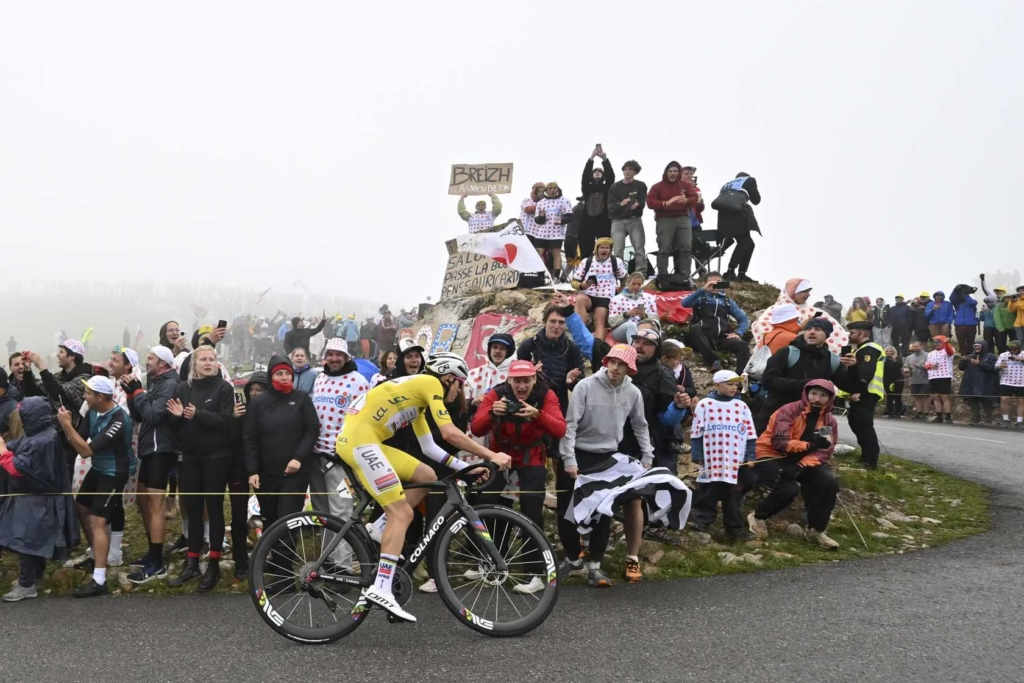
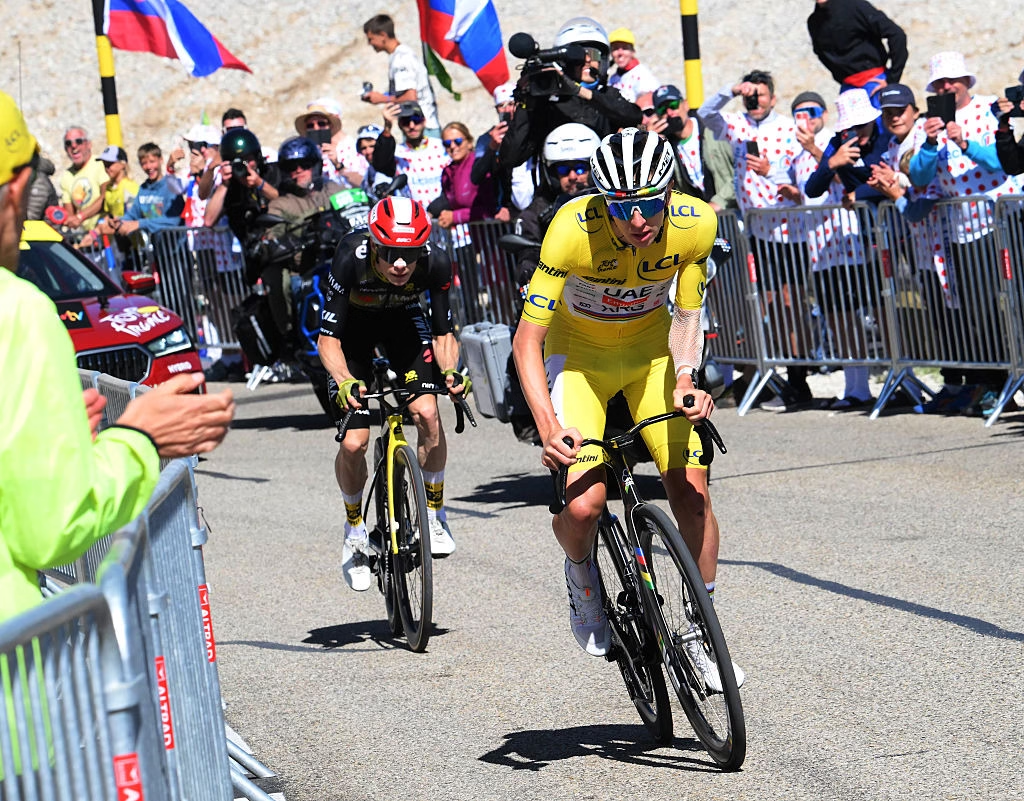
The climb and ski station entered the broader Tour conversation through the men’s race in the 2010s, through La Planche des Belles Filles’ rise as a nearby Vosges reference point, and then through two very different Le Markstein finishes in 2022 and 2023. Annemiek van Vleuten effectively sealed the first Tour de France Femmes there in 2022. A year later, Tadej Pogačar won the final mountain stage of the 2023 men’s Tour there, while Jonas Vingegaard confirmed his second overall victory.

In 2026, Le Markstein returns again. Stage 14 of the Tour de France runs from Mulhouse to Le Markstein Fellering, with 155.3km of racing and 3,800m of climbing. It is not the final Alpine showdown, but it could be one of the most awkward pre-Alps stages of the race. For the full 2026 context, see our Tour de France 2026 full route guide, Tour de France 2026 climbs guide and Tour de France 2026 Vosges and Jura guide.
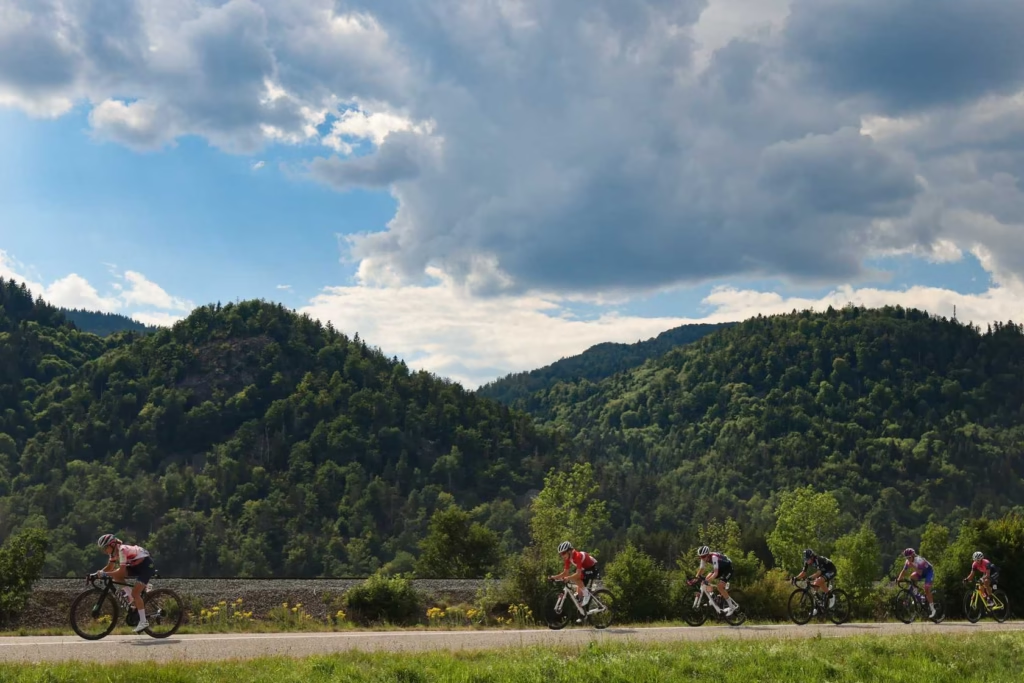
A history of Le Markstein at the Tour de France

Where is Le Markstein?

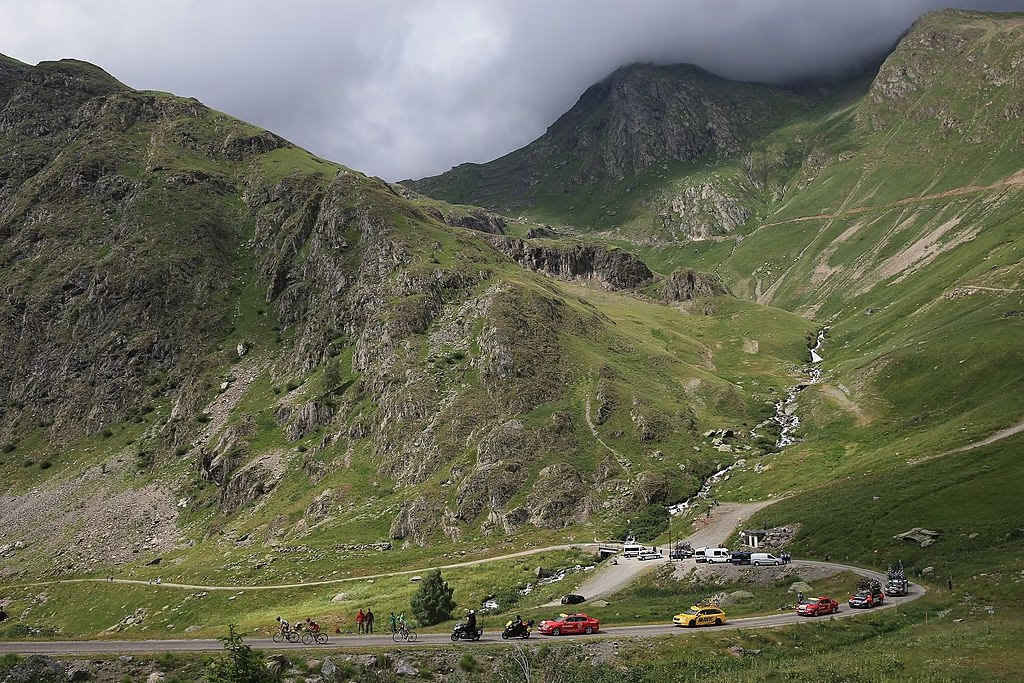
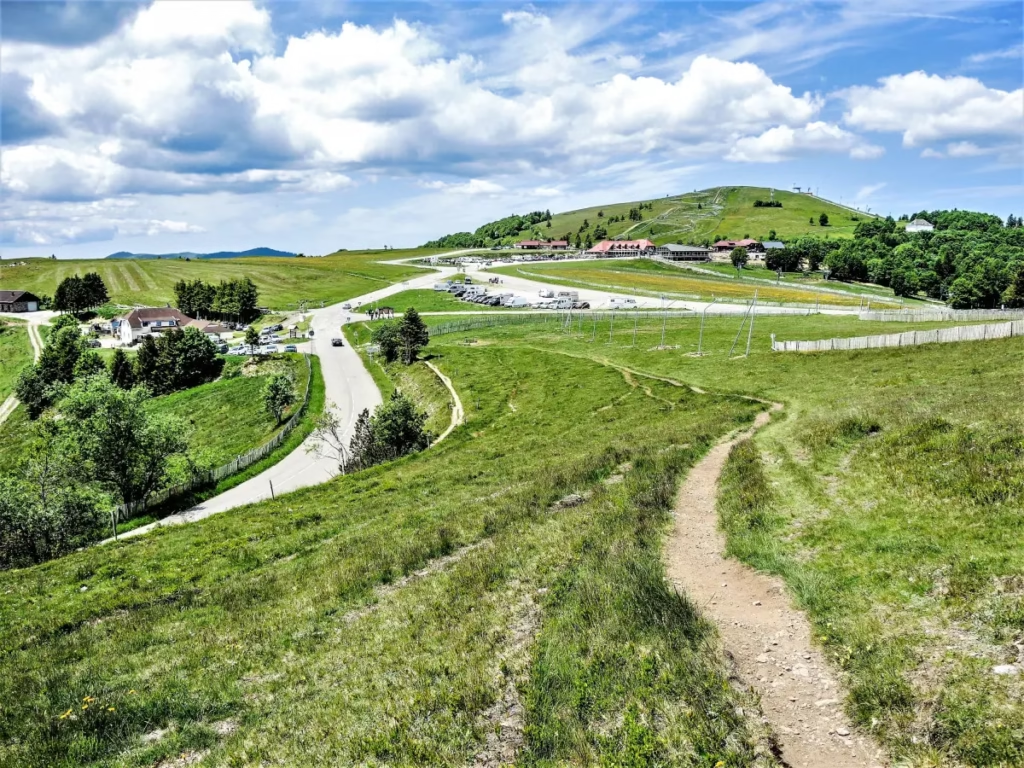
Le Markstein is a mountain and winter sports area in the Vosges, in north-eastern France. It sits in Alsace, close to the Grand Ballon, the highest summit in the Vosges massif. In cycling terms, it belongs to a network of climbs rather than standing alone as a single iconic ascent.

That is one of the main differences between Le Markstein and better-known Tour finishes. Alpe d’Huez is defined by one road and 21 hairpins. Mont Ventoux is defined by one exposed summit. The Tourmalet is defined by a historic pass. Le Markstein is more about how the race reaches it.

The approach can be shaped by climbs such as the Grand Ballon, the Ballon d’Alsace, the Platzerwasel, the Petit Ballon, the Col de la Schlucht, the Col du Haag and other Vosges roads. That gives organisers several ways to design a stage. The finish may be at Le Markstein, but the race can be broken long before the final kilometres.

That is why Le Markstein is best understood as a Vosges stage hub rather than a single-climb monument. Its difficulty comes from accumulation, positioning and rhythm. For the wider climb list in the 2026 race, see our Tour de France 2026 climbs guide.
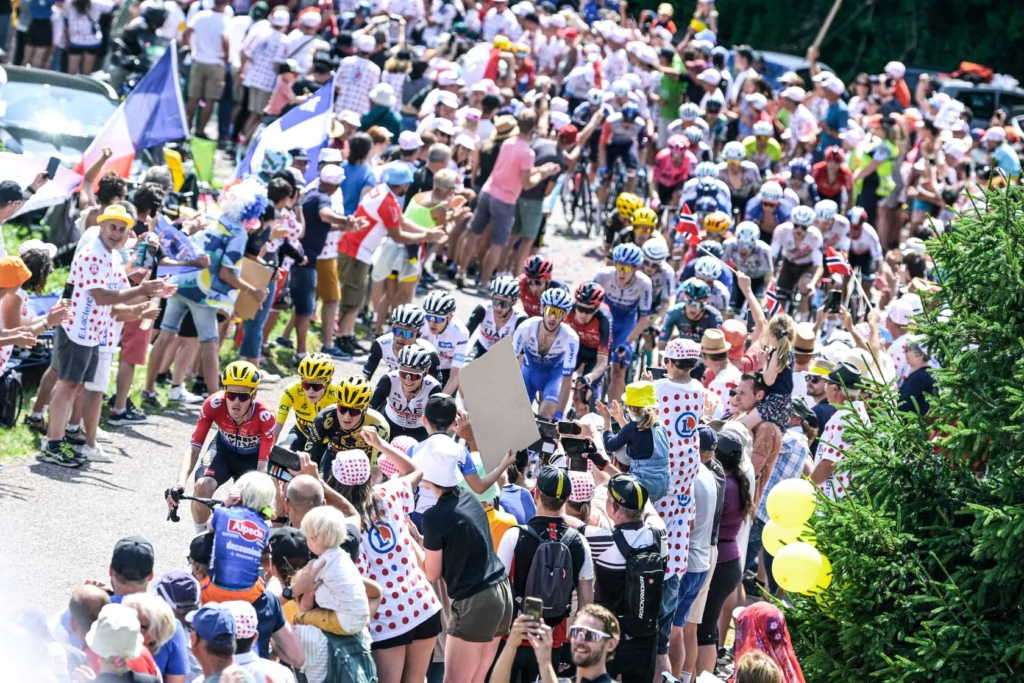
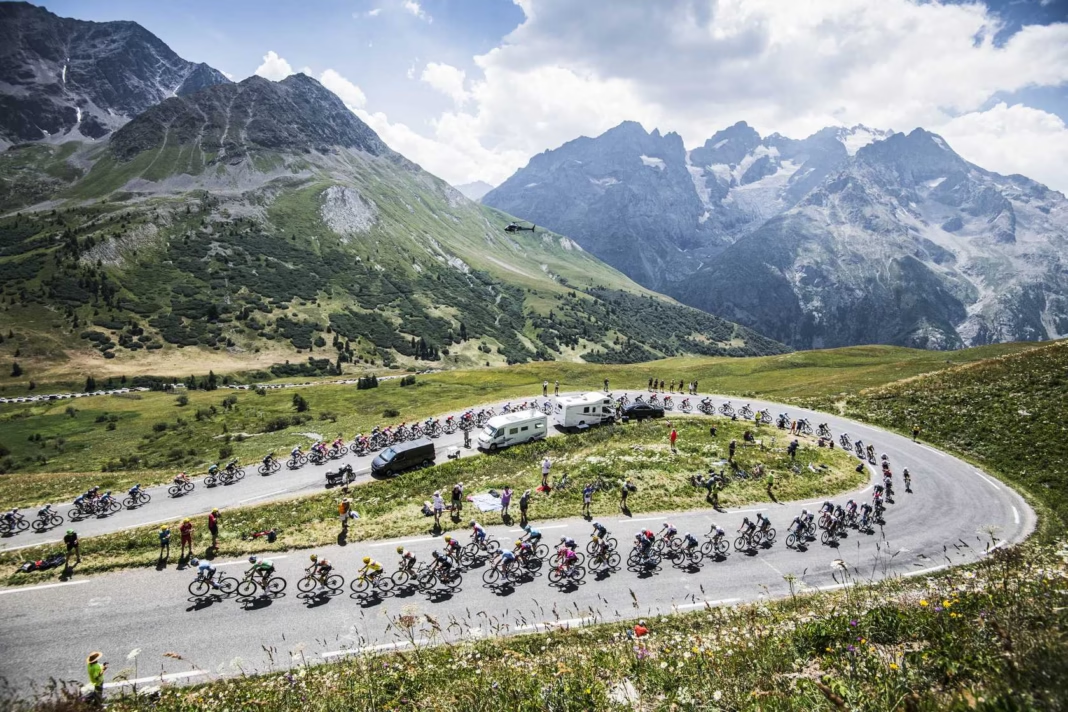
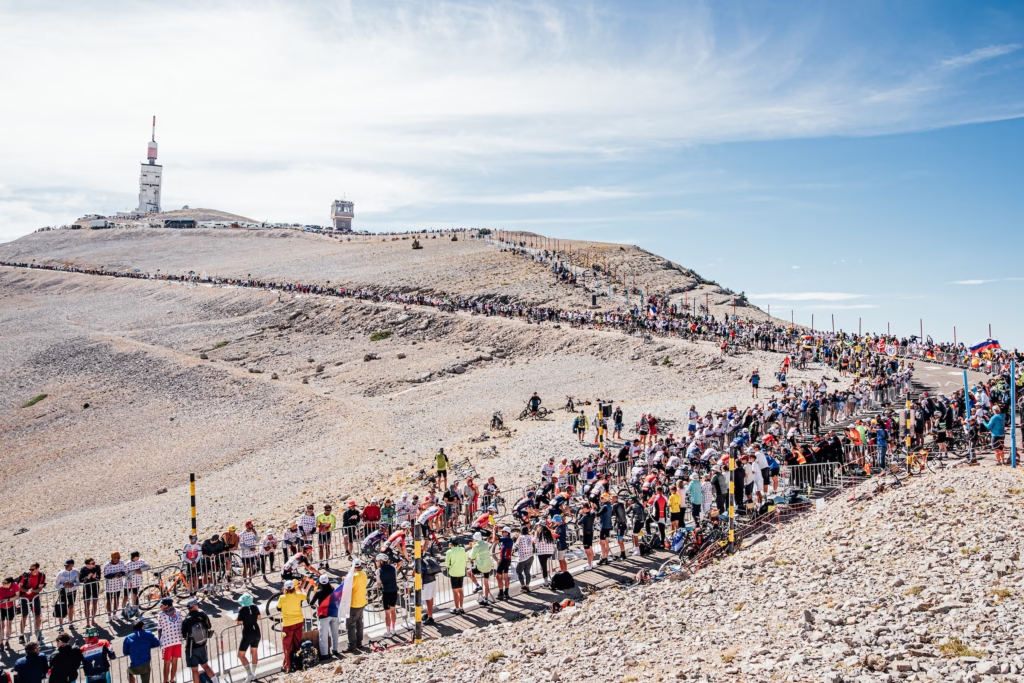
Where is Le Markstein?Photo Credit: A.S.O./Charly López

Why the Vosges matter in the Tour

The Vosges have always had a place in Tour history, even if they do not always get the same attention as the Alps and Pyrenees. The Ballon d’Alsace was one of the Tour’s earliest major mountain references, helping bring climbing into the race’s identity in the early 20th century.

The Vosges are different from the high mountains. They are lower, greener and often less spectacular on television. But that can make them dangerous. The climbs are frequently irregular, the descents can be fast, the roads can be narrow, and the rhythm is rarely as clean as a long Alpine pass.

That suits aggressive racing. A Vosges stage can be difficult to control because the climbs come in clusters. Teams can lose domestiques gradually. Riders can be put under pressure without one obvious summit-finish showdown. A leader may not crack dramatically, but they can be isolated, forced to chase or slowly worn down.

Le Markstein’s Tour history is tied to that character. It is not about one legendary gradient. It is about the way the Vosges can make a race messy.

For more on how this block fits the 2026 route, see our Tour de France 2026 route analysis and where the Tour de France 2026 can be won before the Alps.

The early Tour and the Ballon d’Alsace legacy

Le Markstein itself is not one of the Tour’s earliest names, but the Vosges are central to the race’s mountain history. The Ballon d’Alsace became one of the first major climbs to define what the Tour could be. It showed that the race could move beyond distance and endurance and become a contest of climbing ability.

That matters when discussing Le Markstein because the 2026 stage again uses the Vosges as a place of selection. The modern Tour no longer needs the Vosges to prove that mountains belong in the race. The Alps and Pyrenees have long since done that. But the Vosges still offer a different kind of test.

The Ballon d’Alsace gives the area historical weight. Le Markstein gives the modern race a flexible finish point. Together, they show how the Tour can use an old mountain range in a new way.

The Vosges are not just a warm-up for bigger peaks. Used correctly, they can become the place where teams begin to fall apart before the race reaches the final week. For the broader story of how the Tour developed, see our brief history of the Men’s Tour de France.

Le Markstein before it became a finish

Before Le Markstein became a Tour finish, it appeared more as part of the Vosges terrain than as the headline destination. That matters because it explains why the climb’s history feels different from the great summit finishes.

The Tour often builds mythology around finish lines. Riders win there, photographs are taken there, crowds gather there, and the place becomes fixed in memory. Le Markstein spent years without that level of identity in the men’s race. It was part of the route, but not yet a place that defined a stage.

That changed once the Tour began looking again at the Vosges as more than transitional terrain. La Planche des Belles Filles helped reframe the region as a decisive modern Tour battleground. Le Markstein then fitted into that same wider movement: lower than the Alps, but capable of producing serious racing.

In other words, Le Markstein’s history is not a simple tale of repeated legendary finishes. It is a story of gradual elevation, from stage terrain to modern Tour destination.
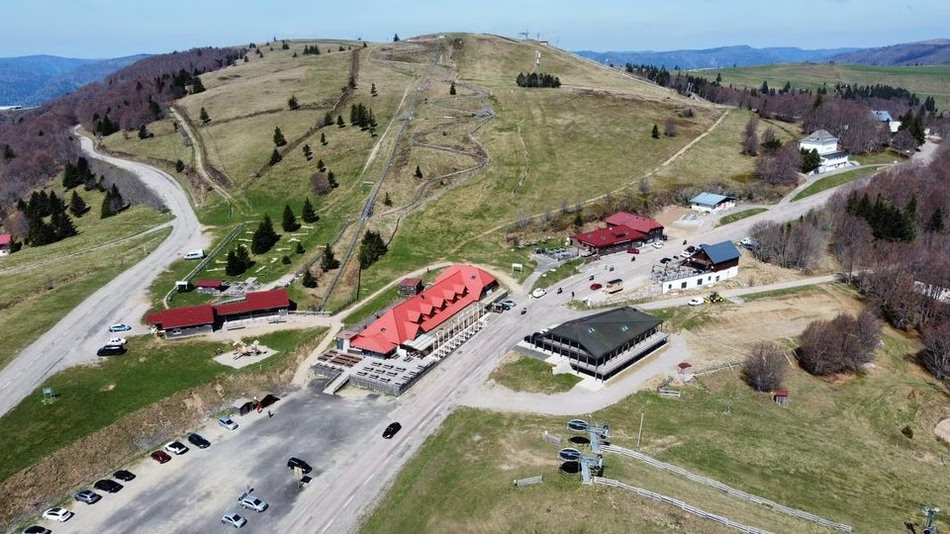
Le Markstein before it became a finish

Why Le Markstein is not a classic summit finish

Le Markstein can be used as a mountain finish, but it does not always function like a classic summit finish. A traditional summit finish often climbs all the way to the line. Le Markstein stages can be more complicated, with a decisive climb before the finish and a short run towards the ski station.

That changes the tactics. If the hardest climb crests several kilometres from the line, riders have to decide whether to attack before the summit, over the top, or wait for the run-in. A small group can reform. Descending and transition power can matter. Team numbers can still influence the final kilometres.

That is important for 2026 because Stage 14 is not simply a straight drag to a famous high-altitude finish. It is a Vosges stage with repeated climbing and a late decisive section. The Col du Haag, which crests close to the finish, may be the key tactical point.

This makes Le Markstein less predictable than a simple summit slog. It can reward pure climbers, but it can also suit riders who climb aggressively, descend well and commit over the top.

For the 2026 climb detail, see our Tour de France 2026 climbs guide and Tour de France 2026 summit finishes guide.

2014 and 2019: Le Markstein as route terrain

Le Markstein appeared in the men’s Tour route before it became a finish. The climb was included in 2014 and 2019, but in those editions it was not the final destination. That meant it served more as part of the day’s accumulated difficulty than as the place where the stage would be remembered.

Those appearances still mattered. They showed how Le Markstein could fit inside a broader Vosges stage, linking climbs and creating pressure before the decisive part of the route. The race did not need to finish there for the area to influence the day.

That is one of the features of Vosges racing. A climb can hurt the bunch without being the final climb. A pass can strip domestiques without producing the stage winner. A section of road can make later attacks possible even if it does not appear in the headline.

By the time Le Markstein became a finish, the Tour had already learned how useful it could be as a connector in a hard mountain stage. That lesson still matters in 2026, where the route uses the Vosges and Jura before the final Alpine block rather than treating them as filler between bigger mountain ranges.
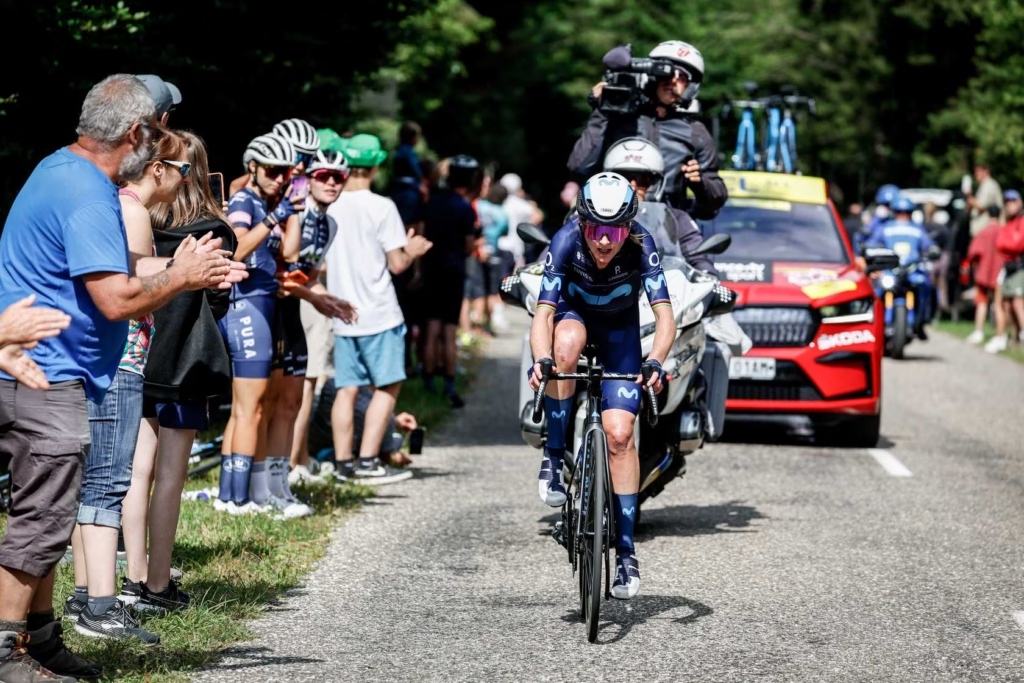
2022: Annemiek van Vleuten and the Tour de France FemmesPhoto Credit: ASO

2022: Annemiek van Vleuten and the Tour de France Femmes

Le Markstein’s first major modern Tour finish came not through the men’s race, but through the Tour de France Femmes. In 2022, Annemiek van Vleuten won the stage to Le Markstein and effectively took control of the race.

That stage was important for several reasons. It came in the first edition of the revived women’s Tour, giving the race a mountain finale with real weight. It also gave Van Vleuten the terrain she needed to show the difference between a strong contender and the strongest climber in the race.

Van Vleuten attacked on the first of the major mountain stages and turned the general classification upside down. The finish at Le Markstein became the place where the first modern Tour de France Femmes found its decisive shape.

That matters for the climb’s history. Le Markstein did not enter modern Tour memory only as a men’s finish. It also belongs to the women’s race, where it helped establish the Tour de France Femmes as a serious stage race rather than a symbolic add-on.

For the wider context, see our guide to the most important women’s cycling races explained and our women’s cycling race hub.

Why Van Vleuten’s ride mattered

Van Vleuten’s 2022 ride mattered because it gave the new women’s Tour a defining mountain performance at the first attempt. The race needed a stage that would separate the contenders and create a clear sporting hierarchy. Le Markstein did exactly that.

The stage also showed what the Vosges could do in women’s racing. It was not a token climb or a decorative finish. It was hard enough to create meaningful gaps and to make the overall victory feel earned through mountain strength.

For Van Vleuten, it was another entry in a career built on long-range aggression and stage-race control. For the Tour de France Femmes, it was a statement that the race could use difficult terrain properly.

Le Markstein therefore carries a different kind of status from older Tour climbs. It is not only part of men’s Tour history. It is also tied to the early identity of the modern women’s Tour.
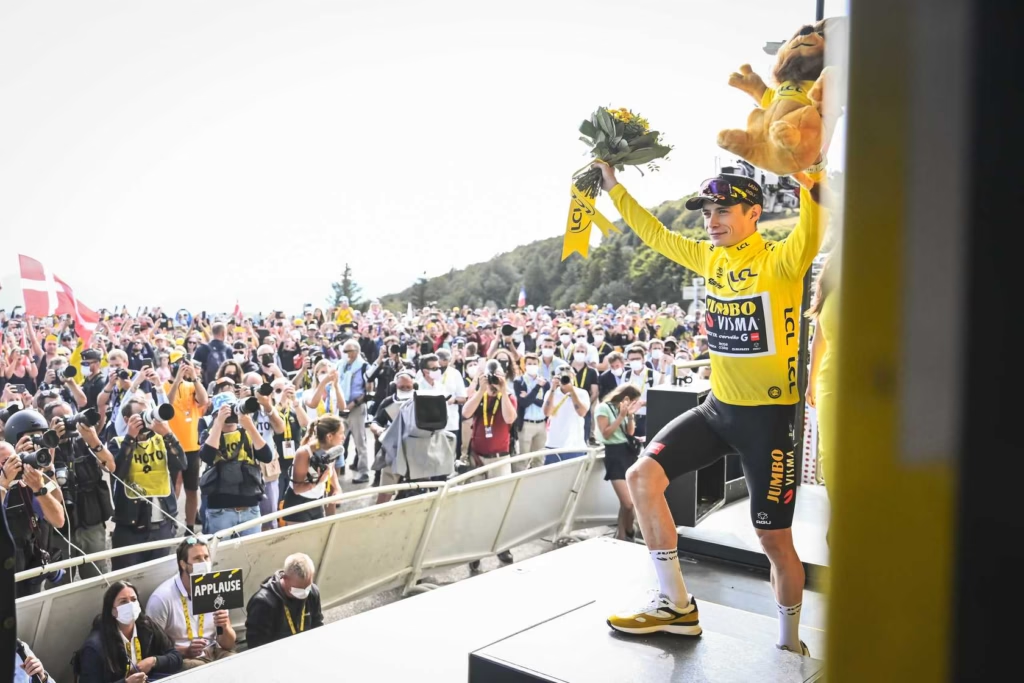
2023: the men’s Tour finally finishes at Le MarksteinPhoto Credit: A.S.O./Pauline Ballet

2023: the men’s Tour finally finishes at Le Markstein

The men’s Tour de France finally finished at Le Markstein in 2023, on Stage 20 from Belfort. It was the final mountain stage of the race and came after Jonas Vingegaard had already taken a commanding lead over Tadej Pogačar.

The route was short by Tour mountain-stage standards at 133.5km, but it was packed with Vosges climbing. The stage included the Ballon d’Alsace, the Col de la Croix des Moinats, the Col de Grosse Pierre, the Col de la Schlucht, the Petit Ballon and the Col du Platzerwasel before the finish at Le Markstein.

That made the stage a classic late-Tour mountain test. It was not about one long Alpine ascent. It was about repeated climbs, fatigue and one final chance for the Pogačar-Vingegaard rivalry to produce something memorable.

Pogačar won the stage, outsprinting Felix Gall and Vingegaard from a small group. Vingegaard finished safely with him and effectively sealed his second Tour de France victory before Paris. Le Markstein therefore became the setting for both Pogačar’s final act of defiance and Vingegaard’s confirmation.

For more on the yellow jersey battle, see our Tour de France 2026 GC favourites ranked and how the Tour de France general classification works.

Pogačar’s 2023 win and what it said about the climb

Pogačar’s 2023 win showed one of Le Markstein’s key qualities: it can produce a selection without necessarily producing huge time gaps. The strongest riders were together at the finish, but the stage still mattered because it came after a hard sequence of climbs and carried heavy psychological meaning.

Pogačar had suffered badly earlier in the third week, especially on the Col de la Loze stage. By winning at Le Markstein, he restored some authority and ended his mountain campaign on a high. It did not change the overall winner, but it changed the tone of the final weekend.

That is often how Le Markstein works. It may not always create the massive separations of the highest Alpine summit finishes, but it can reveal recovery, fatigue and tactical sharpness. It can reward a rider who still has punch after a draining day.

In 2023, that rider was Pogačar. Vingegaard did not need the stage win. He needed control. Both riders got what they needed from the same finish.

For the 2026 rider angle, see our features on Tadej Pogačar at the Tour de France 2026 and Jonas Vingegaard at the Tour de France 2026.
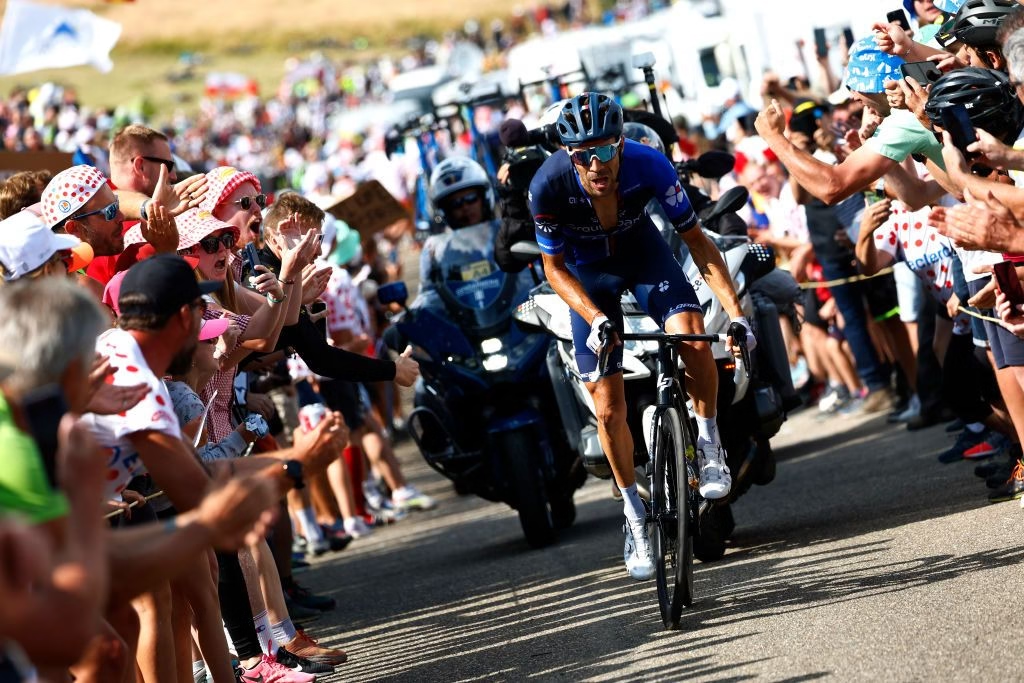
Former-French-star-Thibaut-Pinot-offers-free-stay-at-his-farm-to-celebrate-2026-Tour-de-France-stage-passing-through-home-village-1Photo Credit: Getty

Thibaut Pinot and the Vosges emotion

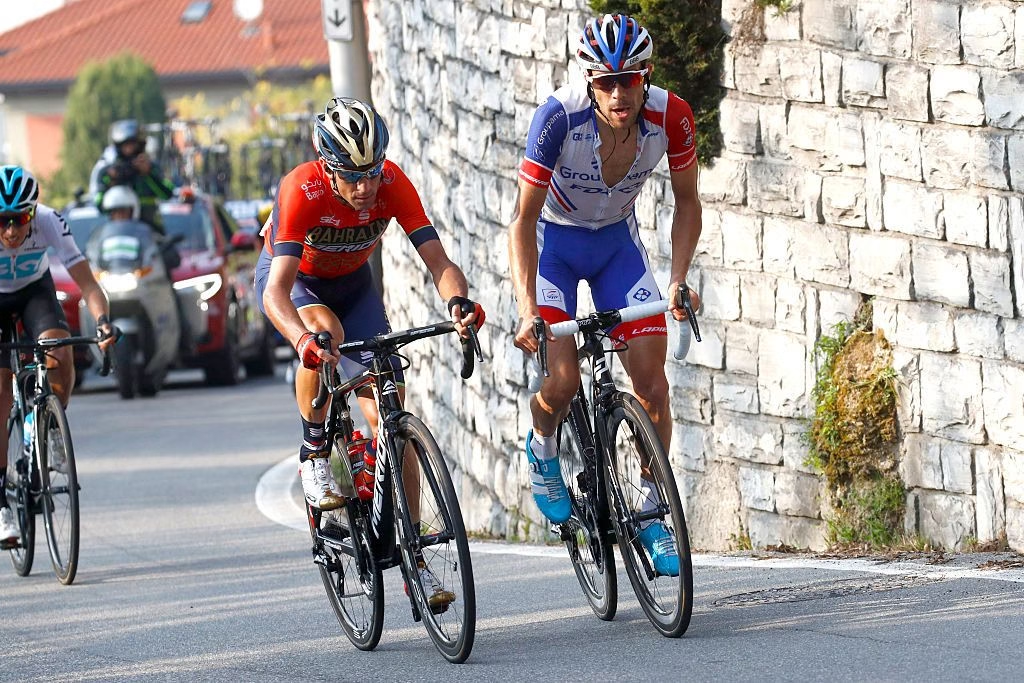
The 2023 Le Markstein stage also mattered because it passed through Thibaut Pinot country. Pinot, one of the most popular French riders of his generation, was riding his final Tour de France. The Vosges became his farewell stage.

The crowds on the Petit Ballon and surrounding roads turned the day into something more than a standard mountain stage. Pinot attacked, rode with emotion and briefly gave the race the feeling of an old-fashioned French mountain story. He did not win, but the stage became one of the defining images of his final Tour.

That is important for Le Markstein’s identity. The climb and its surrounding roads are not only tactical tools. They sit in a region with its own French cycling culture, close to riders, fans and memory. The Vosges can feel personal in a way that some bigger, more famous climbs do not.

Pinot’s 2023 farewell gave Le Markstein a human layer. It was not just Pogačar versus Vingegaard. It was also a regional goodbye.

For the French Tour angle, see our best French riders to watch at the Tour de France 2026 and Paul Seixas and the next French Tour de France generation.

Le Markstein compared with La Planche des Belles Filles

Le Markstein’s rise makes more sense when compared with La Planche des Belles Filles. Both are Vosges-related Tour reference points, but they work differently.

La Planche des Belles Filles is more explosive and more clearly defined as a summit finish. It has become famous for steep gradients, GC punches and repeated Tour use in a short period. It is a modern climb with a sharp identity.

Le Markstein is broader and more complex. It is less about one final wall and more about a hard network of roads. The final kilometres can matter, but the earlier climbs often do just as much damage. It is a stage-design tool rather than a single-climb statement.

That difference helps explain why Le Markstein has a quieter reputation. It may not produce the same instant visual as a steep final ramp, but it can create a more layered race. The damage can build gradually rather than arrive in one burst.

For the Tour, that makes Le Markstein useful. It gives the route another way to create mountain pressure without repeating the same kind of finish.
Why Le Markstein is different from the Alps

Why Le Markstein is different from the Alps

Le Markstein is not Alpine racing. That is the point.

The Alps often bring long climbs, high altitude and big-name passes. They create fear through scale. The Vosges create difficulty through repetition and disruption. The climbs are lower, but they can be steeper than expected, irregular and close together.

That changes how teams race. On a long Alpine pass, a strong mountain train can set tempo for long periods. In the Vosges, the constant changes of rhythm can make control harder. Descents arrive quickly. Roads twist. The race can become less predictable.

Le Markstein fits that style perfectly. It can punish riders who are comfortable on long, steady climbs but less happy with repeated accelerations. It can suit punchier climbers, aggressive breakaway riders and GC teams that want to create stress before the final week.

That is why the climb should not be judged only by altitude or fame. Its value is tactical. For the contrast with the final mountain block, see our Tour de France 2026 Alps guide and Tour de France 2026 queen stage guide.

Le Markstein and the polka-dot jersey

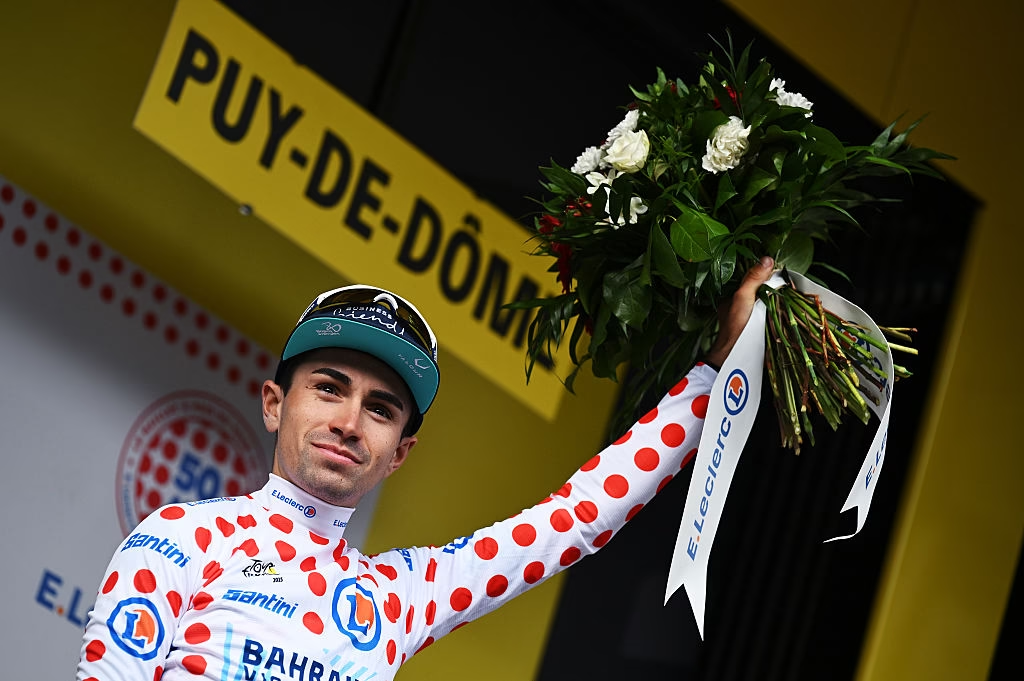
Le Markstein stages can also matter for the mountains classification. The Vosges usually offer several categorised climbs in one stage, which makes them attractive for riders chasing the polka-dot jersey.

A rider who gets into the breakaway can score points across multiple climbs before the GC favourites take over. That can be especially important if the hardest summit finishes later in the race are likely to favour the main yellow jersey contenders.

In 2026, Stage 14 could become a useful day for riders chasing mountain points. With the Grand Ballon, Ballon d’Alsace and late Vosges climbs in the route, there may be enough points on offer to change the classification or give a breakaway specialist a serious foothold.

The difficulty is that the stage may also interest GC teams. If the yellow jersey contenders race hard, breakaway riders may find it harder to survive to the finish. But even then, the early climbs could still matter for the polka-dot battle.

For more on the competition, see our Tour de France 2026 climbers guide, best climbers at the Tour de France 2026 and Tour de France 2026 jerseys explained.
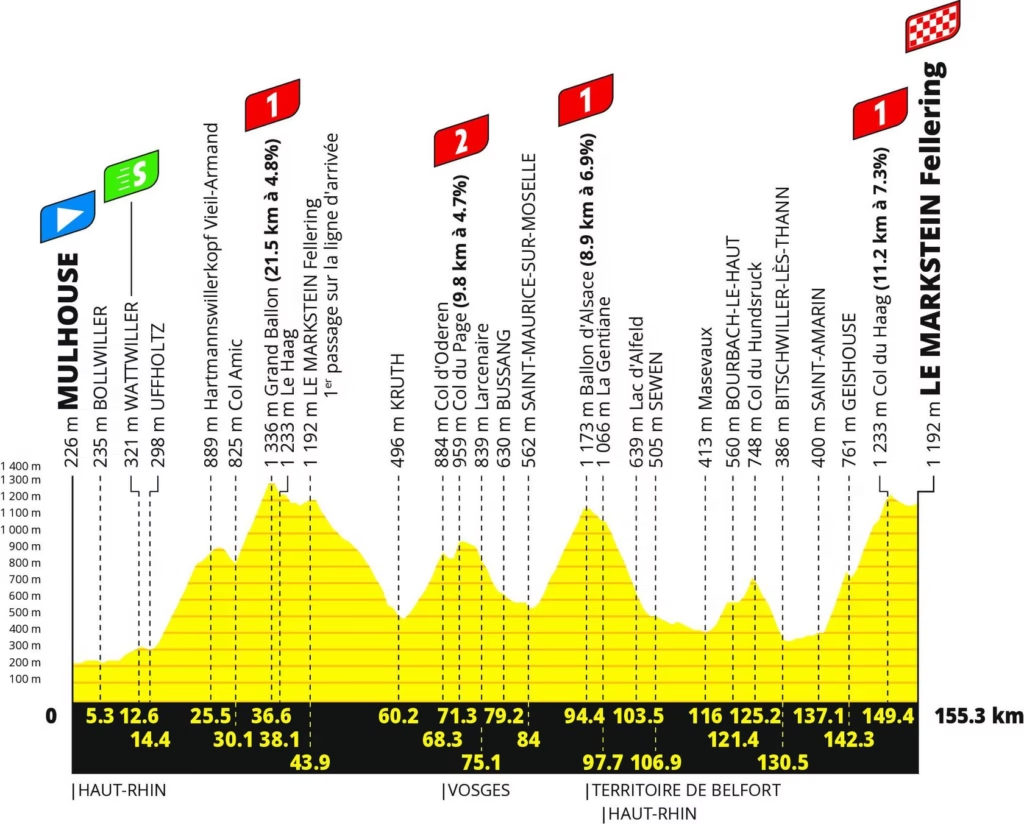
Stage 14: Mulhouse to Le Markstein Fellering The 2026 return: Mulhouse to Le Markstein Fellering

The 2026 return: Mulhouse to Le Markstein Fellering

The 2026 Tour brings Le Markstein back on Stage 14, from Mulhouse to Le Markstein Fellering. The stage is 155.3km long with 3,800m of climbing, placing it firmly among the key mountain days before the final week.

Its position is important. It comes after Stage 13 to Belfort, the longest stage of the race, and before Stage 15 to Plateau de Solaison. That makes it part of a difficult three-day block through the Vosges and Jura. Riders will not be able to treat it as an isolated test.

The stage includes several major Vosges features, with the Grand Ballon early and the Col du Haag late. The Col du Haag is especially important because it crests close enough to the finish for attacks to carry through to Le Markstein. If a rider opens a gap there, the run to the line may not be long enough for the race to come back together.

This is why Stage 14 could be more important than its profile suggests at first glance. It is not the highest stage of the Tour. It is not the final Alpine showdown. But it sits in exactly the kind of position where fatigue, team strength and tactical pressure can create serious consequences.

For more detail, see our Tour de France 2026 Vosges and Jura guide, Tour de France 2026 mountain stages ranked by difficulty and Tour de France 2026 route: best days for GC attacks.

Why Stage 14 could matter before the Alps

The 2026 Tour will not be decided only in the Alps. By the time the race reaches Le Markstein, riders will already have faced Barcelona, the Pyrenees, the Massif Central and the longest stage of the race. That means fatigue will already be layered into the bunch.

Le Markstein can exploit that. A rider who looked comfortable on the Tourmalet may be less convincing after two weeks of racing. A team that looked strong in the opening week may have fewer helpers left. A contender who is carrying small weakness may find it exposed on repeated climbs rather than one famous summit.

That is what makes Stage 14 dangerous. It may not be the stage everyone circles first, but it could shape what happens later. A rider who loses time there goes into Plateau de Solaison under pressure. A rider who spends too much controlling there may pay for it the next day. A rider who gains even 20 seconds could shift the tactical balance before the time trial and Alps.

Le Markstein is therefore not just a finish. It is a stress test before the final phase of the Tour. For a wider view of the race before the Alps, see our Tour de France 2026 Massif Central guide and where the Tour de France 2026 can be won before the Alps.

What kind of rider can win at Le Markstein?

Le Markstein can suit different types of riders depending on how the stage is raced.

If the GC teams control the day, the winner is likely to be a general classification rider with a fast finish from a reduced group. That is what happened in 2023, when Pogačar won from a small selection.

If the breakaway is allowed to go, the stage can suit an aggressive climber or all-rounder who can handle repeated climbs and still accelerate after a long day. The Vosges often reward riders who are tactically sharp rather than simply the lightest climbers.

If the race becomes chaotic early, team numbers may matter. A rider with a teammate in the front group can save energy or use tactical pressure. A rider isolated too early may have to chase every move alone.

The ideal Le Markstein rider is therefore not just a pure climber. They need endurance, repeatability, descending confidence and a strong final effort.

For riders who could fit that profile in 2026, see our Tour de France 2026 stage hunters to watch, Tour de France 2026 route: best days for breakaways and Tour de France 2026 dark horses for the general classification.

How Le Markstein could shape the modern Tour

Le Markstein’s future in the Tour depends on what the race wants the Vosges to do. If organisers want a mountain stage that feels different from the high Alps, it is a useful finish. It provides climbing, regional identity and tactical uncertainty without relying on a climb that has been overused for decades.

It also helps balance the route. The Tour needs more than the Pyrenees and Alps. The Massif Central, Jura and Vosges are crucial because they stop the race from becoming too predictable. They create stages where the strongest rider might not win by simply waiting for the final kilometre.

Le Markstein fits that modern need. It can be used as a finish, a pass, a launchpad or part of a larger mountain chain. It gives route designers flexibility.

That is why its history may still be at an early stage. Compared with Alpe d’Huez, Le Markstein is young in Tour memory. But that gives it room to grow. The 2026 stage will be another test of whether it can become a recurring modern mountain reference.

For another modern mountain-history comparison, see our history of Alpe d’Huez at the Tour de France.

Le Markstein in Tour history explained simply

Le Markstein is not an old Tour legend in the same way as the Tourmalet or Alpe d’Huez. Its importance comes from modern route design and from the way the Vosges are now used to shape the race before the Alps.

The climb and ski area sit inside a wider Vosges network of roads, so the difficulty often comes from the whole stage rather than one final ascent. That makes Le Markstein tactical. It can create pressure, break teams, help breakaways and test GC riders before the final week.

Its key modern moments are clear: Annemiek van Vleuten taking control of the first Tour de France Femmes in 2022, Tadej Pogačar winning the final mountain stage of the 2023 men’s Tour, Jonas Vingegaard confirming overall victory there, and the 2026 Tour returning to the same area with another hard Vosges stage.

Le Markstein is still building its Tour identity. But that is precisely why it matters. It shows how the Tour keeps creating new reference points, even in mountain ranges that have been part of the race for more than a century.

For more Tour de France 2026 coverage, visit our Tour de France hub, beginner’s guide to Men’s Tour de France 2026 and how to watch Tour de France 2026 in the UK.
Tour of Britain Women 2026 route guide

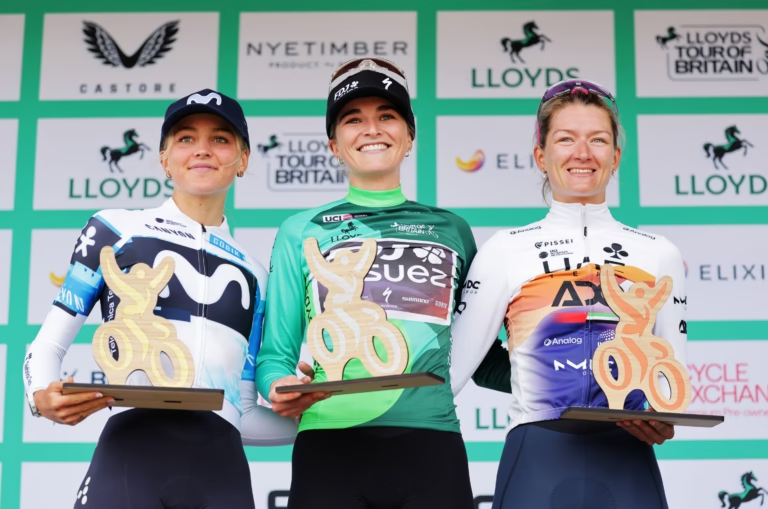
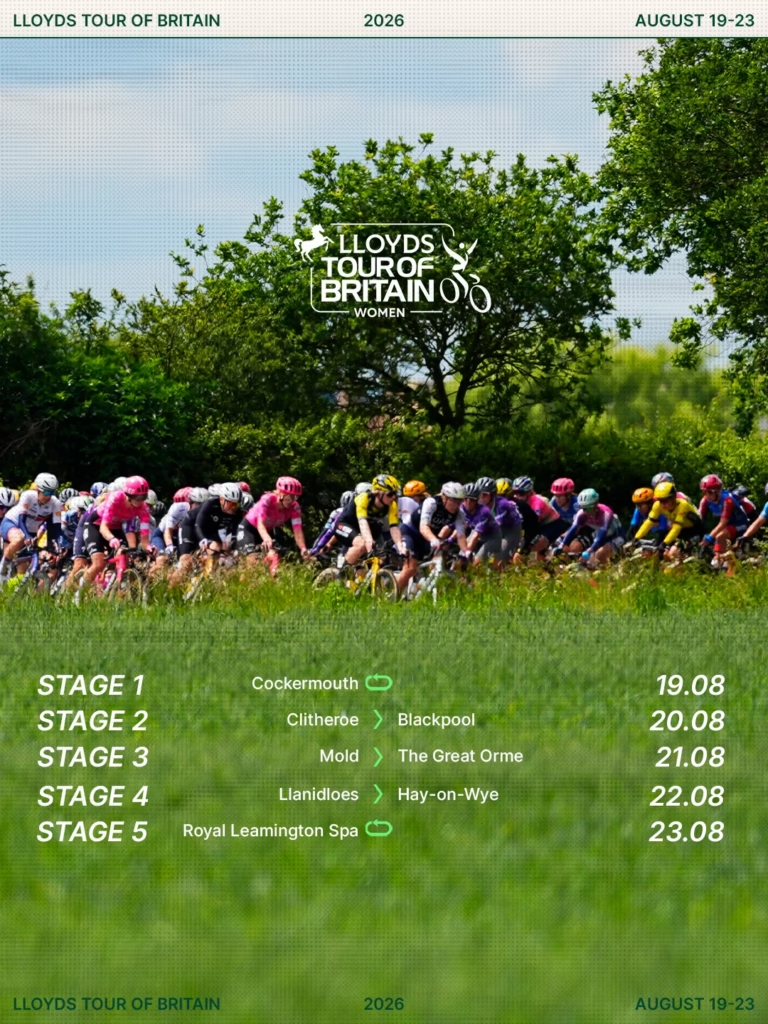
The Tour of Britain Women 2026 will run from Wednesday 19 August to Sunday 23 August, giving Britain’s leading women’s stage race five days of racing for the first time in its current Tour of Britain era. It is a significant step for the event, both symbolically and tactically, with the women’s race now matching the men’s edition in stage count.

The route moves across England and Wales, starting in Cockermouth in Cumbria before heading to Lancashire, North Wales, Mid Wales and Warwickshire. The race begins with a challenging loop through western Cumbria, takes in a likely sprint or reduced sprint finish in Blackpool, then reaches one of the key GC days on the Great Orme in Llandudno. The final two stages through Powys and Warwickshire should then decide whether the race belongs to a pure climber, a punchy all-rounder or a rider who can survive repeated hard days.

The full stage maps, timings, sprint points, climbs and road closure details have not yet been released, so this guide focuses on the confirmed host towns, the likely tactical shape of each stage and where the general classification may be decided. Even without the detailed profiles, the structure already tells us plenty. This is not a flat procession. The 2026 race has variety, geographical spread and a clear mid-race climbing flashpoint.

For wider context, see our Tour of Britain Women to expand to five stages in 2026, 2026 Tour of Britain set for biggest edition yet and women’s cycling route guide hub.

Tour of Britain Women 2026 route overview

StageDateRouteLikely race type
Stage 1Wednesday 19 AugustCockermouth to CockermouthRolling / hilly opener
Stage 2Thursday 20 AugustClitheroe to BlackpoolSprint or reduced sprint
Stage 3Friday 21 AugustMold to The Great Orme, LlandudnoUphill finish / GC stage
Stage 4Saturday 22 AugustLlanidloes to Hay-on-WyeHilly / GC and breakaway stage
Stage 5Sunday 23 AugustRoyal Leamington Spa to Royal Leamington SpaFinale / stage hunters or reduced sprint

The shape is clear even before the full maps arrive. Stage 1 should test the field immediately in western Cumbria. Stage 2 looks the most obvious day for fast finishers, though Lancashire roads can still make that harder than a simple bunch sprint. Stage 3 is the headline climbing day because of the finish on the Great Orme. Stage 4 through Powys has the feel of a dangerous penultimate day, with terrain that can reward aggressive racing. Stage 5 brings the race to Warwickshire, where the overall winner will be crowned in Royal Leamington Spa.

It is a compact five-day race, but not a simple one. The winner will need more than one good day. Positioning, recovery, stage craft and the ability to handle British roads will matter throughout.

For more race context across the season, see our women’s cycling race hub and guide to the 2026 Women’s WorldTour.

Why the five-stage format matters

The move to five stages changes the sporting feel of the Tour of Britain Women. A four-day race can be decided quickly, especially if one stage creates a clear GC hierarchy. A five-day race gives teams more room to recover, rethink and attack again.

That matters because the 2026 route has different types of stages. A sprinter may look strong in Blackpool, but that does not solve the Great Orme. A climber may gain time in Llandudno, but still has to manage the roads of Mid Wales and Warwickshire. A team that controls too heavily early may pay for it later.

It also gives the race more narrative space. The opening stage can create early tension. The second stage can bring the sprint teams into the race. The third stage can shape the GC. The fourth stage can reopen it. The fifth stage can decide whether the leader’s team is strong enough to finish the job.

For women’s cycling more broadly, that extra day is important. Route design has become one of the key ways stage races create depth, and the Tour of Britain Women now has more room to offer different kinds of racing. For more on that wider trend, see our feature on how race routes are shaping women’s cycling in 2026.

Picture by Alex Whitehead/SWpix.com - 08/06/2025 - Cycling - UCI Women's World Tour - 2025 Lloyds Tour of Britain Women - Stage 4: The Glasgow Stage - Lorena Wiebes (Team SD Worx - Protime) wins the final stagePhoto Credit: Alex Whitehead/SWpix.com

Stage 1: Cockermouth to Cockermouth

The 2026 Tour of Britain Women begins in Cockermouth, with a start and finish in the historic market town. British Cycling has described the stage as a challenging route through western Cumbria before returning to Cockermouth for the finish.

That wording matters. Western Cumbria is unlikely to offer a completely flat opener. Even without the detailed route map, the terrain points towards a stage that could be awkward from the start. The roads can be rolling, exposed and rhythm-breaking, which is exactly the sort of terrain that can split a nervous peloton early in a stage race.

The first stage is unlikely to decide the whole race, but it can decide who is already under pressure. Riders targeting the general classification will need to stay alert, especially if the route uses narrow lanes, rolling climbs or exposed sections. Teams with ambitions for the overall will not want to spend the first evening chasing lost seconds.

For sprinters, the key question will be how hard the stage becomes before the finish. A flat run-in to Cockermouth could still bring a sprint, but the description of a challenging route suggests the fast finishers may need to survive a selective day first. That could open the door to punchier riders, reduced bunch sprinters or a late attack if the peloton hesitates.

Cockermouth has already hosted the men’s Tour of Britain, including a team time-trial in 2018, but this is the first stage of the modern women’s race in the town. That gives the opening day a clear sense of occasion. The race starts with a new women’s chapter in a region that already has Tour of Britain history.

What Stage 1 means tactically

The first day of a stage race is often more dangerous than it looks. Riders are fresh, teams are nervous and nobody yet knows how the race hierarchy will settle. A rolling Cumbrian opener could make that even more pronounced.

The strongest teams will want to keep their leaders near the front, avoid splits and stop any dangerous breakaway from gaining too much time. Smaller teams may see the same stage differently. If the final route contains enough rolling terrain, Stage 1 could be one of the best opportunities to attack before the GC becomes more controlled.

The finish in Cockermouth will be important. If the final kilometres are technical, positioning will be crucial. If the approach is flatter and more open, sprint teams may still be able to organise. If there is late climbing, then the stage becomes much more suited to punchy riders and classics-style all-rounders.

The safest expectation is an opener that suits strong, alert riders rather than pure specialists. Anyone who wants to win the race overall cannot afford a passive first day.

2025 Lloyds Tour of Britain WomenPhoto Credit: Alex Whitehead/SWpix.com

Stage 2: Clitheroe to Blackpool

Stage 2 takes the race from Clitheroe in the Ribble Valley to Blackpool, bringing Lancashire into the Tour of Britain Women for the first time. On paper, this looks like the clearest sprint opportunity of the race, with the finish in a seaside resort that has a long history with British racing.

Blackpool has hosted several Tour of Britain finishes in the modern era, and its promenade setting naturally points towards a fast finish. The question is how much work the riders have to do before they get there. A start in Clitheroe and a route through the Ribble Valley could add rolling roads before the race reaches the coast.

That makes Stage 2 more interesting than a simple flat transfer. Sprint teams will see the finish as a major chance, but they may need to control a breakaway over terrain that is harder than the final destination suggests. If the wind is up near the coast, positioning could also become important late in the day.

For the pure sprinters, this should be the stage circled most clearly. For the GC riders, it is a day to stay safe, avoid crashes and make sure no splits appear before the finish. For breakaway riders, the best chance may come if the stage proves harder than the sprint teams expect.

Could Stage 2 be a bunch sprint?

A bunch sprint is the most likely broad reading of Stage 2, but it is not guaranteed. The route has not yet been published in full, and Lancashire can offer more difficult roads than the word “Blackpool” might suggest.

If the organisers choose a direct and controlled route into the resort, the sprint teams should have the advantage. The long pull towards the coast could give them enough time to manage the gap, bring the race back together and set up a fast finish.

If the route uses more rolling terrain through the Ribble Valley or takes in exposed roads before Blackpool, the stage could become more complicated. A reduced sprint, a strong breakaway or a late move would then become more realistic.

The stage is also important for points classification riders. A fast finisher who survives Stage 1 and wins in Blackpool could take early control of the points race, especially if the Great Orme and Powys stages later make life harder for pure sprinters.

For wider context on sprint development in the women’s peloton, see our feature on why women’s cycling sprint finishes are getting faster.

The Great Orme Llandudno North Wales

Stage 3: Mold to The Great Orme, Llandudno

Stage 3 is the headline GC stage on the confirmed route. The race starts in Mold and finishes on the Great Orme in Llandudno, one of the most recognisable climbing finishes in British road racing.

The Great Orme is not a long Alpine climb, but that is not what makes it dangerous. It is steep, exposed and decisive at the end of a stage. The road can break a group quickly, especially if the pace is high before the climb starts. In a five-day race, even gaps of 10, 20 or 30 seconds can matter.

This stage should suit punchy climbers, explosive GC riders and all-rounders who can handle repeated changes of pace. It is less likely to suit pure sprinters unless the route before Llandudno is much easier than expected and the field reaches the climb relatively intact.

The Great Orme also has recent Tour of Britain relevance. Llandudno hosted a stage finish in 2024, when Lotte Kopecky won on the promenade, while the men’s race has also used the Great Orme as a decisive finish. That gives the stage a ready-made sense of importance.

If one day is going to create clear GC gaps, Stage 3 is the obvious candidate.

Why the Great Orme is such a strong finish

The Great Orme works because it is short enough to produce explosive racing and hard enough to punish hesitation. It is the kind of finish where a rider can win through timing, power and positioning rather than only pure climbing endurance.

That makes it especially suited to women’s stage racing. The gaps may not be enormous, but they can be decisive because the race is only five days long. A rider who gains time on the Great Orme could spend the final two stages defending rather than chasing.

The approach will matter. If the stage is controlled until Llandudno, the climb may become a straight fight between the strongest riders. If the route before the finish is already hard, the Great Orme could be the final blow after a day of attrition.

Teams with multiple cards will have options. They can attack before the climb, force rivals to chase, then save their strongest finisher for the final ascent. Teams with one clear leader will need to keep the race tight and make sure that leader begins the climb in the right position.

The Great Orme is the point where the 2026 route stops being a race of possibilities and becomes a race of gaps.

Picture by Alex Whitehead/SWpix.com - 06/06/2025 - Cycling - UCI Women's World Tour - 2025 Lloyds Tour of Britain Women - Stage 2: Hartlepool to Saltburn-by-the-Sea - Mara Roldan (Team Picnic PostNL) wins stage 2 into Saltburn-by-the-Sea

Stage 4: Llanidloes to Hay-on-Wye

Stage 4 takes the race through Mid Wales, from Llanidloes to Hay-on-Wye. British Cycling has described the stage as a challenging and scenic route through Powys, with the general classification battle entering its final stages.

This could be the most tactically complex stage of the race. It comes the day after the Great Orme, which means the GC order may already be established. Riders who lost time in Llandudno will need to attack. Teams defending the lead will need to decide how much control they can afford. Breakaway riders will see opportunity.

Powys is ideal for that kind of racing. The roads can be rolling, narrow, exposed and difficult to organise. Even without a summit finish, this stage could be harder to control than a more obvious mountain stage. The terrain may not produce one single decisive climb, but it can wear down teams and make the final hour unpredictable.

Hay-on-Wye gives the stage a distinctive finish town, and both Llanidloes and Hay-on-Wye are new start and finish hosts for the race. That gives the penultimate day a fresh identity, but the sporting angle is the more important one. This is exactly the kind of stage where the race can be reopened.

Could Stage 4 decide the GC?

Yes. Stage 3 may create the first major selection, but Stage 4 could decide whether that selection holds.

The day after a hard climbing finish is always revealing. Riders who looked strong on the Great Orme may feel the effort in their legs. Teams that spent heavily to set up the stage may have fewer resources to defend. Riders who lost time have a clear incentive to gamble.

That is why Stage 4 should not be treated as a transition day. It may not have the same obvious headline climb as Stage 3, but it has the ingredients for a dangerous penultimate stage. Rolling Welsh roads can make chasing difficult, especially if a strong group gets clear.

The key question will be how large the gaps are after Llandudno. If the race is still tight, teams may race conservatively and wait for the final day. If one rider has a clear lead, rivals may have no choice but to attack in Powys.

This is the stage where team strength could matter most. A leader without enough support may be vulnerable. A team with several strong riders can cover moves, control the road and discourage attacks before they become dangerous.

Picture by Alex Whitehead/SWpix.com - 07/06/2025 - Cycling - UCI Women's World Tour - 2025 Lloyds Tour of Britain Women - Stage 3: The Scottish Borders Stage, Kelso - Kristen Faulkner (EF Education-Oatly)Photo Credit: Alex Whitehead/SWpix.com

Stage 5: Royal Leamington Spa to Royal Leamington Spa

The 2026 Tour of Britain Women finishes in Royal Leamington Spa, with a Warwickshire loop starting and ending in the town. It is the first time Warwickshire will host the overall finish of the women’s race, although the county has a long history with the event.

Royal Leamington Spa has previously hosted women’s race finishes, including victories for Chloe Hosking in 2017 and Sarah Roy in 2018. That history points towards a finale that could suit fast finishers, although the final route map will decide how selective the stage becomes.

As the last day of a five-stage race, Stage 5 has two jobs. It must decide the final stage winner and confirm the overall champion. If the GC gaps are wide, the stage may tilt towards sprint teams and breakaway riders. If the gaps are small, every intermediate sprint, bonus second and late attack could matter.

Warwickshire roads can be deceptively tricky. They may not have the same climbing reputation as Wales or Cumbria, but rolling terrain, road furniture and technical town-centre approaches can still make the final stage stressful. A leader’s team will need to stay organised until the race is fully secure.

What kind of rider does the route suit?

The 2026 Tour of Britain Women route looks best suited to a versatile all-rounder rather than a pure climber or pure sprinter. The Great Orme gives climbing ability real value, but the race does not appear to be a mountain-heavy stage race. The winner will probably need to climb sharply, position well, handle rolling roads and stay alert across five days.

A punchy GC rider who can attack on the Great Orme and defend on rolling terrain should be well suited. A classics-style rider with a strong uphill finish may also be dangerous if they can limit losses on Stage 3. A pure sprinter could win stages, especially in Blackpool and possibly Leamington Spa, but winning the overall will be harder unless they can survive the hillier days without losing time.

The route also gives teams with multiple attacking options a real chance. A rider who cannot win on the Great Orme might still move into contention through consistency, bonus seconds and aggressive racing in Powys or Warwickshire.

This is where the five-stage format helps. It does not reduce the race to one climb. It gives the strongest teams time to build pressure. For a broader look at how this fits the season, see our guide to the 2026 Women’s WorldTour.

Picture by Elliot Keen/British Cycling via SWpix.com - 06/06/2024 - Cycling - UCI Women's World Tour - Lloyds Bank Tour of Britain Women - Stage 3: The Warrington Stage, Cheshire, England -

Where will the general classification be decided?

The Great Orme is the obvious answer, but it may not be the whole answer.

Stage 3 should create the clearest climbing selection. It is the day where the strongest uphill riders can make a direct difference. If one rider is clearly superior there, the rest of the race becomes a defence job.

Stage 4 may be just as important tactically. It comes at the right point in the race for attacks, ambushes and breakaway pressure. If the leader’s team is not strong enough, Powys could become the day where the race changes direction.

Stage 5 then depends on the gaps. If the top of the standings is still close, the Warwickshire finale could become more tense than expected. Bonus seconds, positioning and small splits may matter if the race has not been settled earlier.

The most likely GC pattern is this: Stage 1 filters the contenders, Stage 3 creates the first real hierarchy, Stage 4 tests that hierarchy, and Stage 5 confirms or overturns it.

Best stages for sprinters

Stage 2 into Blackpool is the clearest sprint opportunity. A seaside finish, a major host town and a likely fast final all point towards the sprinters having their best chance there.

Stage 5 in Royal Leamington Spa may also suit fast finishers, depending on the final circuit and the GC situation. If the overall battle is settled, sprint teams may be given more freedom to organise. If the GC is close, the stage could become more nervous and less predictable.

Stage 1 could be possible for a reduced bunch sprint, but the western Cumbria description suggests it may be more selective. Stages 3 and 4 are less likely to suit pure sprinters, though durable fast riders may still survive longer than expected.

The points classification should therefore be shaped by more than raw sprint speed. Riders who can contest Blackpool, survive the Great Orme and still sprint in Leamington Spa will have a stronger hand than those relying on one clean bunch finish. For wider context, see our guide to why women’s cycling sprint finishes are getting faster.

Tour-of-Britain-Women-Mara-Roldan-wins-stage-2-with-14km-solo-attackPhoto Credit: Getty

Best stages for attackers

Stage 4 looks the best day for attackers. The terrain through Powys, the timing in the race and the pressure after the Great Orme all make it a natural breakaway or ambush stage.

Stage 1 may also suit early aggression, especially if the route through western Cumbria is rolling and difficult to control. A strong breakaway could test teams before they have fully settled into the race.

Stage 3 could include attacks before the Great Orme, but the final climb may keep teams cautious. Many riders may prefer to save themselves for the uphill finish rather than spend energy too early.

Stage 5 will depend on the GC situation. If the race is close, attacks may come from riders within striking distance. If the GC is settled, breakaway riders may target the stage while sprint teams decide whether they have enough control left.

What the route means for British riders

The Tour of Britain Women is always important for British riders because it gives them a WorldTour stage race on home roads. The 2026 edition spreads that opportunity across Cumbria, Lancashire, Wales and Warwickshire, giving the race a broader domestic footprint.

The route should suit several types of British rider. Climbers and punchy all-rounders will look at the Great Orme. Strong rouleurs and breakaway riders will look at Powys. Fast finishers will look at Blackpool and Leamington Spa. Young riders may see the five-stage format as a chance to learn how to handle repeated WorldTour-level racing.

That development angle matters. The Tour of Britain Women has long been one of the most visible entry points for British fans into elite women’s racing. A five-stage WorldTour race on British roads gives domestic riders, teams and spectators a bigger platform.

For riders likely to be relevant on home roads, see our British riders to watch in women’s cycling 2026. For a broader look at the race’s place in the calendar, see our guide to the most important women’s cycling races explained and our women’s cycling race hub.

Fan guide: best places to watch

The best stage to watch depends on the kind of racing you want.

Cockermouth should offer the atmosphere of an opening stage, with team presentation energy, fresh legs and early race tension. It is likely to be a good option for fans who want the start and finish experience in one place.

Blackpool is the obvious choice for a fast finish and a big crowd setting. The promenade has strong spectator appeal and should be one of the most accessible finishes of the race.

The Great Orme is the best pure racing location. If you want to see the riders under pressure, Stage 3 is the one to target. The climb should create the most visible selection of the race.

Llanidloes to Hay-on-Wye may be the best stage for fans who want a more traditional roadside experience in difficult terrain. It could also be the best day for those who enjoy tactical racing rather than a straightforward finish.

Royal Leamington Spa is the best choice for the final-day atmosphere. It will crown the overall winner and should bring the biggest sense of closure to the week.

For home viewing around the wider women’s calendar, see our women’s cycling TV guide hub.

What still needs to be confirmed

The major host towns are now known, but the detailed race route still needs to be published.

The missing information includes full stage maps, distances, start and finish times, categorised climbs, intermediate sprints, feed zones, road closures, spectator points and broadcast details. These will matter because they can change how each stage is interpreted.

For example, Stage 2 looks like a sprint stage from the host towns alone, but the detailed route could make it harder. Stage 4 looks dangerous through Powys, but the exact climbs and final kilometres will decide whether it is a GC stage or a breakaway day. Stage 5 could be a sprint, a reduced sprint or a tactical GC finish depending on the Warwickshire loop.

Until those details are released, the safest reading is based on geography and race structure rather than exact stage profiles.

Tour of Britain Women 2026 route verdict

The Tour of Britain Women 2026 route looks like a strong step forward for the race. The extra stage gives the event more room to breathe, while the host towns create a varied course across England and Wales.

The Great Orme gives the route a clear headline climb. Powys gives it a dangerous penultimate day. Blackpool and Leamington Spa offer likely chances for fast finishers. Cockermouth gives the race a testing opener rather than a soft start.

That balance should make the race difficult to control. It is not designed only for climbers, sprinters or breakaway riders. It asks for versatility, team depth and good race management across five days.

The likely winner will be a rider who can handle the Great Orme, stay alert through Mid Wales and still have enough support to finish the job in Warwickshire. The route does not need huge mountains to be decisive. It has enough variety to make every day matter.

For more women’s cycling coverage, visit our women’s cycling hub, women’s cycling race hub and women’s cycling route guide hub.

A history of Alpe d’Huez at the Tour de France

Alpe d’Huez is not the longest climb in the Tour de France. It is not always the hardest. It is not even used every year. Yet few places in cycling carry the same weight. Its 21 hairpins have turned into a shorthand for Tour de France drama, from Fausto Coppi’s first summit win in 1952 to Tom Pidcock’s descending-led victory in 2022.

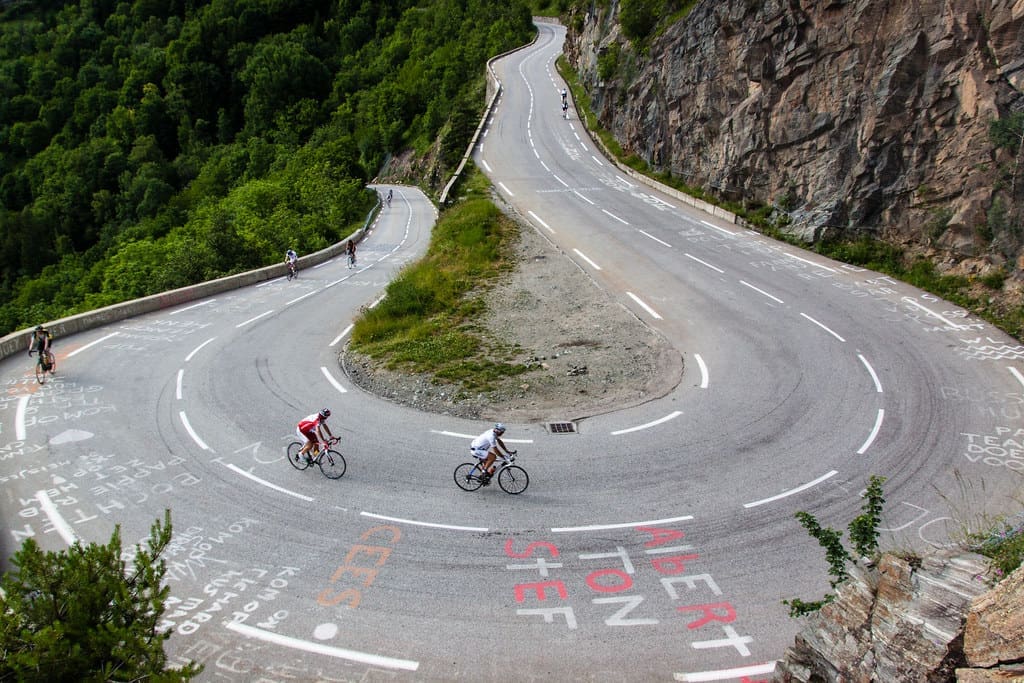
The climb has become famous because it combines a simple sporting test with a very public setting. The road rises from Bourg d’Oisans to the ski resort above, twisting through numbered bends that have become part of Tour history. The gradient is hard enough to split the best climbers, the crowds are close enough to make the climb feel enclosed, and the finish has often arrived late enough in the race to matter.

In 2026, Alpe d’Huez returns with unusual force. The Tour will finish there on consecutive mountain stages, first from Gap on Stage 19, then again from Le Bourg d’Oisans on Stage 20 after a much harder Alpine route. It gives the climb a central place in the final weekend and brings one of the Tour’s most recognisable stages back into the general classification fight.

For the full 2026 race context, see our Tour de France 2026 full route guide, Tour de France 2026 Alps guide and Tour de France 2026 queen stage guide.

divFrom-a-crucial-TTT-to-double-Alpe-dHuez-–-The-key-stages-that-will-decide-the-Tour-de-FrancedivPhoto Credit: Getty

Why Alpe d’Huez matters

Alpe d’Huez matters because it is easy to understand and hard to survive. The climb has 21 famous hairpins, a steep opening section, and a final approach that can feel endless when riders are already deep into a mountain stage.

It is also a climb that creates images. Riders weaving through crowds. Leaders isolated. Domestiques dropping away. Attacks on the lower slopes. Riders looking across at rivals with the finish still far above them. It is a road that makes the Tour visible in a way that television, roadside fans and history all recognise.

The climb is often described through emotion, but its sporting value is straightforward. It is long enough for the best climbers to make a difference, steep enough to expose weakness, and famous enough to change how riders and teams behave. Nobody wants to crack on Alpe d’Huez. Nobody wants to waste a chance to win there.

That pressure changes the race. Some riders attack too early. Others ride within themselves and hope rivals make the first mistake. Teams try to control the lower slopes, but once the climb opens up, the strongest riders usually find their own level.

For more on the wider place of the climb in Tour history, see our feature on Alpe d’Huez: why the Tour still fears the 21 bends and its history. For the 2026 climbing context, see our Tour de France 2026 mountain stages ranked by difficulty and how the Tour de France general classification works.

1952: Fausto Coppi and the first mountain-top finish

Alpe d’Huez entered Tour history in 1952, when Fausto Coppi won the stage and helped define a new kind of mountain racing. The finish is widely remembered as the Tour’s first true mountain-top finish, and Coppi’s victory immediately gave the climb status.

That matters because before then, the Tour’s mountain mythology was built largely around passes and descents. Riders climbed major cols, but the decisive finish was not always at the top. Alpe d’Huez changed the shape of the race. It allowed the climb itself to become the finish line.

Coppi was the ideal first winner. He was already one of cycling’s defining figures, a rider whose climbing and style made him look suited to grand gestures. His win gave the climb instant credibility. Alpe d’Huez did not need decades to become important. It arrived with one of the sport’s great names already attached to it.

The Tour did not immediately return every year, but the link was made. Alpe d’Huez had shown what a summit finish could do.

Alpe d'Huez, France

A long wait before the climb returned

After 1952, Alpe d’Huez disappeared from the Tour for more than two decades. That absence is part of its story. The climb did not become iconic because of constant repetition. It became iconic because when it returned, it arrived as something different from the rest of the race.

The Tour came back to Alpe d’Huez in the 1970s, just as television, bigger roadside crowds and modern stage design were changing how the race was watched. The climb was no longer just a difficult road to a ski station. It was a natural amphitheatre for the Tour.

That return also created the foundation for the climb’s Dutch identity. Dutch riders began winning there often enough that the mountain became linked with orange crowds, camping fans and one of cycling’s most recognisable roadside cultures.

By the end of the 1970s and into the 1980s, Alpe d’Huez was no longer only Coppi’s climb. It had become one of the Tour’s central stages.

For a wider race-history overview, see our brief history of the Men’s Tour de France.

The Dutch mountain

Alpe d’Huez is often called the Dutch mountain. That nickname comes from the number of Dutch winners during the climb’s formative Tour years and from the fans who turned hairpin seven into Dutch Corner.

Joop Zoetemelk, Hennie Kuiper, Peter Winnen, Steven Rooks and Gert-Jan Theunisse all helped build the Dutch story on the climb. Those wins came when the Tour was developing into a more international television event, and Dutch supporters made Alpe d’Huez their own.

Dutch Corner became part of the experience. It is not just a place on the climb. It is a symbol of how Alpe d’Huez turns spectators into part of the stage. The orange crowds, noise and density create one of the most intense fan environments in the sport.

That atmosphere is part of why the climb can feel different from other Alpine finishes. On many climbs, the mountain dominates. On Alpe d’Huez, the crowd often feels just as important as the gradient. Riders are not only climbing a road. They are passing through a corridor of expectation.

Alpe d'Huez, France cycling

Why the 21 hairpins became famous

The 21 hairpins are central to the climb’s identity. They give Alpe d’Huez a structure that fans can follow and riders can feel. Each bend becomes a marker of suffering, progress and history.

The lower bends are often the hardest psychologically. The climb begins steeply from Bourg d’Oisans, and riders quickly understand whether they are having a good day or a bad one. The road then opens into a rhythm of turns, ramps and crowd sections.

The hairpins also make the climb visually clear. Television cameras can show the road stacked above itself, with riders turning from one level to the next. Fans can see the race approaching and hear the noise build. The numbered bends give the climb a sense of countdown.

That matters for storytelling. Many climbs are harder on paper. Few are easier to recognise instantly. The official Alpe d’Huez tourism guide to the 21 bends gives the climb’s basic shape: 21 bends, a start in Bourg d’Oisans, a finish at Alpe d’Huez, and more than 1,100m of height gain.

1976: Joop Zoetemelk and the modern Alpe d’Huez era

Joop Zoetemelk’s 1976 victory helped begin the modern Alpe d’Huez era. It was the first Tour finish on the climb since Coppi, and it confirmed that the road could still shape the race more than two decades later.

Zoetemelk was already one of the major Tour riders of his time. His win connected the climb to a new generation and helped start the Dutch run that would define the following years. Alpe d’Huez became not only a historic return but a recurring stage with its own identity.

The 1970s and 1980s were crucial because they established the climb as a place where the Tour expected something important to happen. It was not just a difficult finish. It was a stage that carried weight before the riders even reached the bottom.

From that point, Alpe d’Huez became one of the roads the Tour could use when it wanted a mountain stage to feel bigger than the ordinary race pattern.

divAlpe-dHuez-–-A-history-of-the-most-famous-21-turns-of-the-Tour-de-Francediv-1

1984: Luis Herrera and Colombia’s breakthrough

Luis Herrera’s victory on Alpe d’Huez in 1984 became one of the great international moments in Tour history. He was a Colombian climber racing in an era when South American riders were beginning to change how European cycling understood the mountains.

Herrera’s win mattered because it showed a different climbing culture arriving at the Tour. Colombian riders had grown up at altitude and brought a natural rhythm to long climbs that made them dangerous in the high mountains. Alpe d’Huez was the perfect stage for that talent to be seen.

The victory also helped widen the mythology of the climb. Coppi had given it Italian grandeur. The Dutch had made it orange. Herrera gave it a Colombian chapter and showed that the climb could introduce new cycling worlds to the Tour audience.

That became part of Alpe d’Huez’s appeal. It was not only a place for established champions. It could also be a place where cycling’s geography expanded.

1986: Hinault, LeMond and one of the Tour’s defining images

The 1986 Alpe d’Huez stage produced one of the most famous images in Tour history: Bernard Hinault and Greg LeMond crossing the line together. Hinault won the stage, LeMond strengthened his path towards overall victory, and the finish became wrapped in the complicated politics of team leadership.

The image looked like unity. The story beneath it was more complicated. Hinault, already a five-time Tour winner, had promised to support LeMond, but the 1986 race was full of tension between ambition, loyalty and control. Alpe d’Huez became the place where that tension was frozen into one photograph.

It remains one of the reasons the climb still matters historically. Alpe d’Huez did not simply produce a stage result. It revealed a team dynamic, a generational shift and the psychology of the yellow jersey battle.

Many climbs decide time gaps. Alpe d’Huez often seems to expose relationships.

For more on how team roles shape the Tour, see our how Tour de France teams work and what is a domestique at the Tour de France?.

Alpe d'Huez a scenic view of a mountain range with a trail in the foreground

The Italian years and the Pantani legend

Alpe d’Huez has also been a major Italian stage. Gianni Bugno won there twice in the early 1990s, Roberto Conti won in 1994, Marco Pantani won in 1995 and 1997, and Giuseppe Guerini added another Italian victory in 1999.

Pantani’s place in the climb’s history is especially strong. His climbing style, acceleration and aura made him look made for Alpe d’Huez. His 1997 ascent is still widely cited as the fastest recorded climb of the Alpe, though exact times can vary depending on the start and finish points used for measurement.

Pantani’s Alpe d’Huez performances sit in a complicated period of cycling history, but they remain central to how many fans remember the climb. He did not merely win there. He attacked the climb in a way that made the road feel explosive.

That is one reason Alpe d’Huez has such a strong hold on cycling memory. It has often rewarded riders whose style matched the scale of the stage. Pantani’s style did.

For the modern climbing comparison, see our best climbers at the Tour de France 2026 and Tour de France 2026 climbers guide.

Guerini Crashes

1999: Giuseppe Guerini and the spectator collision

Giuseppe Guerini’s 1999 victory is remembered for one of the strangest incidents in Alpe d’Huez history. Riding alone towards the finish, Guerini collided with a spectator who had stepped into the road while trying to take a photograph.

The crash could have ruined the stage. Instead, Guerini got back up, continued and still won. It became a classic Alpe d’Huez moment because it showed both the energy and danger of the climb’s crowd culture.

Alpe d’Huez is famous partly because fans are so close to the riders. That closeness creates atmosphere, but it can also create risk. The 1999 incident remains one of the clearest reminders that the Tour’s great roadside theatre depends on restraint as well as passion.

Guerini’s win survived the chaos. The image of the crash became part of the climb’s mythology.

The Armstrong era and its difficult legacy

The early 2000s gave Alpe d’Huez more famous images, but they now sit inside one of cycling’s most difficult periods. Lance Armstrong’s performances on the climb, including the 2001 stage and the 2004 mountain time trial, were once central to modern Alpe d’Huez mythology. They are now part of a stripped and discredited era.

That does not mean the stages disappear from history. They happened, they shaped how people watched the Tour, and they influenced how Alpe d’Huez was remembered at the time. But they cannot be discussed as simple sporting achievements.

The climb has carried cycling’s beauty and its baggage. That is part of the truth of Alpe d’Huez. It has seen clean emotion, racing intelligence, crowd chaos, national celebration and the darker side of the sport’s past.

Any serious history of Alpe d’Huez has to hold those things together rather than pretend the difficult chapters were not there.

L'Alpe d'Huez

2011: Pierre Rolland and a French revival

Pierre Rolland’s victory in 2011 gave France one of its most popular modern Alpe d’Huez moments. Riding for Europcar, Rolland attacked on the climb and won the stage, also securing the white jersey as best young rider.

It mattered because French fans had waited a long time for a home winner on one of the Tour’s most famous mountain finishes. Rolland’s win came with the kind of emotion that Alpe d’Huez can generate better than almost anywhere else.

The stage also showed how the climb can reward riders outside the narrow group of overall winners. Rolland was not winning the Tour, but his victory became one of the defining French moments of that edition.

Alpe d’Huez does not always need to decide yellow to matter. Sometimes it creates a stage victory that lasts in the national memory.

For the current French angle, see our best French riders to watch at the Tour de France 2026.

2013: the double ascent and Christophe Riblon

The 2013 Tour de France used Alpe d’Huez in a different way by climbing it twice on the same stage. The route descended via the Col de Sarenne between the two ascents, creating a rare double encounter with the mountain.

Christophe Riblon won the stage, giving France another emotional victory on the Alpe. The double ascent also showed how the Tour could still find new ways to use a familiar climb. Alpe d’Huez was not only a classic finish. It could be redesigned into something more demanding and unpredictable.

That stage remains important when looking ahead to 2026. The Tour has shown a willingness to use the Alpe creatively, not just as the standard final climb from Bourg d’Oisans. When the race returns with back-to-back finishes, it continues that pattern of trying to make a known climb feel fresh.

For the 2026 version of that final Alpine block, see our Tour de France 2026 queen stage guide and why back-to-back Alpe d’Huez finishes could define the Tour de France 2026.

2018: Geraint Thomas wins in yellow

Geraint Thomas won on Alpe d’Huez in 2018 while wearing the yellow jersey. It was a major moment in his Tour-winning campaign and one of the clearest signs that Team Sky’s leadership balance had shifted.

Thomas did not just defend on the climb. He won the stage. That mattered because Alpe d’Huez victories carry extra symbolic value. Winning there in yellow suggested control, confidence and superiority in one of the race’s most visible settings.

The stage also came during a period when Alpe d’Huez remained a test of team strength as much as individual climbing. Strong squads could control the approach, place their leaders and reduce the options for rivals. But once the road steepened, the leader still had to finish the work.

Thomas did that. His win remains one of the defining British moments on the climb.

For the current British Tour picture, see our best British riders to watch at the Tour de France 2026.

Tom Pidcock Alpe d'Huez Tour de France 2022

2022: Tom Pidcock and the modern Alpe d’Huez

Tom Pidcock’s 2022 victory gave Alpe d’Huez a very different kind of modern winner. He attacked from the breakaway, used his descending skill to help shape the stage, then climbed strongly enough to win on one of cycling’s most famous roads.

Pidcock’s win stood out because it showed another way to win on Alpe d’Huez. It was not a classic yellow jersey duel. It was a breakaway performance built on descending, tactical timing and climbing ability. He became the youngest rider to win a Tour stage on the climb, and the victory gave Britain another major Alpe d’Huez chapter after Thomas.

The stage also underlined how the climb can still reinvent itself. In the past, Alpe d’Huez was often viewed as a pure GC arena. In 2022, it became a place where a multi-discipline rider could use a wider skill set to win.

That is part of why the climb remains relevant. It does not only belong to the old pattern of mountain racing.

For more on Pidcock’s 2026 Tour role, see our Tom Pidcock at the Tour de France 2026 and our 2022 report on Tom Pidcock winning on Alpe d’Huez.

Alpe d’Huez and the general classification

Alpe d’Huez is famous for stage wins, but its bigger role is often psychological. A rider can lose the Tour there without losing the stage by minutes. The climb is so public, so loaded and so late in the race that weakness feels amplified.

GC riders know that any bad moment on Alpe d’Huez will be replayed. Teams know that isolation on the lower slopes can look like a warning sign. Rivals know that attacks on the climb carry more meaning than attacks on a lesser-known mountain.

That is why Alpe d’Huez can affect the race even before the riders reach it. Teams plan around it. Leaders try to save energy for it. Fans expect it to matter. The climb sits in the minds of riders long before the first hairpin.

In pure time terms, other climbs can be harder. In Tour terms, few climbs apply pressure in the same way.

For more on the overall battle, see our how the Tour de France general classification works, Tour de France 2026 GC favourites ranked and Tour de France 2026 route: best days for GC attacks.

The climb’s most famous winners

Alpe d’Huez has produced winners from different eras, countries and rider types. Some were Tour champions. Some were stage hunters. Some won from the breakaway. Some were already wearing yellow.

YearWinnerWhy it mattered
1952Fausto CoppiFirst Tour mountain-top finish on Alpe d’Huez
1976Joop ZoetemelkRestarted the modern Alpe d’Huez story
1984Luis HerreraColombian climbing breakthrough
1986Bernard HinaultFamous finish with Greg LeMond
1995Marco PantaniPart of Pantani’s Alpe d’Huez legend
1997Marco PantaniWidely cited fastest ascent
1999Giuseppe GueriniWon despite colliding with a spectator
2011Pierre RollandMajor modern French victory
2013Christophe RiblonWon the double-ascent stage
2018Geraint ThomasWon on Alpe d’Huez in yellow
2022Tom PidcockYoungest winner on the climb

The list shows why the climb carries so much weight. It links Coppi, Dutch dominance, Colombian climbing, French emotion, British success and the modern breakaway era in one place.

Why Alpe d’Huez is different from other Tour climbs

The Tour has harder climbs than Alpe d’Huez. The Col du Galibier is higher. The Col du Tourmalet has deeper history. Mont Ventoux is more exposed and more isolated. The Col de la Loze is more extreme in modern gradient terms.

Alpe d’Huez is different because it combines difficulty, repetition, crowd culture and finish-line status. It is not just a pass on the way somewhere else. It is usually the destination. The stage is built around arriving there.

The climb is also visually compact. The hairpins give it rhythm. The resort finish gives it space for a major stage ending. The crowds give it noise. The history gives it meaning before the racing even begins.

That combination is rare. Many climbs can hurt the riders. Fewer can carry the weight of the Tour’s past at the same time.

For the wider 2026 climbing picture, see our Tour de France 2026 climbs guide.

The 2026 double Alpe d’Huez return

The 2026 Tour will bring Alpe d’Huez back in an unusually strong form. Stage 19 finishes there from Gap over 127.9km, with 3,500m of climbing. Stage 20 then returns to Alpe d’Huez from Le Bourg d’Oisans over 170.9km, with 5,450m of climbing.

That second stage is the bigger GC test. It comes on the penultimate competitive day before Paris and includes a huge amount of climbing. The route is designed to make the final Alpe d’Huez finish more than a ceremonial return. It could decide the Tour.

Back-to-back finishes also change the psychology. Riders will not only climb Alpe d’Huez once and move on. They will have to face it, recover, then face it again after an even harder route. That creates a different kind of pressure. A rider who survives Stage 19 may still crack on Stage 20. A rider who loses time on the first Alpe finish may have one last chance the next day.

That is why the 2026 edition feels like a deliberate use of history. The Tour is not simply including Alpe d’Huez. It is putting the climb at the centre of the final mountain argument. The official Tour de France Stage 20 page confirms the Le Bourg d’Oisans to Alpe d’Huez route as 170.9km with 5,450m of climbing.

For the route detail, see our Tour de France 2026 Alps guide, Tour de France 2026 summit finishes guide and Tour de France 2026 queen stage guide.

What Alpe d’Huez means for fans

For fans, Alpe d’Huez is one of the most recognisable places to watch the Tour de France. It is accessible compared with some high Alpine passes, has a clear road structure, and offers a full day of atmosphere before the riders arrive.

But it also requires planning. The climb becomes crowded early. Roads close. Movement is limited. Dutch Corner and the most famous bends can be packed long before the race reaches the mountain. Anyone visiting needs to treat it as a full-day commitment rather than a casual roadside stop.

That is part of the appeal. Alpe d’Huez is a cycling pilgrimage. Fans go there not only to watch a stage, but to stand on a road where so many Tour stories have happened.

In 2026, with two consecutive finishes, the crowds should be even greater. That will make the atmosphere bigger, but it will also make logistics more difficult. The Alpe will be the place many fans want to be, and that means early planning will matter.

For wider fan planning, see our Tour de France 2026 in Catalonia: what fans need to know, how to visit the Tour de France 2026 Grand Départ in Barcelona and how to watch Tour de France 2026 in the UK.

Why Alpe d’Huez still defines the Tour

Alpe d’Huez still defines the Tour because it does what the race needs its great climbs to do. It creates selection, emotion, fear, noise and memory. It gives riders a chance to become part of history and gives the race a stage that casual fans recognise instantly.

It is also a climb that can absorb different eras. Coppi made it historic. The Dutch made it theirs. Hinault and LeMond gave it politics. Pantani gave it speed. Guerini gave it chaos. Rolland gave it French emotion. Thomas and Pidcock gave it modern British wins. The 2026 route will give it a new double-stage chapter.

That is why Alpe d’Huez is more than a mountain finish. It is one of the Tour’s great recurring tests. Every return adds another layer, but the basic challenge stays the same: reach Bourg d’Oisans, turn onto the climb, and find out who has something left.

For more Tour de France 2026 coverage, visit our Tour de France hub, beginner’s guide to Men’s Tour de France 2026 and Tour de France 2026 route analysis.

Why do sprinters suffer in the Tour de France mountains?

Sprinters suffer in the Tour de France mountains because they are built for a different kind of cycling. The best sprinters are powerful, explosive and fast over short distances. The best climbers are lighter, more efficient uphill and able to sustain hard efforts for long periods. When the road tilts upwards for 30, 40 or 60 minutes at a time, the advantages that make a sprinter fast on flat roads become much less useful.

That does not mean sprinters are weak riders. Far from it. A Tour de France sprinter is still one of the strongest endurance athletes in the world. They can survive huge distances, repeated accelerations, sprint finishes, crosswinds, crashes and three weeks of pressure. The problem is that mountain stages ask a very different question: how much power can a rider produce relative to their body weight, again and again, while already fatigued?

That is where the Tour becomes cruel for sprinters. Their larger muscle mass helps them produce huge peak power in a sprint, but it becomes extra weight on long climbs. Their teams may no longer be riding for a stage win. The pace is being set by GC teams, climbing domestiques and mountain specialists. The goal changes from winning to surviving.

At the 2026 Tour de France, that will matter because the route includes eight mountain stages, early Pyrenean pressure, the Massif Central, the Vosges, the Jura and a final Alpine block with back-to-back Alpe d’Huez stages. For sprinters chasing the green jersey or flat-stage wins, getting through those mountains will be just as important as winning in Bordeaux, Bergerac or Paris.

For the wider race picture, see our Tour de France 2026 full route guide, Tour de France 2026 mountain stages ranked by difficulty and Tour de France 2026 sprinters guide: who can win green?.

Sprinters are built for power, not climbingPhoto Credit: Getty

Sprinters are built for power, not climbing

The most obvious reason sprinters struggle in the mountains is body type. A sprinter needs explosive power. That usually means more muscle mass, especially in the legs, hips and upper body. That muscle helps them accelerate at the end of a flat stage and produce the huge watts needed to win a bunch sprint.

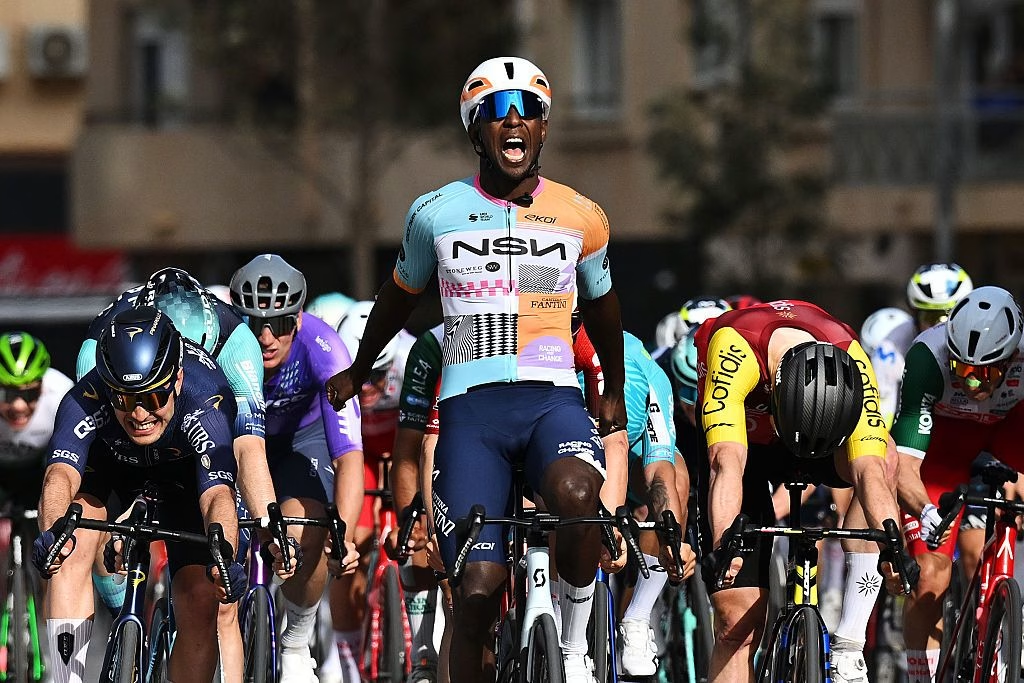
On flat roads, that power is a major advantage. In the final 200 metres, a top sprinter can produce more peak power than almost anyone else in the race. That is why riders like Jasper Philipsen, Tim Merlier, Olav Kooij, Arnaud De Lie, Biniam Girmay and Mads Pedersen can be so dangerous when the road and timing suit them.

On climbs, the calculation changes. Riders are not only fighting air resistance. They are fighting gravity. Every extra kilogram has to be carried uphill. A sprinter can still produce enormous power, but if they are heavier than a climber, they may need to produce much more just to climb at the same speed.

That is why power-to-weight ratio matters so much in the mountains. A sprinter may have a bigger engine in absolute terms, but a climber can often produce more power per kilogram for the duration of a long climb. Over one short ramp, a sprinter can cope. Over a full Alpine stage, the difference becomes brutal.

For the wider sprint field, see our best sprinters at the Tour de France 2026.

Peak power and climbing power are not the same thing

Sprint power is short, violent and explosive. Climbing power is sustained. That is a completely different demand.

A sprinter’s best weapon might last 10 to 20 seconds. Their job on a flat stage is to survive in the bunch, stay protected, then unleash one maximum effort at the finish. They need acceleration, positioning, timing and nerve.

A mountain stage asks them to hold hard but controlled efforts for far longer. A climb such as the Tourmalet, Galibier, Croix de Fer or Alpe d’Huez is not about one burst. It is about repeated threshold efforts, recovery between climbs, pacing, fuelling and staying inside the time cut.

That is why some sprinters can look strong on short hills but still suffer badly in the high mountains. A punchy climb of two or three minutes is not the same as a 40-minute ascent at altitude after four hours of racing.

The Tour exposes that difference. It does not ask whether a sprinter is fit. It asks whether they can repeat a climbing effort that does not match their physiology.

divThey-want-more-excitement-–-Tim-Merlier-laments-lack-of-sprint-opportunities-in-2026-Tour-de-Francediv-1Photo Credit: Getty

Why weight matters so much uphill

Climbing is partly about how much force a rider needs to move their body and bike against gravity. The steeper and longer the climb, the more costly extra weight becomes.

A sprinter’s muscle mass is useful when accelerating on flat roads, but in the mountains it becomes weight to carry. A climber may be much lighter, meaning they can climb at a high speed with less absolute power. A heavier sprinter might produce more watts but still go slower because those watts are spread across more kilograms.

This is why sprinters often try to arrive at the Tour as light as possible without losing their sprint. It is a delicate balance. Lose too much weight and they may lose the power that makes them fast. Carry too much and the mountains become harder.

Teams know this. A sprinter’s Tour preparation is not only about top speed. It is about surviving the mountain stages without weakening the sprint. That is a difficult compromise.

For pure climbers, the mountains are where they can win. For sprinters, they are often where they try not to lose the Tour before the next sprint chance arrives. For the climbing side of that contrast, see our best climbers at the Tour de France 2026.

The pace is set by riders with different goals

Sprinters do not suffer only because the climbs are hard. They suffer because the pace is being dictated by riders who want something completely different.

On flat stages, sprint teams often control the race. They set the speed, manage the breakaway and save their sprinters for the final kilometres. The whole rhythm of the stage is built around the sprinter’s needs.

In the mountains, that changes. GC teams take over. Climbing domestiques set hard tempo. Teams chasing the yellow jersey or stage win use the climbs to drop rivals. The pace is not designed to be survivable for sprinters. It is designed to create selection.

That means sprinters are often in trouble long before the final climb. The first major climb may already be ridden fast enough to split the peloton. The second climb may remove more riders. By the final climb, the sprinters are usually in a different race entirely.

Their aim is no longer to follow the favourites. It is to manage losses, find the gruppetto and finish inside the time limit.

For more on how team aims change the race, see our how Tour de France teams work and Tour de France 2026 domestiques who could decide the race.

CYCLING-TDF-2024-STAGE14Photo Credit: Getty

What is the gruppetto?

The gruppetto is the group of riders who form at the back of the race on mountain stages. It is usually made up of sprinters, lead-out riders, heavier domestiques and anyone else who cannot follow the climbing pace of the main contenders.

The gruppetto is not a casual group. It has a job: reach the finish inside the time cut while spending as little energy as possible. Riders cooperate because they all need the same outcome. They ride steadily, share pacing and avoid panic.

Experienced sprinters know how to ride in the gruppetto. They understand when to let the peloton go, how hard to ride on the climbs, when to recover on descents and how to calculate the time limit. A rider who tries to hang on too long with the favourites may explode and lose more time than if they had settled into the gruppetto earlier.

The gruppetto is one of the Tour’s hidden tactical worlds. It does not decide the yellow jersey, but it decides whether sprinters are still in the race when the next flat stage arrives.

What is the time cut?

The time cut is the maximum time a rider can lose on a stage and still remain in the Tour. If a rider finishes outside the time limit, they can be eliminated.

The time cut is based on the stage winner’s time, the difficulty of the stage and the speed of the race. Hard mountain stages usually allow more time than flat stages, but they are also much harder to complete. That means sprinters still have to ride properly. They cannot simply roll to the finish.

The time cut is why mountain days are so stressful for sprinters. They are not racing for the stage, but they are racing against elimination. A bad day, a crash, illness, heat, poor fuelling or a very fast stage can suddenly make survival difficult.

The danger is especially high when the favourites race hard from early in the stage. If the winner’s time is fast, the allowed finishing time can still be demanding. Sprinters then need the gruppetto to work efficiently.

The Tour occasionally allows discretion if a large group misses the cut in exceptional circumstances, but riders cannot depend on that. The safest approach is to beat the limit.

For a full breakdown, see our how Tour de France time cuts work. For more on how the broader standings work, see our how the Tour de France general classification works.

Chaos-and-calm-on-Mont-Ventoux-–-Reflections-from-the-Tour-de-France-1

Why mountain stages can end a sprinter’s Tour

A sprinter’s Tour can end in the mountains in several ways.

The obvious one is missing the time cut. If they finish too far behind the stage winner, their race can be over. That is the nightmare scenario for any sprinter still hoping for flat stages later in the race.

The second is fatigue. A sprinter might survive the stage but spend so much energy that they lose sharpness for the next sprint. Winning a bunch sprint requires freshness, confidence and timing. If a mountain block leaves a sprinter drained, they may still be in the race but no longer at full speed.

The third is illness or dehydration. Mountain stages can be hot, long and difficult to fuel. A rider who cannot eat or drink properly may fade quickly. Once the body is empty, even a moderate climb can feel impossible.

The fourth is crashes or mechanical issues. A sprinter already near the back has less margin for error. A puncture at the wrong time can make the time cut much harder.

This is why sprinters treat mountain stages as survival days. The goal is not glory. The goal is to still be in the Tour tomorrow.

The 2026 route is especially awkward for sprinters

The 2026 Tour route gives sprinters chances, but it also gives them plenty to survive.

The race begins with a team time-trial in Barcelona, then quickly moves into climbing terrain. Stage 2 finishes on Montjuïc, stage 3 heads towards Les Angles, and stage 6 goes to Gavarnie-Gèdre after serious Pyrenean climbing. That means sprinters have to deal with difficult terrain early, before the Tour has properly settled.

The middle of the race is not straightforward either. The Massif Central, Vosges and Jura create repeated hard days where pure sprinters may not be fighting for victory but still have to spend energy. These stages can be dangerous because they are not always labelled as the biggest mountain days, yet they still contain enough climbing to hurt.

Then comes the Alps. Orcières-Merlette, Plateau de Solaison and the double Alpe d’Huez finale will be survival tests for the fastest riders. By that point, the sprinters will have already raced for more than two weeks. The problem is not only climbing ability. It is climbing ability under fatigue.

For the hardest climbing days, see our Tour de France 2026 Alps guide, Tour de France 2026 summit finishes guide and Tour de France 2026 queen stage guide.

20220714TDF1009 Alpe d'Huez

Why sprinters still have to train for mountains

Modern sprinters cannot ignore climbing. The Tour is too hard and the time cuts are too important. Even the fastest sprinter in the race has to prepare for mountain survival.

That does not mean sprinters train like pure climbers. They still need speed, strength and sprint-specific work. But they also need enough aerobic base to get through long climbs, recover between efforts and handle repeated mountain stages.

Training for a Tour sprinter is therefore a compromise. They need to be light enough and fit enough to survive the mountains, but powerful enough to win on the flat. Too much climbing focus can blunt their sprint. Too much sprint focus can leave them exposed in the mountains.

The best sprinters find the balance. They may never enjoy the Alps, but they know how to get through them.

Mads Pedersen and Biniam Girmay are good examples of riders whose broader skill sets can help in a three-week race. They are not pure climbers, but they can handle harder terrain better than many traditional fast men. That can matter in the green jersey fight.

For more on how the points competition rewards more than raw speed, see our Tour de France 2026 jerseys explained.

Why green jersey contenders must survive the mountains

The green jersey is decided across the whole Tour, not only on the flat stages. That means a sprinter cannot win green if they leave the race in the mountains.

Survival is part of the points competition. A rider may win a sprint stage early in the Tour, but if they miss the time cut in the Alps, they cannot score in Paris. Meanwhile, a more durable rider can keep collecting points on intermediate sprints, hilly finishes and later flat stages.

This is why the green jersey often rewards more than pure speed. A rider who can sprint, climb respectably and recover well has a better chance across three weeks. That is especially true on routes where sprint chances are spread out and broken up by mountain blocks.

At the 2026 Tour, the points competition could be shaped by which sprinters are still fresh enough after the Pyrenees, Massif Central, Vosges, Jura and Alps. The fastest rider on stage 5 may not be the strongest by stage 21.

For more on the points battle, see our Tour de France 2026 sprinters guide: who can win green? and best sprinters at the Tour de France 2026.

Jasper Philipsen Stage 8 2025 Vuelta Espana SprintPhoto Credit: Getty

Why descents do not fully save sprinters

Some sprinters are excellent descenders. Heavier riders can also be fast downhill because gravity helps them accelerate. But descents do not cancel out the damage done on climbs.

First, a rider has to reach the top of the climb close enough to the time cut. If they are already losing too much time, descending well may not be enough.

Second, descents can be technical, dangerous and mentally draining. A tired sprinter descending at high speed after a long climb cannot relax. They still need concentration, skill and nerve.

Third, descending fast does not restore energy. It may reduce the time gap, but it does not refill glycogen, repair muscle damage or solve dehydration. The next climb may still be waiting.

Sprinters can use descents to manage their day, but they cannot rely on them to survive a mountain stage alone.

Why heat makes mountain stages worse

Heat can make mountain stages much harder for sprinters. Larger riders often produce and retain more heat, and long climbs reduce airflow compared with fast flat roads. That can make cooling more difficult.

When a sprinter overheats, power drops. They may struggle to eat, drink and recover. Dehydration can also increase the risk of cramps, fatigue and poor decision-making.

In July, the Tour can be brutally hot, especially on exposed climbs or long valley roads. A sprinter already fighting the gradient may also be fighting body temperature. Ice socks, cold drinks, open jerseys and careful hydration all become part of survival.

Heat also affects the gruppetto. If the group slows too much, the time cut becomes a threat. If it rides too hard, riders risk blowing up. Managing effort in hot conditions is one of the hardest parts of mountain survival.

For the wider physical challenge, see our how hard the Tour de France really is.

Jasper Philipsen Stage 1 2025 Tour de France

Why fuelling is difficult in the mountains

Sprinters need to keep eating and drinking on mountain stages, but that is not always easy.

The pace can be high early in the stage. Feed zones may come at awkward moments. Climbs can make it harder to eat solid food. Heat can reduce appetite. Descents require concentration, leaving fewer safe moments to reach for food.

If a sprinter under-fuels, the consequences can be severe. They may feel fine for the first climb, then suddenly collapse on the second or third. Once glycogen is low, every kilometre becomes harder.

This is why teams plan mountain fuelling carefully. Riders take gels, drinks, rice cakes, bars and bottles at specific points. Teammates may help collect food from the car. The aim is to avoid a crisis before it starts.

For sprinters, fuelling is not about preparing for a sprint finish on mountain days. It is about keeping the body working long enough to reach the finish.

Why some sprinters climb better than others

Not all sprinters suffer equally. Some are naturally better over hills and mountains than others.

A heavier pure sprinter with a very explosive profile may struggle badly on long climbs. A more versatile sprinter or classics-style fast rider may cope better because they have more endurance, better repeatability and a stronger aerobic base.

Riders like Mads Pedersen, Biniam Girmay and Michael Matthews can often survive harder terrain better than the purest flat-stage specialists. They may not climb with the GC favourites, but they can remain competitive on rolling stages and manage mountain days more effectively.

That difference matters in the Tour. A pure sprinter may be faster in a clean flat finish, but a more durable sprinter may score points on more days and arrive in the final week fresher.

The mountains therefore separate sprinters in two ways: who can survive, and who can still sprint well afterwards.

For the route days that suit different types of fast rider, see our Tour de France 2026 route: best days for sprinters and Tour de France 2026 sprint stages ranked.

Tour-Auvergne-Rhone-Alpes-stage-4-LIVE-Hilly-course-with-flat-finale-offers-up-chance-for-the-versatile-sprinters-1Photo Credit: Getty

How teams help sprinters survive

Sprinters rarely survive mountain stages completely alone. Their teams help them manage the day.

A teammate may stay with the sprinter in the gruppetto. Another may fetch bottles, offer encouragement or help pace the group. Lead-out riders often suffer too, but they know their sprinter’s survival protects future stage chances.

Teams also plan effort. A sprinter may be told exactly where to conserve energy, where to ride harder and where the gruppetto should form. Directors in the team car monitor time gaps and calculate the time cut.

This support matters. A sprinter who panics and rides alone can waste energy quickly. A sprinter inside an organised group has a much better chance of finishing inside the limit.

The mountain stage may not be a sprint team’s target, but it still requires teamwork.

For more on team roles, see our how Tour de France teams work and what is a domestique at the Tour de France?.

Why sprinters sometimes abandon in the mountains

Sprinters abandon in the mountains when the physical cost becomes too high, the time cut is impossible, or illness or injury makes continuing unrealistic.

Sometimes the decision is made by the road. A rider is dropped early, cannot recover and loses too much time. Sometimes it is a medical decision. A rider may be sick, dehydrated, injured from a crash or unable to produce enough power to continue safely.

Sometimes a sprinter stays in the race despite huge suffering because there are still sprint opportunities ahead. Other times, there may be no realistic reward left. If the rider is exhausted, far from form and unlikely to contest future stages, abandoning can become the sensible choice.

That is one of the harsh truths of the Tour. The mountains do not only decide the yellow jersey. They decide who gets to keep racing.

Why the mountains can shape the sprint stages that follow

A mountain stage can change the next sprint stage. A sprinter who survives easily may arrive with confidence. A sprinter who spent the day fighting the time cut may be flat, sore and mentally drained.

This affects lead-outs too. If a sprint team’s key helpers are exhausted from the mountains, the train may be weaker. A sprinter can be fast but still lose position if their team is tired.

Recovery is also cumulative. One hard mountain day can be manageable. A sequence of mountain and hilly stages can slowly drain riders. By the third week, the sprint hierarchy may look different from week one.

This is why experienced sprinters often talk about surviving the Tour as much as winning stages. The fastest rider in the first week is not always the fastest rider in the final week.

For more on recovery, see our how Tour de France riders recover between stages.

Why sprinters still enter a race full of mountains

Sprinters enter the Tour because the rewards are huge. A Tour de France stage win can define a career. The green jersey is one of cycling’s biggest prizes. The Paris finish is still one of the most prestigious sprint targets in the sport.

They also know the suffering is part of the job. A Tour sprinter does not expect the mountains to suit them. They expect to endure them so they can reach the stages that do.

There is pride in that. Watching a sprinter fight through the Alps in the gruppetto may not look as dramatic as a GC attack, but it is still one of the defining efforts of the Tour. They are racing a different battle, with different stakes.

The mountains are where sprinters lose comfort, speed and sometimes hope. But if they survive, they return to the flat roads with another chance to win.

Sprinters in the Tour mountains explained simply

Sprinters suffer in the Tour de France mountains because climbing rewards light, efficient riders who can sustain power for a long time. Sprinting rewards explosive riders who can produce huge power for a short burst. Those are different physical demands.

On flat stages, sprinters use power, positioning and lead-outs to win. In the mountains, they carry more muscle uphill, lose the aerodynamic advantage of the bunch, follow a pace set by climbers and fight the time cut instead of the stage victory.

Their aim is not to beat the climbers. It is to survive, recover and reach the next sprint chance.

That is why the mountains are so important to the sprint competition. The green jersey is not won only by being fast. It is won by being fast, durable and still in the race when the Tour reaches its final week.

For more Tour de France 2026 coverage, visit our Tour de France hub, beginner’s guide to Men’s Tour de France 2026 and how to watch Tour de France 2026 in the UK.

How do Tour de France teams work?

Tour de France teams work by building everything around a race plan. Each squad starts with eight riders, but those riders rarely have equal freedom. Some are leaders, some are sprinters, some are climbers, some are domestiques, some are road captains, and some are selected because they can do several jobs across three weeks.

The Tour de France is won by an individual rider, but it is almost never won alone. A yellow jersey contender needs teammates to protect them from wind, crashes, splits, hunger, mechanical problems and tactical traps. A sprinter needs a lead-out train. A breakaway specialist needs freedom. A young rider needs support and patience. Even riders who never appear in the results can be essential to how a team functions.

At the 2026 Tour de France, 23 teams are expected to start: 18 UCI WorldTeams and five UCI ProTeams. That means 184 riders if every team begins with a full eight-rider squad. The route, which starts with a team time-trial in Barcelona before moving quickly towards the Pyrenees, will immediately test team organisation rather than only individual strength.

For the full race context, see our Tour de France 2026 full route guide, Tour de France 2026 team-by-team guide and Tour de France 2026 route analysis.

20250727TDF1152 UAE Team Emirates Yellow Jersey

How many riders are on a Tour de France team?

Each Tour de France team starts with eight riders. Across 23 teams, that creates a full peloton of 184 riders at the start.

Those eight places have to cover every task the team wants to perform. That is why selection is so important. A squad built only around climbing may lack power on flat stages. A team built around a sprinter may not have enough mountain support. A team chasing breakaways may not be able to defend a GC position if the race changes.

A Tour team usually includes some mix of:

RoleMain job
GC leaderTargets the overall classification and yellow jersey
SprinterTargets flat stage wins and sometimes the green jersey
Climbing domestiqueSupports the leader in the mountains
Flat-road domestiqueProtects leaders, chases breaks and controls positioning
Lead-out riderGuides a sprinter into the final metres
Road captainMakes tactical calls inside the race
Breakaway riderChases stage wins from attacks
All-rounderCovers several roles depending on the stage

Some riders fit more than one category. The best Tour squads are not just collections of strong riders. They are balanced teams with clear jobs.

For the confirmed selection picture, see our full start list for Tour de France 2026.

Why do teams matter in an individual race?

The Tour de France is officially an individual race for the yellow jersey, but the race is shaped by teams every day.

A GC leader cannot fetch every bottle, close every gap, chase every attack, position themselves before every climb and still win the Tour. A sprinter cannot control a flat stage alone. A climber cannot survive crosswinds without help. Even the best rider in the race needs teammates to reduce the number of problems they have to solve.

Teams matter because cycling is tactical and aerodynamic. Riding behind another rider saves energy. Being placed near the front reduces crash risk. Having teammates around you means someone can give you food, lend a wheel, chase a break, set the pace, or calm the race down.

That is why a Tour winner often looks protected for most of the day. Their teammates are spending energy so the leader does not have to.

For a deeper look at that overall race battle, see our how the Tour de France general classification works and Tour de France 2026 GC favourites ranked.

What is a team leader?

A team leader is the rider the squad is built around. In the Tour de France, that usually means a GC contender or a sprinter, but some teams can have different leaders for different objectives.

A GC leader targets the general classification. Their aim is to finish the whole Tour in the lowest possible time. The team protects them on flat stages, supports them in the mountains and organises the race around keeping them safe.

A sprint leader targets stage wins and sometimes the green jersey. Their team works to control flat stages, bring back breakaways and deliver them into the final few hundred metres in the best possible position.

Some teams have one clear leader. Others arrive with shared leadership. That can be useful if the race goes badly for one rider, but it can also create tactical tension. If two riders need support at the same moment, the team has to choose.

The best teams know exactly who they are riding for before the race starts.

What is a domestique?

A domestique is a rider whose main job is to work for someone else. The word comes from French and is central to how Tour de France teams operate.

A domestique might ride on the front of the peloton to control the pace. They might fetch bottles from the team car. They might drop back to help a leader after a mechanical problem. They might guide a sprinter through the final kilometres. They might set a hard tempo on a climb until they have nothing left.

Domestiques often finish far behind the leaders because they have already done their job. Their value is not always visible in the results sheet. A rider who finishes 80th on a mountain stage may have been one of the most important riders in the race if they protected their leader for the first 170km.

Different domestiques have different specialisms. Some are powerful flat-road riders. Some are climbers. Some are lead-out riders. Some are experienced road captains who keep the team organised.

For more on this role, see our what is a domestique at the Tour de France? and Tour de France 2026 domestiques who could decide the race.

Remco-Evenepoel-loses-key-World-Championships-road-captain-as-Tiesj-Benoot-tests-positive-for-COVID-19-1

What does a road captain do?

A road captain is an experienced rider who helps direct the team during the race. They are not always the strongest rider, but they are often one of the most trusted.

The road captain reads the race from inside the peloton. They know when to move up, when to stay calm, when to chase, when to let a break go and when the team leader needs support. They also communicate with riders around them and help translate instructions from the team car into practical action.

Race radios are important, but they do not replace judgement. A directeur sportif in the car can see television pictures and time gaps, but a road captain can feel the wind, see the road narrowing, sense nervousness in the bunch and understand when the peloton is about to split.

On chaotic Tour stages, the road captain can be the difference between a team looking controlled and a team looking scattered.

How do Tour de France teams choose their riders?

Teams choose riders based on objectives. The first question is usually: what are we trying to achieve?

A team targeting yellow will select riders who protect a GC leader. That usually means strong climbers, experienced flat-road protectors, time-trial support and riders who can stay calm under pressure.

A sprint team will select lead-out riders, powerful rouleurs and riders who can chase breakaways. The whole squad may be built around giving one fast finisher a handful of chances.

A team without a realistic GC or sprint favourite may select aggressive riders for breakaways. That can be a smart Tour strategy because stage wins, television exposure and mountain points can all come from attacking.

Some teams try to do several things at once. They might bring a GC leader, a sprinter and a stage hunter. That gives options, but also creates trade-offs. With only eight riders, every selection means leaving someone else at home.

For the 2026 race, see our full start list for Tour de France 2026 and Tour de France 2026 team-by-team guide.

divA-season-delaying-crash-a-coach-break-up-and-losing-key-teammates-–-Has-Jonas-Vingegaards-2026-Tour-de-France-bid-gone-wrong-before-its-even-starteddiv

What are the main types of Tour de France team?

Not every team arrives with the same aim. Broadly, Tour squads fall into a few categories.

Team typeMain objectiveWhat they need
GC teamWin or place high overallClimbing support, road captains, time-trial strength
Sprint teamWin flat stages or green jerseyLead-out train, rouleurs, chase power
Breakaway teamWin stages from attacksAggressive riders, tactical freedom, endurance
Mountains teamChase climbing stages or polka-dot jerseyClimbers, opportunists, recovery
Development teamBuild experience around young ridersProtection, patience, flexible goals
Mixed teamCombine GC, sprint and stage aimsBalance and clear priorities

The strongest teams can cover several aims at once, but the Tour often exposes unclear planning. If a team says it wants everything, it may end up fully committing to nothing.

That is especially true on a route like the 2026 Tour, where the opening team time-trial, early mountains, sprint stages and final Alpine block all ask different questions.

For a wider view of how squads may balance those aims, see our Tour de France 2026 team-by-team guide.

How does a GC team work?

A GC team works by protecting its leader from time loss. That starts on stage 1 and continues until Paris.

On flat stages, the team keeps the leader near the front but out of the wind. That reduces crash risk and avoids splits. In crosswinds, teammates form part of the shield around the leader. Before climbs, they position the leader near the front so they do not waste energy moving up.

In the mountains, climbing domestiques set pace, discourage attacks and stay with the leader as long as possible. Sometimes they ride hard to weaken rivals. Sometimes they ride steady to protect their own leader. Sometimes they chase. Sometimes they wait if the leader has a problem.

A GC team also controls emotion. Leaders can panic if they are isolated, badly positioned or forced to respond to every attack. A strong team gives them structure and calm.

At the 2026 Tour, the GC teams will be tested immediately by the Barcelona team time-trial. A strong squad can give its leader a good start. A weaker one can leave them chasing from day one. For more, see our Tour de France 2026 team time-trial explained and how the stage 1 team time-trial could change the Tour de France 2026.

Even-without-a-final-kilometre-lead-out-fastest-in-the-world-Lorena-Wiebes-finds-a-way-to-win-at-the-Tour-de-France-Femmes-1

How does a sprint team work?

A sprint team works by controlling flat stages and delivering its sprinter to the finish. That is harder than it looks.

First, the team helps manage the breakaway. If a small group attacks early, sprint teams may allow it to go but keep the time gap under control. They do not want to catch the break too early, because that invites more attacks. They also cannot leave it too late, or the sprinter loses the chance to win.

In the final kilometres, the lead-out train takes over. Riders line up in front of the sprinter, keeping speed high and guiding them through the chaos. Each lead-out rider does a short effort, then swings away. The final lead-out rider tries to drop the sprinter into the perfect launch position.

A sprint team needs power, timing and trust. If the train goes too early, the sprinter is exposed. If it goes too late, they may be boxed in. If one rider loses position, the whole plan can collapse.

For the 2026 sprint picture, see our Tour de France 2026 sprint stages ranked and best sprinters at the Tour de France 2026.

How does a breakaway team work?

A breakaway team works by creating opportunities rather than controlling the race. These teams may not have a rider capable of winning the Tour or dominating bunch sprints, so they race aggressively.

A breakaway rider attacks early, hoping to join the right move. The team then decides whether to place more riders in the break, protect the rider in front, disrupt the chase behind or save energy for another day.

Breakaway racing is tactical. The strongest rider does not always win. A rider needs timing, endurance, nerve and the ability to cooperate with rivals before attacking them later.

For smaller teams, breakaways are also important because they give sponsor visibility. Hours at the front of the Tour can be valuable even if the stage win does not arrive.

The 2026 route should offer several breakaway chances, especially on hilly stages, transitional days and mountain stages where GC teams may not want to chase all day. For more, see our Tour de France 2026 route: best days for breakaways and Tour de France 2026 breakaway stages ranked.

Red Bull Bora Hansgrohe Team Car

What does the team car do?

The team car is the mobile control centre. It carries spare bikes, wheels, food, drink, clothing, radios, medical supplies and the directeur sportif.

The directeur sportif, often shortened to DS, gives instructions from the car. They receive information from race radio, television images, time gaps and team staff. They then tell riders when to chase, when to wait, when to eat, where the danger points are and what the tactical plan should be.

The car also provides mechanical support. If a rider punctures or crashes, the team car can supply a spare wheel or bike. If the leader has a problem, teammates may drop back to help while the car moves up when allowed.

Position in the convoy matters. The higher a team’s best rider is on GC, the better its car position usually is. That can be important because a car closer to the front can reach riders more quickly after mechanical problems.

The team car cannot solve everything, but it is essential to how the race is managed.

What do team staff do?

A Tour de France team is much bigger than the eight riders on the start line. Behind them is a travelling operation of directors, coaches, mechanics, soigneurs, doctors, chefs, nutritionists, press officers and logistics staff.

Mechanics prepare bikes, wheels, tyres and spare equipment. Soigneurs look after food, drinks, massage, laundry and rider care. Doctors manage illness, crashes and medical checks. Chefs and nutritionists help riders refuel properly. Directors plan tactics. Press staff handle media. Logistics staff make sure bags, hotels, transfers and vehicles work.

This matters because the Tour is three weeks long. A rider’s performance depends on sleep, food, equipment, recovery, confidence and routine. Teams that manage the small details well can save energy every day.

For more on the recovery side, see our how Tour de France riders recover between stages.

78th Tour Auvergne-Rhone-Alpes 2026 - Stage 3

How does the team time-trial show team strength?

A team time-trial is the clearest example of a Tour team functioning as a single unit. Riders take turns on the front, then move aside and recover in the slipstream. The aim is to keep the group fast, smooth and organised.

The strongest individual rider cannot win a team time-trial alone. If they ride too hard, teammates are dropped. If the team goes too slowly, time is lost. The best squads balance power and cohesion.

The 2026 Tour starts with a team time-trial in Barcelona, which means team strength will be visible from the first day. GC leaders with powerful squads can gain time immediately. Leaders with weaker support may start the Tour under pressure before the road has even climbed properly.

That is why the opening stage is more than a spectacle. It is a team audit. For more detail, see our Tour de France 2026 team time-trial explained and best time-triallists at the Tour de France 2026.

What happens if a team leader crashes?

If a team leader crashes, the team reacts immediately. Nearby teammates may stop or slow down to help them return to the peloton. One rider might give up a wheel or bike. Others might pace the leader back. The team car provides mechanical or medical support when possible.

The response depends on the stage and situation. If the crash happens early, the team may be able to recover calmly. If it happens in crosswinds or near the finish, the damage can be much greater. If the leader is injured, the team may have to change its entire Tour plan.

Sometimes a team will switch objectives after a leader crashes. A squad that came for GC may start chasing stages. A domestique may get more freedom. A sprinter may become the main focus. The Tour forces teams to adapt quickly.

This is one reason teams bring riders with flexible skill sets. A Plan B can save a race.

2026 Giro d'Italia PelotonPhoto Credit: RCS

How do teams control the peloton?

Teams control the peloton by riding on the front. This sets the speed, manages gaps and influences how difficult the stage becomes.

A sprint team may ride steadily for hours to keep a breakaway close. A GC team may set a hard pace in the mountains to weaken rivals. A team defending yellow may chase dangerous riders but ignore harmless ones. A team trying to split the race in crosswinds may suddenly accelerate.

Control is not just about strength. It is also about judgement. Chasing too hard too early wastes energy. Waiting too long can lose the race. Letting the wrong rider into a breakaway can create a tactical problem.

The best teams control without appearing desperate. They make the race feel predictable for their leader and uncomfortable for everyone else.

Why do teams sometimes let breakaways go?

Teams let breakaways go because chasing everything is impossible. The Tour is too long to control every attack.

If a breakaway contains riders who are far behind on GC, the yellow jersey team may allow it to build a lead. That gives the breakaway a chance at the stage while the peloton saves energy.

Sprint teams think differently. On flat stages, they often want to bring the break back before the finish. But even then, they may allow a small break to go early because it makes the stage easier to control. A predictable breakaway of three or four riders is often less dangerous than constant attacks.

GC teams may also prefer a breakaway to take bonus seconds at the finish. If the break wins the stage, rival GC riders cannot gain stage-win bonuses. That can be tactically useful.

Breakaways are therefore not just attacks. They are part of the negotiation between teams.

COPENHAGEN, DENMARK - JUNE 22: Jordi Meeus of Belgium and Team Red Bull - BORA - hansgrohe (C) celebrates at finish line as race winner ahead of (L-R) Arnaud Demare of France and Team Arkea - B&B Hotels, Alexis Renard of France and Team Cofidis, Phil Bauhaus of Germany and Team Bahrain - Victorious and Dylan Groenewegen of Netherlands and Team Jayco AlUla during the 1st Copenhagen Sprint 2025 - Men's Elite a 235.6km one day race from Roskilde to Copenhagen / #UCIWT / on June 22, 2025 in Copenhagen, Denmark. (Photo by Szymon Gruchalski/Getty Images)

What is a lead-out train?

A lead-out train is a line of teammates working for a sprinter in the final kilometres. The aim is to keep speed high, hold position and launch the sprinter at the right moment.

The first riders in the train handle positioning and speed. Later riders guide the sprinter through the final bends and road furniture. The final lead-out rider makes the last effort before the sprinter launches.

A good lead-out train reduces chaos. It gives the sprinter a path through the bunch. It also stops rival teams from taking the best position.

The timing is delicate. Launch too early and the sprinter fades. Launch too late and they may never find space. That is why the relationship between sprinter and lead-out rider is one of the most important partnerships in cycling.

For the green jersey and sprint context, see our Tour de France 2026 sprinters guide: who can win green? and Tour de France 2026 route: best days for sprinters.

What is a mountain train?

A mountain train is a group of teammates setting a hard pace on a climb for their leader. It is most often used by GC teams.

The aim can vary. Sometimes the team wants to discourage attacks by making the pace too high. Sometimes it wants to weaken rivals before the leader attacks. Sometimes it wants to protect a leader who is strong but not explosive. Sometimes it is simply about keeping the race under control.

A mountain train works best when the team has several strong climbers. Each rider sets tempo until they are finished, then drops away. The leader stays protected until the final selection.

The tactic can look defensive, but it can also be brutal. A high mountain pace can slowly remove domestiques, reduce the group and expose rival leaders.

At the 2026 Tour, mountain support will matter through the Pyrenees, Massif Central, Vosges, Jura and Alps. For more on the hardest stages, see our Tour de France 2026 mountain stages ranked by difficulty and Tour de France 2026 Alps guide.

Radio pack back

How do teams use race radios?

Race radios allow riders and team cars to communicate during the stage. Directors can warn riders about corners, climbs, wind, crashes, time gaps and tactical changes. Riders can report how they feel, ask for food, request mechanical help or say when a leader is struggling.

Radios make the race more controlled, but they do not remove instinct. A rider still has to make fast decisions in the peloton. The team car may not see everything, and instructions can arrive too late if the race changes suddenly.

Road captains are important because they combine radio instructions with what is happening inside the bunch. They can tell teammates when to move, when to stay calm and when the race is about to become dangerous.

The Tour is too chaotic to be run only from a car. Radios help, but riders still have to read the race.

What is the team classification?

The team classification is a separate competition based on team times. It is not as famous as the yellow, green, polka-dot or white jerseys, but it rewards collective consistency.

The calculation is based on the times of a team’s best riders on each stage. Over the race, those times are added together to create the team standings.

Some teams care about it more than others. A squad without a stage win or GC podium may use the team classification as a target. For others, it is a secondary reward that follows naturally from having several riders high on GC.

The team classification is useful because it shows depth. A team with several strong riders across mountain stages and hard days can rank well even if it does not win the yellow jersey.

For fans, though, it is still secondary to the main individual competitions. The yellow jersey remains the central prize. For the full jersey breakdown, see our Tour de France 2026 jerseys explained.

CYCLING-TDF-2024-STAGE14Photo Credit: Getty

What happens when a team loses riders?

If a rider abandons the Tour, their team continues with fewer riders. They cannot be replaced. That can seriously affect race tactics.

A GC leader who loses a climbing domestique may be isolated earlier in the mountains. A sprinter who loses a lead-out rider may struggle to position properly. A breakaway-focused team may lose one of its main attacking options.

This is why teams try to protect every rider, not just the leader. The eighth rider on the squad may become crucial in the final week if injuries, illness or fatigue reduce the team’s options.

A Tour team that starts strong can look very different by the third week. Depth matters because the race gradually removes choices.

Why do teammates drop back for bottles?

Riders need food and drink constantly during the Tour. They cannot all go back to the team car whenever they want, so domestiques often collect bottles and bring them forward.

This is called a bottle run. A rider drops back through the convoy, collects bottles from the car, stuffs them into jersey pockets and carries them back to teammates.

It looks simple, but it costs energy. Moving from the front of the peloton to the cars and back again takes effort, especially in wind or on rolling roads. A domestique may do this many times in a stage.

Bottle runs are one of the clearest examples of invisible team work. The leader stays protected near the front because someone else is doing the tiring job behind.

divI-was-breaking-power-records-left-right-and-centre-last-year-and-still-not-winning-–-Adam-Yates-on-the-harsh-reality-of-keeping-up-in-modern-cyclings-constantly-improving-pelotondiv

How do teams decide tactics during a stage?

Tactics are decided before the stage, then adjusted constantly once the race begins.

Before the start, the team discusses the route, wind, climbs, feed zones, danger points, rivals and objectives. Riders are told who protects the leader, who covers attacks, who fetches bottles and who saves energy for later.

Once the stage starts, the plan can change. A dangerous breakaway may force a chase. A crash may remove a key rider. A rival may attack earlier than expected. Wind may split the peloton. A leader may feel worse than planned.

Good teams adapt without panic. They know the ideal plan but also have alternatives. The Tour rewards squads that can make fast decisions under pressure.

Can one team dominate the Tour?

Yes, but domination is harder than it looks. A team with the strongest leader and the strongest support can control large parts of the race. They can defend yellow, set pace in the mountains and make rivals feel trapped.

But the Tour is long. Crashes, illness, heat, bad days, tactics and fatigue can change everything. A team that looks unbeatable in week one can be exposed in week three.

Modern Tour racing is also more aggressive. Rivals are often willing to attack earlier, use satellite riders, exploit crosswinds or race hard on medium mountain stages. That makes complete control difficult.

The strongest team is not always the one with the biggest names. It is the one that can match its riders to the route and keep functioning when the race becomes chaotic.

For more on the scale of the challenge, see our explainer on how hard the Tour de France really is.

How the 2026 route could shape team tactics

The 2026 Tour route makes team structure especially important.

Stage 1 is a team time-trial, so collective strength matters immediately. The early Pyrenean stages mean GC teams cannot hide weak climbing support. The flat stages give sprint teams chances, but they will need chase power and lead-outs. The Massif Central, Vosges and Jura create breakaway and ambush opportunities. The final Alps demand deep mountain support.

That means teams will have to make hard selection choices. A squad with a sprinter may still need enough climbers to survive the final week. A GC team may still need powerful rouleurs for Barcelona and flat-stage positioning. A breakaway team may need riders who can handle repeated hard stages rather than one-day specialists.

The route rewards complete squads. It punishes teams built too narrowly.

For the key 2026 terrain, see our Tour de France 2026 Pyrenees guide, Tour de France 2026 Massif Central guide and Tour de France 2026 Vosges and Jura guide.

Tour de France teams explained in simple terms

The easiest way to understand Tour de France teams is this: one rider may get the result, but the whole team creates the chance.

A leader needs protection. A sprinter needs a lead-out. A climber needs support in the mountains. A breakaway rider needs freedom. A domestique may sacrifice their own result completely so someone else can win.

That is what makes the Tour different from many other sports. The winner stands alone on the podium, but behind that win are teammates who controlled the peloton, fetched bottles, closed gaps, gave shelter, chased attacks, set pace and made the race manageable.

The Tour de France is an individual race built on collective work. Understanding the teams is the key to understanding why the race unfolds the way it does.

For more Tour de France 2026 coverage, visit our Tour de France hub, beginner’s guide to Men’s Tour de France 2026 and how to watch Tour de France 2026 in the UK.

How does the Tour de France general classification work?

The Tour de France general classification is the competition to decide the overall winner of the race. It is usually called the GC, short for general classification, and it is based on time rather than points. The rider with the lowest total time after all 21 stages wins the Tour de France and wears the yellow jersey.

That sounds simple, but the GC is the most important and most complex part of the Tour. Every climb, time trial, crash, split, bonus second and team tactic can change the standings. A rider does not need to win the most stages to win the Tour. They need to complete the whole race in less accumulated time than everyone else.

At the 2026 Tour de France, that will mean surviving a route that starts with a team time-trial in Barcelona, climbs early in the Pyrenees, crosses the Massif Central, heads through the Vosges and Jura, then finishes with a brutal Alpine block including back-to-back Alpe d’Huez stages. The GC riders will have to be consistent from the opening weekend to Paris.

For the broader race picture, see our Tour de France 2026 full route guide, Tour de France 2026 route analysis and Tour de France 2026 GC favourites ranked.

Tadej Pogacar Yellow Jersey 2025Photo Credit: A.S.O./Billy Ceusters

What is the general classification?

The general classification is the overall standings in the Tour de France. After every stage, each rider’s time is added to their total. The rider with the lowest total time leads the race.

That leader wears the yellow jersey. If the race ended that day, they would be the Tour winner. Because the Tour lasts three weeks, the yellow jersey can change hands several times before the final result is decided.

A rider can lead the GC without winning a stage. They can also win multiple stages and still not be close to the overall lead. Sprinters may win flat stages, climbers may win mountain stages and breakaway riders may take spectacular victories, but the GC is about the full race.

The Tour de France winner is therefore not necessarily the rider who looks best on one day. It is the rider who loses the least time across every stage.

How is GC time calculated?

At the end of each stage, every rider receives a finishing time. That time is added to their previous total.

For example, if a rider takes 4 hours on stage 1, 5 hours on stage 2 and 3 hours 30 minutes on stage 3, their total time is 12 hours 30 minutes. The same calculation is made for every rider across the race.

The GC standings are then ordered by total time. The smallest number leads.

RiderStage 1Stage 2Stage 3Total time
Rider A4:00:005:00:003:30:0012:30:00
Rider B4:00:104:59:503:30:2012:30:20
Rider C4:01:005:00:303:29:0012:30:30

In that example, Rider A leads the general classification by 20 seconds over Rider B and 30 seconds over Rider C.

This is why small time gaps matter. A few seconds lost in a time trial or on a climb can still be important two weeks later.

divIf-youre-going-to-dream-you-might-as-well-dream-big-Ben-Healy-and-EF-Education-EasyPost-aim-high-as-they-defend-Tour-de-France-yellow-jerseydiv-1Photo Credit: Getty

Why is the yellow jersey so important?

The yellow jersey is the symbol of the Tour de France leader. It is worn by the rider leading the general classification after each stage.

The jersey carries sporting, historical and psychological weight. It tells the peloton who is currently winning the race. It also changes how that rider’s team has to race. A team defending yellow may need to control breakaways, position their leader, chase dangerous moves and protect them from crashes or crosswinds.

Wearing yellow can be motivating, but it can also be costly. The leader’s team has more responsibility, more media attention and less tactical freedom. Sometimes a team may even prefer not to take the yellow jersey too early if it means burning energy for several weeks.

By Paris, though, the aim is simple. The rider in yellow after the final stage wins the Tour de France.

For the jersey hierarchy, see our Tour de France 2026 jerseys explained.

How do riders gain time in the Tour de France?

GC riders gain time by finishing ahead of their rivals. That usually happens in four main ways:

SituationHow time is gained
Mountain stagesA rider attacks or drops rivals on a climb
Time trialsA rider completes the course faster than rivals
Team time-trialsA rider benefits from a faster team performance
Splits, crashes or crosswindsRivals lose contact before the finish

The biggest gaps usually come in the mountains and time trials. A rider can lose minutes on a bad climbing day, while a strong time-triallist can take time on flatter solo efforts.

Smaller gaps can come from stage finishes, late attacks, bonus seconds or bunch splits. These may look minor, but the Tour can be decided by less than a minute.

The best GC riders therefore have to be alert every day. They cannot only focus on the famous climbs. Flat stages, windy roads, technical finishes and team time-trials can all change the general classification.

divTour-de-France-stage-18-LIVE-A-battle-for-the-yellow-jersey-on-the-Tours-savage-Queen-stagediv-1

What are time gaps?

A time gap is the difference between riders at the finish. If one rider finishes 20 seconds ahead of another, that 20 seconds is added to the second rider’s GC deficit.

Time gaps can be created naturally, as riders finish apart on climbs or after attacks. They can also appear when the peloton splits into different groups.

On flat stages, large groups often receive the same time if they finish together. That is why a sprinter can win a stage while the GC riders behind them all keep the same general classification time. But if a split opens in the final kilometres and the officials record a gap, riders behind that split can lose time.

This is why GC teams fight for position even on sprint stages. They may not care about the stage win, but they care deeply about avoiding the wrong side of a split.

For the stages where that could matter in 2026, see our Tour de France 2026 route: best days for GC attacks.

What are bonus seconds?

Bonus seconds are time rewards taken off a rider’s GC total. At the Tour de France, stage-finish bonuses are usually awarded to the first three riders on most road stages. In 2026, the official route states that the first three finishers will receive 10, 6 and 4 seconds respectively.

That means a rider who wins a stage does not only gain any time gap they create on the road. They can also gain 10 bonus seconds. Second place receives 6 seconds, third place receives 4 seconds.

For example, if two GC riders finish together but one wins the stage and the other finishes fourth, the winner can still gain 10 seconds overall through bonuses.

Bonus seconds are especially important on punchy stages and summit finishes. Riders who are explosive enough to win stages can slowly build an advantage even without creating big gaps. That is one reason riders like Tadej Pogačar are so dangerous in the Tour. They can gain time through attacks, stage wins and bonuses.

Tour-de-France-2025-stage-5-preview-Caen-time-trial-brings-GC-battle-between-Pogacar-Vingegaard-and-Evenepoel-into-spotlight

How do time trials affect the GC?

Time trials are one of the clearest GC tests because riders cannot hide behind teammates for most of the effort. In an individual time trial, each rider races alone against the clock. The faster rider gains the exact time difference over slower rivals.

A strong time-triallist can gain a lot of time even if they are not the best climber. A weaker time-triallist can ride well in the mountains but still lose serious ground against more complete GC contenders.

The 2026 Tour includes time-trial pressure from the start because stage 1 is a team time-trial in Barcelona. There is also an individual time-trial later in the race. That means the GC will not be decided only by climbing.

The best Tour contenders now need to limit losses or gain time against the clock. A pure climber who cannot time-trial well starts with a major disadvantage.

For more on that opening test, see our Tour de France 2026 team time-trial explained and best time-triallists at the Tour de France 2026.

How does the team time-trial affect the GC?

A team time-trial is different from an individual time trial because riders race together in their trade teams. They take turns on the front, shelter each other from the wind and try to keep the group moving as fast as possible.

In the 2026 Tour, the opening stage in Barcelona gives the team time-trial extra importance. It can put time between GC contenders before the race has even reached the mountains.

A strong team can protect its leader and start the Tour with an advantage. A weaker team can leave its leader chasing from day one. That can change tactics immediately. A rider who loses time in Barcelona may have to attack earlier in the race, while a rider who gains time can ride more defensively.

Team time-trials also test organisation. It is not enough to have one strong leader. The whole squad needs power, timing and discipline. If riders are dropped too early or the formation breaks down, the leader can lose time before the decisive climbs arrive.

For the race-specific implications, see our how the stage 1 team time-trial could change the Tour de France 2026.

2025 TDF Tadej Pogacar MontmartrePhoto Credit: A.S.O./Bastien Séon

Why do mountains matter so much for GC?

Mountains are where the Tour de France usually creates its biggest GC gaps. Climbs expose differences in power, weight, endurance, recovery and team support. A rider who looks comfortable on flat roads can lose minutes on a long Alpine climb.

Mountain stages matter because drafting helps less when the gradient is steep. On flat roads, a rider can save energy by sitting behind teammates. On climbs, the speed is lower and the strongest riders are harder to hide from. If a leader cannot follow the pace, they lose contact.

The 2026 Tour has several major mountain tests. The early Pyrenees will test riders quickly, the Massif Central adds mid-race difficulty, and the final Alpine block includes Orcières-Merlette and two stages finishing on Alpe d’Huez.

That final week could decide the race. A rider may survive the opening two weeks in contention, then lose everything if they crack in the Alps.

For the key climbing days, see our Tour de France 2026 mountain stages ranked by difficulty, Tour de France 2026 summit finishes guide and Tour de France 2026 queen stage guide.

What is a GC contender?

A GC contender is a rider who can realistically compete for the overall victory, podium or high overall placing. They are usually strong climbers, good time-triallists or all-rounders who can survive every type of stage.

A GC contender needs more than one standout ability. They must climb well, avoid crashes, recover every day, handle pressure, time-trial strongly, follow attacks, descend safely and rely on a strong team.

Modern Tour contenders are especially complete. Riders like Tadej Pogačar, Jonas Vingegaard and Remco Evenepoel can shape the race in different ways. Pogačar can attack explosively and take bonus seconds. Vingegaard is one of the best pure mountain GC riders. Evenepoel brings major time-trial strength and long-range power.

Other riders may aim for the podium, top five, top 10, white jersey or stage wins if GC slips away. Not every protected rider is racing to win the Tour. Some are trying to build a strong general classification position over three weeks.

For more on the main names, see our Tour de France 2026 GC favourites ranked, Tadej Pogačar at the Tour de France 2026 and Jonas Vingegaard at the Tour de France 2026.

20250724TDF2141 Tadej Pogacar yellow jerseyPhoto Credit: A.S.O./Billy Ceusters

What does a GC team do?

A GC team exists to protect its leader. That means more than riding near the front on mountain stages.

On flat stages, teammates keep the leader safe from crashes, wind and splits. In crosswinds, they help position them before the race breaks apart. In the mountains, climbing domestiques set the pace, chase attacks or stay with the leader until the final kilometres. In time trials, staff and equipment choices become part of the GC plan.

A good GC team can make the race feel controlled. It can discourage attacks, bring back dangerous moves and keep its leader calm. A weak team forces the leader to spend more energy solving problems alone.

That is why the Tour is often described as an individual race won by a team. Only one rider wins the yellow jersey, but they rarely do it without a full squad built around them.

For more on team roles, see our Tour de France 2026 team-by-team guide, Tour de France 2026 domestiques who could decide the race and what is a domestique at the Tour de France?.

Why do GC riders stay near the front?

GC riders stay near the front because danger usually starts before the television pictures make it obvious. Crashes, road furniture, narrow roads, roundabouts, wind, corners and technical finishes can all split the peloton.

Being near the front reduces the risk of being caught behind a crash or split. It also means a team can react quickly if another GC squad accelerates.

This is why flat stages are often more stressful than they look. A casual viewer might see a sprint day and assume the GC riders are relaxing. In reality, their teams may spend hours fighting for position to avoid losing time.

A Tour contender can lose the race without being dropped by another climber. They can lose it by being badly positioned when the peloton splits, by crashing in the wrong place or by wasting energy all day trying to move back up.

divThere-have-been-some-good-ups-this-year-but-mostly-a-lot-of-downs-–-Jasper-Philipsen-reflects-on-opportunities-missed-after-Tour-de-France-crashdiv-1

What is the 3km or 5km rule?

The Tour uses specific rules to protect riders from losing GC time because of crashes or mechanical problems near the finish on certain stages. Traditionally, many flat stages have used a 3km rule, where riders caught by a crash or mechanical issue inside the final 3km can be given the same time as the group they were in.

In recent Tours, that protection has been extended to 5km on selected stages. The exact application depends on the stage and the race regulations. It is not a blanket rule for every finish, and it does not usually apply in the same way on summit finishes or stages where the final climb is part of the selection.

The principle is important: the Tour tries to stop GC riders losing time purely because of unavoidable chaos in sprint finales. That does not remove the need for positioning, but it can reduce the damage from late crashes.

For fans, the key point is to wait for official results. A rider may cross the line behind after a crash, but the jury may still award them the same time as their previous group if the rule applies.

What is the time cut?

The time cut is the maximum time a rider is allowed to lose on a stage and still remain in the race. It is mainly relevant to sprinters, domestiques and injured riders on very hard mountain days.

The time cut is calculated as a percentage of the stage winner’s time. The exact percentage depends on the type and difficulty of the stage and the speed at which it is raced. Harder stages usually allow a bigger percentage than easier stages.

A rider who finishes outside the time cut can be eliminated. In rare cases, the race jury can reinstate riders if a large group misses the cut because of exceptional circumstances, but riders cannot rely on that.

The time cut affects GC indirectly. A leader will not usually be close to missing it, but their teammates might be. If key domestiques are eliminated, the leader’s support weakens for the rest of the race.

It also shapes how sprinters ride mountain stages. They may form a gruppetto, a group of riders working together to reach the finish inside the limit while saving as much energy as possible.

divIve-struggled-the-last-few-years-–-New-approach-and-Classics-style-racing-see-Mathieu-van-der-Poel-back-in-Tour-de-France-yellow-jerseydivPhoto Credit: Getty

How do rest days affect the GC?

Rest days do not count directly towards the general classification because there is no stage time to add. But they can still affect the race.

Some riders recover well and feel better after a rest day. Others struggle when the rhythm changes. The stage after a rest day can sometimes produce surprises because not every body responds the same way.

Rest days also give teams time to reassess tactics. A rider who was defending might decide to attack. A rider who looked strong might be hiding fatigue. A team may change priorities if a leader has lost too much time.

In the 2026 Tour, the rest days come before important blocks of racing. The way riders recover before the Massif Central, Vosges, Jura and Alps could shape the final GC.

For more on recovery between stages, see our how Tour de France riders recover between stages.

Can a rider lose the Tour on a flat stage?

Yes. Flat stages may not usually create huge gaps between the main GC riders, but they can still be dangerous.

A crash can injure a contender. Crosswinds can split the peloton. Poor positioning can leave a rider trapped behind a gap. A mechanical problem at the wrong moment can cost time. Even if no time is lost, the stress and effort of a chaotic flat stage can affect recovery for the next day.

This is why GC teams work hard on stages that look simple on paper. They know the Tour can be lost anywhere.

Flat stages are also important because they are often the days when GC riders want to save energy. If they are forced to chase, reposition or close gaps repeatedly, that hidden effort can add up before the mountains.

For the sprint days where GC riders will still need to stay alert, see our Tour de France 2026 sprint stages ranked and Tour de France 2026 route: best days for sprinters.

Tour-de-France-stage-21-LIVE-Can-anyone-outwit-the-sprinters-before-the-finish-on-the-Champs-Elysees-1

Why does the final stage usually not change GC?

The final stage of the Tour traditionally ends in Paris and is often treated as a celebration for the overall winner, unless the time gaps are extremely small or the route has an unusual competitive structure.

That does not mean the stage does not count. It does. But in normal circumstances, the yellow jersey is effectively settled before the final day because attacking the overall leader on the Paris circuits has traditionally been considered against race custom.

However, the final stage can still matter for the points classification, stage victory and prestige. In recent editions, the Paris finale has also become more tactically interesting because of the use of the Montmartre climb.

For GC, the decisive action usually happens before Paris: in the mountains, time trials and any stages where the race splits.

How can a rider win the Tour without winning a stage?

A rider can win the Tour without winning a stage because the GC is based on total time, not stage victories.

If a rider consistently finishes near the front, avoids bad days and gains time in key moments, they can beat riders who won individual stages but lost more time elsewhere.

For example, a rider might finish second or third on several mountain stages, ride a strong time trial and never lose significant time. Another rider might win two stages but lose five minutes on a bad day in the Alps. The more consistent rider would lead the GC.

This is one of the most important things for new fans to understand. Stage wins are valuable, but the Tour winner is the rider with the lowest total time across the whole race.

divIm-definitely-not-Superman-Tadej-Pogacar-insists-business-as-usual-after-maintaining-Tour-de-France-lead-with-record-breaking-Mont-Ventoux-ascentdiv-1Photo Credit: Getty

How do breakaways affect the GC?

Breakaways are groups of riders who attack ahead of the peloton. Many breakaways are made up of riders who are not dangerous in the GC because they are already far behind overall.

GC teams often allow those riders to go clear, especially on stages where the breakaway does not threaten the yellow jersey. That lets the peloton save energy while the breakaway fights for the stage win.

But a breakaway can become a GC issue if it contains a rider close enough overall to threaten the lead. In that case, the yellow jersey team or other GC teams may chase.

Breakaways can also affect bonus seconds, stage wins and team tactics. If the breakaway takes the stage, the main GC riders may lose a chance to gain bonus seconds at the finish. If the break is caught late, the GC riders may fight for the stage and bonuses themselves.

For more on likely breakaway terrain, see our Tour de France 2026 route: best days for breakaways and Tour de France 2026 breakaway stages ranked.

What happens if riders have the same time?

If riders are tied on total time, the Tour has tie-break rules. These can include fractions of seconds from time trials, stage placings and overall placing calculations across the race.

In practice, ties at the very top of the Tour are rare by the final week because the mountains and time trials usually create separation. Early in the race, though, many riders can be on the same time, especially after sprint stages where the peloton finishes together.

This is one reason bonus seconds and time trials are so important in the opening days. They help create an early order in the GC when many riders might otherwise be level.

What is the difference between GC and other classifications?

The general classification is the race for the yellow jersey and the overall Tour win. It is based on time.

Other classifications work differently:

ClassificationJerseyHow it works
General classificationYellowLowest total time
Points classificationGreenPoints from finishes and intermediate sprints
Mountains classificationPolka-dotPoints from categorised climbs
Young rider classificationWhiteBest GC rider under the age limit
Team classificationNo leader’s jerseyCombined times of selected riders from each team

A rider can be important in one classification and irrelevant in another. A sprinter may be fighting for green while sitting hours down on GC. A climber may chase the polka-dot jersey without trying to win the Tour. A young GC rider may target the white jersey while also aiming for the top 10 overall.

The yellow jersey remains the main prize because it decides the Tour de France winner.

For a full classification explainer, see our Tour de France 2026 jerseys explained.

How the 2026 route could shape the GC

The 2026 route creates several different GC tests.

The opening team time-trial in Barcelona can immediately create gaps between contenders. The early Pyrenean stages mean riders cannot wait until the second week to find form. The Massif Central and Vosges-Jura sections add fatigue and tactical danger before the Alps. The final mountain block then gives the strongest climbers one last chance to decide the race.

That structure means GC riders need to be ready from day one. A slow start could be costly. A bad day in the Alps could still undo everything. The route rewards complete riders rather than specialists.

The 2026 Tour should suit riders who can climb repeatedly, time-trial well, handle pressure and recover across three weeks. It is not enough to be brilliant once. The winner will need to be consistently strong across the entire route.

For the key terrain, see our Tour de France 2026 Pyrenees guide, Tour de France 2026 Massif Central guide, Tour de France 2026 Vosges and Jura guide and Tour de France 2026 Alps guide.

Tour de France GC explained in simple terms

The easiest way to understand the general classification is this:

Every rider’s time is added up every day. The rider with the lowest total time leads. The rider with the lowest total time in Paris wins.

Everything else is about how riders gain, lose or protect that time. Mountains create gaps. Time trials measure individual strength. Teams protect leaders. Bonus seconds reward stage results. Crashes, splits and bad days can ruin a race. Recovery decides whether a rider can repeat their best efforts across three weeks.

The yellow jersey is therefore not just about being the fastest rider on one stage. It is about being the best rider over the whole Tour de France.

For more Tour de France 2026 coverage, visit our Tour de France hub, beginner’s guide to Men’s Tour de France 2026 and how to watch Tour de France 2026 in the UK.
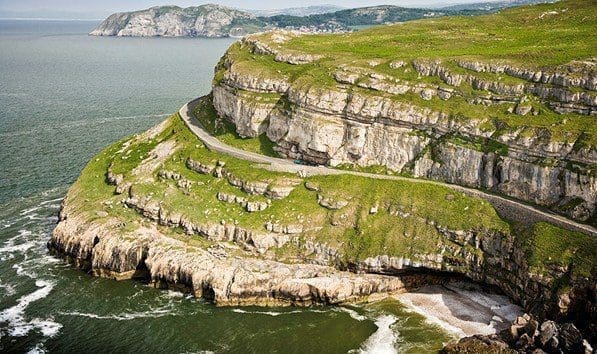
Tour de France 2026 in Catalonia: what fans need to know

The Tour de France 2026 starts in Catalonia with one of the most attractive Grand Départs of recent years. Barcelona hosts the opening stage, Tarragona sends off stage 2, Granollers hosts the start of stage 3, and the race then heads north towards the Pyrenees and France. For fans, that means three days of Tour de France racing in a compact, accessible part of north-east Spain.

It is also not just a ceremonial start. The 2026 Tour begins with a team time-trial in Barcelona, then follows with a difficult stage from Tarragona back to Barcelona, finishing with repeated climbs of Montjuïc. Stage 3 then starts in Granollers and heads to Les Angles, taking the race into the mountains early. The opening weekend will not decide the Tour outright, but it can shape the first yellow jersey battle, the early GC gaps and the mood of the whole race.

That makes Catalonia a strong trip for fans who want more than a roadside glimpse. Barcelona offers an urban team time-trial with landmarks, crowds and public transport access. Tarragona gives stage 2 a coastal start. Montjuïc gives fans a repeat viewing point on the same climb. Granollers offers a more traditional stage-start atmosphere before the race moves towards the Pyrenees.

For the wider race picture, see our Tour de France 2026 full route guide, Tour de France 2026 route analysis and how to visit the Tour de France 2026 Grand Départ in Barcelona.

Sagrada Familia during golden hour

When is the Tour de France 2026 in Catalonia?

The Catalan Grand Départ runs from Saturday 4 July to Monday 6 July 2026.

DateStageRouteType
Saturday 4 July 2026Stage 1Barcelona to BarcelonaTeam time-trial
Sunday 5 July 2026Stage 2Tarragona to BarcelonaHilly stage
Monday 6 July 2026Stage 3Granollers to Les AnglesMountain stage

Stage 1 is the headline city event. Stage 2 gives fans a road stage with a coastal start and a hard Barcelona finish. Stage 3 is the bridge from the Grand Départ atmosphere into the first mountain phase of the Tour.

The key planning point is that Barcelona will be busy across the whole weekend. Fans staying in the city can see stage 1 and the finish of stage 2 without needing a car, but anyone trying to see Tarragona, Granollers or the Pyrenees will need to plan transport carefully. For more on why the city was chosen, see our feature on why Barcelona is hosting the 2026 Tour de France Grand Départ.

Stage 1: Barcelona to Barcelona team time-trial

Stage 1: Barcelona to Barcelona team time-trial

The 2026 Tour opens with a 19.6km team time-trial in Barcelona. It starts by the Mediterranean seafront, uses fast urban roads, passes major city landmarks and finishes on Montjuïc. For spectators, it is an excellent opening stage because the teams pass in sequence rather than in one single peloton. That means more time watching riders at race speed.

The format also matters. Team time-trials are visually dramatic because riders stay in formation, rotate turns and hold very high speeds through technical sections. In Barcelona, that should be especially striking because the course moves from open, fast city roads towards a more demanding finish.

Montjuïc is the obvious focal point. It gives the stage an uphill conclusion and creates a strong viewing area for fans who want effort, noise and atmosphere rather than a flat high-speed blur. The downside is that it will be one of the most crowded places on the route.

Fans who want easier access may prefer earlier parts of the course near the seafront or broader city boulevards. These areas should offer more space, though final route barriers, access points and crowd-control plans will decide what is realistic on the day.

For the race implications, see our Tour de France 2026 team time-trial explained and how the stage 1 team time-trial could change the Tour de France 2026.

Best places to watch stage 1 in Barcelona

The best viewing point depends on what kind of experience you want.

Montjuïc is the best option for atmosphere and race difficulty. The climb should make the speed differences more visible, and the finish area will carry the biggest sense of occasion. It is the place to be if you want to see riders under pressure.

The seafront is better for speed. The opening section of the course should show teams still organised, aerodynamic and fully committed. It may also be easier for fans who want to combine the race with a more relaxed day in the city.

Areas around major landmarks may be visually impressive, but they will also attract heavy crowds. If you are aiming for a famous backdrop, arrive early and expect movement restrictions.

The finish zone will be the hardest place to access without planning. Grand Départ finishes are busy even before the Tour caravan and teams arrive. If your priority is seeing the race clearly rather than being near the podium, a less obvious roadside location may be smarter.

For a more detailed visiting plan, see our Barcelona Grand Départ travel guide.

Stage 2: Tarragona to Barcelona

Stage 2: Tarragona to Barcelona

Stage 2 takes the Tour from Tarragona back to Barcelona. This is not a simple procession along the coast. The stage becomes harder as it approaches the city, then finishes with a demanding Montjuïc circuit. That makes it one of the most interesting early stages for fans and one of the first proper tests for the riders.

Tarragona gives the stage a different feel from Barcelona. It should be a strong option for fans who want a start-line experience rather than the bigger city crowds. Stage starts usually allow spectators to see riders sign on, teams prepare bikes, staff organise vehicles and the race village come to life. It is slower and more personal than watching the bunch flash past at race speed.

Barcelona is the better option for the decisive racing. The Montjuïc climb will be reached multiple times, which makes it especially attractive for spectators. A repeated circuit means fans can see the race more than once from the same general area, depending on access and barriers.

This stage could already create GC movement. A punchy finish in Barcelona will not suit every sprinter, and the repeated climbing gives puncheurs, GC riders and aggressive teams a reason to race hard. For the broader opening-week impact, see our Tour de France 2026 route: best days for GC attacks.

Best places to watch stage 2

For the full race build-up, Tarragona is the best choice. Stage starts give fans access to the atmosphere before the racing begins, and the city should feel fully part of the Grand Départ weekend. It is also likely to be more manageable than trying to move around Barcelona once the stage finish restrictions are in place.

For the racing itself, Montjuïc is the obvious target. The repeated climb means the crowd can build around one decisive section, and the riders will be under real pressure each time they come through. It should be one of the most atmospheric places in the whole Catalan opening.

For fans who want fewer crowds, the approach roads into Barcelona may be worth considering once the detailed route and closures are confirmed. The trade-off is that you may only see the race once and may have less public transport flexibility.

The best practical plan is to choose either Tarragona or Barcelona for stage 2, not both. Trying to watch the start and then race the Tour to the finish is rarely worth the stress, especially with road closures and heavy crowds.

Stage 3: Granollers to Les Angles

Stage 3: Granollers to Les Angles

Stage 3 starts in Granollers and heads north towards Les Angles in the Pyrenees. This is the point where the Grand Départ shifts from Catalan city racing into the first mountain phase of the Tour.

For fans based in Barcelona, Granollers is the most accessible part of stage 3. It offers a stage-start experience without needing to travel deep into the Pyrenees. That makes it a good choice for visitors who want one more Tour morning before flying home or staying in Barcelona.

For fans with more time, stage 3 can become the start of a Pyrenean road trip. The route towards Les Angles will pull the race into more mountainous terrain, and the atmosphere will change quickly from city spectacle to climbing test. That is where the Tour begins to feel like a Grand Tour rather than only a Grand Départ.

The important planning point is distance. Granollers is manageable from Barcelona. Les Angles is not a casual day trip once race traffic and mountain access are considered. If you want to watch the finish, stay closer to the Pyrenees and expect access restrictions.

For the wider early mountain context, see our Tour de France 2026 Pyrenees guide and Tour de France 2026 summit finishes guide.

Barcelona or Tarragona: where should fans base themselves?

Barcelona is the easiest base for most fans. It has the largest choice of flights, hotels, restaurants and public transport, and it gives you direct access to stage 1 and the stage 2 finish. If this is your first Tour de France trip, Barcelona is the simplest option.

Tarragona is better if you want a slightly calmer base and a strong stage 2 start experience. It is also a good choice for fans who want to combine the Tour with the Costa Daurada rather than staying in the busiest part of Barcelona.

Granollers is useful for stage 3, but less obvious as a main base unless you are specifically chasing the stage start or heading north afterwards. It works best as a practical stop rather than the centre of the trip.

For a three-day fan itinerary, Barcelona is the safest base. For a two-day city-and-coast trip, Barcelona plus Tarragona works well. For a more serious cycling trip, Barcelona to Tarragona to the Pyrenees is the more ambitious option.

Barcelona people walking on park during daytime

How to get around during the Catalan Grand Départ

Public transport should be the default option inside Barcelona. Driving into or across the city during a Tour stage is likely to be slow, restricted and frustrating. Road closures can begin well before the race arrives, and team buses, race vehicles, barriers and crowds all change normal traffic patterns.

For stage 1, use the metro, tram, suburban trains or walking routes where possible. Choose your viewing area before travelling and avoid assuming you can cross the course freely once barriers are in place.

For stage 2, trains between Barcelona and Tarragona may be useful for fans watching the start, but allow more time than usual and expect crowds. If you are watching the finish in Barcelona, stay in the city and move early.

For stage 3, Barcelona to Granollers is the most realistic public-transport move. Travelling from Barcelona to the Les Angles finish on race day is much more complicated and may require staying closer to the mountains.

The golden rule is simple: do not plan like it is a normal weekend in Catalonia. Plan like the Tour is closing roads, filling trains and changing the city timetable.

Will roads be closed?

Yes. Road closures are an unavoidable part of watching the Tour de France. Exact closure times will depend on the final local traffic plans, but fans should expect restrictions several hours before the riders arrive, especially around starts, finishes, climbs, technical sections and team areas.

In Barcelona, closures around Montjuïc, the finish zones and the team time-trial route will be especially important. On stage 2, the repeated Montjuïc circuit will make access more complicated because roads may be controlled for longer than on a normal point-to-point stage.

In Tarragona and Granollers, start areas will also have barriers, team bus zones and restricted access. That can be part of the appeal because fans can see the race infrastructure close up, but it also means normal routes through the city may not work.

If you are staying in Barcelona, check whether your hotel is inside or near a race closure zone. That matters for taxis, luggage, airport transfers and any plan to leave early on race day.

montjuic barcelona a view of a city with tall buildings

How early should fans arrive?

For the most popular spots, early means early morning. Montjuïc on stage 1 and stage 2 will be busy because it combines race difficulty, city access and a strong visual setting. Fans wanting a good position should not assume they can arrive shortly before the race.

For stage starts in Tarragona and Granollers, arriving early gives you more time to enjoy the team area, caravan atmosphere and sign-on. Once the crowd thickens, moving between buses, barriers and viewing points becomes harder.

For less obvious roadside locations, you may not need to arrive quite as early, but the same principle applies: once roads close, your options narrow. It is better to be in place too soon than stuck on the wrong side of the course.

Bring water, sun protection, food and patience. July in Catalonia can be hot, and Tour days involve waiting.

What should fans bring?

A Tour stage is a long outdoor day, even in a city. Fans should bring water, sunscreen, a hat, comfortable shoes, a portable phone charger and enough food to avoid relying completely on nearby cafés or shops.

For Barcelona, comfortable walking shoes matter more than anything. You may need to walk further than expected because of closures. A small bag is better than anything bulky, especially in dense crowds.

For the Pyrenees or stage 3 finish areas, bring layers as well as sun protection. Mountain weather can shift, and a long wait at altitude can feel very different from a morning in Barcelona.

A printed or saved offline map is also sensible. Mobile data can struggle in crowds, and road closures can make normal navigation apps misleading.

montjuic barcelona aerial view of city buildings during daytime

Can fans ride parts of the route?

Some fans will be tempted to bring bikes or hire them in Barcelona. That can be a good idea, but it needs care. The Tour route itself will be closed and controlled on race day, so do not assume you can ride on the course close to race time.

Barcelona is a bike-friendly city in many areas, but Tour weekend will not be a normal cycling weekend. Use marked cycling routes, avoid closed roads and follow police instructions. If you want a proper ride, do it away from the race route or on the days before and after the Grand Départ.

Montjuïc is an obvious cycling landmark, but it will also be one of the busiest parts of the race. Riding there on the morning of the stage may become impractical once closures and crowds build.

For fans wanting a cycling holiday, the smarter approach is to use the Tour weekend as the anchor, then ride before or after the stages rather than trying to combine a long ride with race-day logistics.

Is the Catalan Grand Départ good for families?

Yes, especially in Barcelona, but it needs planning. The team time-trial format on stage 1 is family-friendly because the action lasts longer than a standard road stage. Instead of waiting hours for one short peloton pass, fans see team after team ride through.

The challenge is crowd density. Montjuïc and the finish areas may be too busy for young children if you arrive late or try to stand in the most popular spots. A wider roadside section earlier in the stage may be easier.

Stage starts can also work well for families because they are slower and more interactive. Tarragona or Granollers may offer a more relaxed way to see riders, team buses and the Tour caravan.

For families, the best plan is not necessarily the most famous viewing point. It is the place with space, shade, toilets, food access and an easy exit.

green trees montjuic barcelona

What makes Montjuïc so important?

Montjuïc is the sporting centre of the Catalan Grand Départ. It appears in the stage 1 team time-trial and again in the stage 2 finale. That means it can shape the yellow jersey battle on consecutive days.

The climb is not long enough to decide the Tour, but it is steep and awkward enough to create gaps, especially in a team time-trial or a hilly stage finish. Riders who are poorly positioned, isolated or already struggling can lose time quickly.

It also gives the race a visual identity. Barcelona has many landmarks, but Montjuïc provides the racing drama. It is where the opening weekend moves from spectacle to selection.

For fans, that makes it both the best and busiest place to watch. If you want atmosphere, go to Montjuïc. If you want space, look elsewhere.

What race action should fans expect?

Stage 1 should be about teamwork, time gaps and the first yellow jersey. The strongest squads will try to keep their GC leaders protected while still riding fast enough to challenge for the stage. The final climb towards Montjuïc could expose weaker teams or riders who cannot hold formation.

Stage 2 should be more aggressive. The route from Tarragona to Barcelona gives teams time to control the race, but the Montjuïc finish makes a pure sprint unlikely. Puncheurs, GC riders and aggressive all-rounders could all be involved.

Stage 3 should begin the first mountain phase. It is early enough that many riders will still be fresh, but hard enough to make the Tour feel serious. The race will not wait until France to test the general classification contenders.

For fans, that means all three Catalan days matter. This is not a parade start. It is a proper opening sequence. The first yellow jersey picture is explained further in our Tour de France 2026 jerseys guide.

How expensive will it be?

Barcelona is already a major tourist city, and the Tour will increase demand for hotels and short stays. Prices are likely to be higher than normal, especially for accommodation close to the route or Montjuïc.

Booking early is the safest option. Staying slightly away from the immediate course can reduce cost and stress, especially if you are near a metro or rail connection.

Tarragona may offer better value for some fans, but stage 2 will also increase demand there. Granollers may be practical for stage 3, but it has fewer obvious tourist options than Barcelona.

The cheapest way to watch the Tour is still roadside. The race itself is free to watch, but accommodation, transport and food can become expensive if left late.

Three possible fan itineraries

Barcelona weekend

Base yourself in Barcelona. Watch the stage 1 team time-trial on Saturday, then return to Montjuïc or a different Barcelona location for the stage 2 finish on Sunday. This is the easiest and most efficient plan.

Catalan start-line trip

Stay in Barcelona but travel to Tarragona on Sunday morning for the stage 2 start, then return later without trying to chase the race. On Monday, go to Granollers for the stage 3 start. This is best for fans who enjoy team buses, sign-ons and pre-stage atmosphere.

Grand Départ to Pyrenees trip

Start in Barcelona for stage 1, go to Tarragona or the stage 2 route on Sunday, then move north for stage 3 and the Pyrenees. This is the best cycling-fan trip, but it needs proper planning, accommodation outside Barcelona and a realistic view of mountain access.

Common mistakes to avoid

The biggest mistake is trying to do too much. Watching the start and finish of the same stage is often unrealistic, especially during a Grand Départ. Pick one main objective each day.

The second mistake is relying on cars in Barcelona. Public transport and walking will usually be smarter.

The third mistake is arriving too late at Montjuïc. It will be one of the busiest points of the weekend.

The fourth mistake is ignoring the heat. July in Catalonia can make a long roadside wait harder than expected.

The fifth mistake is assuming stage 3 is “near Barcelona” just because it starts in Catalonia. Granollers is accessible. Les Angles is a different kind of trip.

Is the Catalan Grand Départ worth visiting?

Yes. The 2026 Catalan Grand Départ is one of the best fan opportunities on the route because it combines city access, landmark settings, a team time-trial, a hilly Barcelona finish and an early move towards the Pyrenees.

For casual fans, Barcelona is the obvious choice. You can see the race, enjoy the city and avoid complicated transfers. For committed cycling fans, the combination of Barcelona, Tarragona, Granollers and the Pyrenees makes a longer trip much more appealing.

The key is planning around the race rather than trying to fit the race around a normal city break. Roads will close. Crowds will build. Transport will be busy. Montjuïc will be packed. But if you choose your viewing points carefully, arrive early and keep the itinerary realistic, Catalonia should offer one of the most memorable starts to a Tour de France in years.

For more 2026 Tour coverage, visit our Tour de France hub, beginner’s guide to Men’s Tour de France 2026 and how to watch Tour de France 2026 in the UK.

Paul Seixas and the next French Tour de France generation

Paul Seixas will start the 2026 Tour de France carrying more than his own ambitions. He will also carry the newest version of France’s longest-running cycling question: when will the home nation produce another rider capable of winning the Tour?

That question has followed every promising French climber since Bernard Hinault’s last Tour victory in 1985. It followed Richard Virenque in a different era. It followed Thibaut Pinot through the emotional peaks and collapses of the 2010s. It followed Romain Bardet as he turned podium finishes into national hope. More recently, it has followed David Gaudu, Lenny Martinez, Kévin Vauquelin and every young French rider who looks comfortable when the road goes uphill.

Seixas changes the tone because he arrives with a different kind of profile. He is not just a young climber being pushed into the Tour because France needs a story. He is already a serious stage-race and one-day prospect, an all-rounder with climbing, time-trial ability and the kind of sharp acceleration that modern Grand Tour racing demands. His 2026 Tour debut with Decathlon CMA CGM is not being framed as a ceremonial first appearance. It is being framed as the beginning of a project.

The important word is “beginning”. Seixas may be the biggest French Tour story of 2026, but he is not the whole story. The next French generation is broader than one rider. Kévin Vauquelin has already shown the level needed to compete high on GC. Lenny Martinez remains one of the most natural climbers in the French pool. Romain Grégoire has the punch and race craft for hard stages. Paul Lapeira, Jordan Jegat, Valentin Paret-Peintre and other riders give France a wider base than it has had for several years.

For the 2026 race context, see our Tour de France 2026 full route guide, Tour de France 2026 route analysis and best French riders to watch at the Tour de France 2026.

37000m-of-elevation-gain-in-two-weeks-–-How-super-talent-Paul-Seixas-is-ramping-up-his-training-ahead-of-highly-anticipated-Tour-de-France-debut-1

Why Paul Seixas matters

Seixas matters because he fits the modern Tour de France more naturally than many French hopes before him. The Tour is no longer a race where a pure climber can wait for the Alps, limit losses in the time trials and hope to survive everything else. The best riders now climb, time-trial, descend, accelerate, recover and race aggressively across almost every kind of terrain.

That is why Seixas is interesting. He is not being discussed only because he is French. He is being discussed because his skill set looks relevant to the way the Tour is now raced. He can climb, he has a strong time-trial background from his junior years, and he has shown the ability to race with confidence rather than simply follow wheels.

France has had good climbers before. It has had emotional Tour stories before. What it has lacked is a rider who looks like a complete modern GC project early enough to be shaped properly. Seixas gives Decathlon CMA CGM that possibility.

The danger is obvious. The Tour can distort development. A French rider with promise quickly becomes a national debate. Every attack is treated as evidence. Every bad day becomes a verdict. Seixas has the talent to justify excitement, but the scale of the expectation around him needs controlling.

His first Tour should be judged as the start of a long build, not as a referendum on whether France has found its next Tour winner. For the wider youth race, see our Tour de France 2026 young riders to watch.

What makes Seixas different?

The most obvious difference is range. Seixas is not only a mountain prospect. He has the background of a rider who can build towards the full GC package.

That matters because the 2026 Tour begins with a team time-trial in Barcelona. A young climber can lose the race psychologically before the mountains if the opening stage goes wrong. Seixas will need Decathlon CMA CGM to guide him through that first day cleanly, but his own time-trial ability should help him handle the pressure better than a more limited climber.

The second difference is how early his results have arrived. France has had riders who looked promising as under-23s, then needed years to turn that into WorldTour impact. Seixas has moved quickly. That does not guarantee a Tour podium, but it changes the development curve.

The third difference is temperament. He does not look like a rider who wants to hide. That can be a strength, especially in a sport increasingly shaped by riders who attack early and race without waiting for perfect conditions. It can also be a risk. The Tour punishes overreach. A young rider who spends too much energy chasing moments in week one can pay for it heavily in week three.

That balance will define his debut. Seixas needs to race with ambition without turning every mountain stage into a statement.

For more on where he sits among the young contenders, see our Tour de France 2026 young riders to watch and Tour de France 2026 dark horses for the general classification.

Who-will-join-Paul-Seixas-at-the-Tour-de-France-and-is-there-room-for-Olav-Kooij-A-closer-look-at-the-riders-in-line-for-selection-at-Decathlon-CMA-CGM

The weight of French expectation

French cycling has never been short of hope. The problem is that hope often arrives before the rider is ready for it.

Pinot carried that better than most, but his Tour story also showed how heavy it could become. Bardet reached the podium and gave France a genuine GC rider, yet even that was judged through the gap to yellow. Gaudu has had strong moments but has also had to deal with the difficulty of being seen as the next answer. Martinez has already had to manage expectation because his climbing talent is so visible.

Seixas enters that same environment with even more attention because his ceiling looks so high. The French public does not just want a stage winner. It wants a rider who can make the Tour feel nationally alive again. The danger is that a teenager becomes a symbol before he has had time to become a Grand Tour rider.

That is why Decathlon CMA CGM’s management matters. The team has to protect him from the noise as much as from crosswinds and mountain attacks. He needs a plan, a race rhythm and a clear definition of success that does not shift every time a television camera finds him in the bunch.

A good first Tour might be a top 10. It might be a strong white jersey challenge. It might be two excellent mountain days and one controlled bad day. It might even be a quieter ride that teaches him how the Tour works. What it cannot be is a demand that he solves four decades of French frustration in three weeks.

The wider French picture is covered in our best French riders to watch at the Tour de France 2026.

Decathlon CMA CGM and the Seixas project

Seixas also matters because he gives Decathlon CMA CGM a clear sporting identity. The team has moved beyond being a useful French WorldTour squad. It now has a rider around whom it can build a serious long-term Tour project.

That changes recruitment, tactics and pressure. A team with a protected young GC rider needs time-trial strength, mountain support, road captains and patience. It also needs to decide when to race for the present and when to protect the future.

The 2026 Tour will be a major test of that balance. Decathlon have to support Seixas, but they also have Olav Kooij as a sprint option and other riders with stage ambitions. A Tour team cannot serve every aim equally. If Seixas is genuinely the GC project, then the team structure around him has to reflect that.

The stage 1 team time-trial is the first proof point. A poor opening day could put Seixas under pressure before the race has properly started. A clean, controlled ride gives him stability before the Pyrenees. In a first Tour, that kind of emotional and tactical stability matters.

For more on that opening test, see our Tour de France 2026 team time-trial explained, how the stage 1 team time-trial could change the Tour de France 2026 and best time-triallists at the Tour de France 2026.

divI-have-never-seen-anything-like-this-–-Paul-Seixas-sends-warning-to-Pogacar-and-Evenepoel-for-Liege-Bastogne-Liege-with-masterclass-on-Ardennes-debutdiv-1

The 2026 route is a tough first Tour

The 2026 Tour is not a gentle route for a debutant GC rider. It starts with a team time-trial, moves quickly into the Pyrenees and keeps placing difficult terrain throughout the race. There is no long soft opening where Seixas can quietly settle into his first Grand Tour.

Stage 3 to Les Angles comes early. Stage 6 to Gavarnie-Gèdre follows soon after. That means Seixas will be tested before the race has reached its rhythm. For an experienced leader, that is simply part of the Tour. For a first-time rider, it can be a lot to manage.

The middle of the race is not easy either. The Massif Central, Vosges and Jura can create fatigue before the Alps. Those are the sections where young riders often learn the difference between being good in the mountains and being good across three weeks. It is not only about the final climb. It is about positioning, eating, recovery, avoiding crashes and never spending energy carelessly.

Then comes the final Alpine block, including back-to-back finishes on Alpe d’Huez. That is where Seixas’ first Tour could be defined. If he reaches that point still inside the top 10, still composed and still improving, France will have reason to believe. If he fades, that should not be treated as failure. It would simply be a reminder that the Tour is a different race from anything else.

For more on the decisive terrain, see our Tour de France 2026 summit finishes guide, Tour de France 2026 Massif Central guide and Tour de France 2026 Alps guide.

What would be a successful Tour for Seixas?

The realistic answer is not “win the Tour”. Not yet. The field is too strong, the route is too demanding and the race is too long to treat a 19-year-old debutant as a normal yellow jersey contender.

A successful Tour for Seixas would start with staying calm. He needs to get through Barcelona without unnecessary time loss, survive the early Pyrenees without panic and avoid turning every French roadside expectation into a tactical decision.

A top 10 overall would be a major success. A serious white jersey challenge would be a major success. A stage where he follows the best climbers deep into the final kilometres would be a major success. Even a Tour where he loses time but learns how to manage three weeks could still be useful if the team handles it properly.

The bigger aim is not July 2026 alone. It is the years after. If Seixas is going to become a real French Tour contender, the first appearance should give him information, confidence and experience rather than exhaustion and pressure.

That is the line Decathlon need to walk. Ambition is justified. Overload is not. His wider GC context is covered in our Tour de France 2026 GC favourites ranked.

divKevin-Vauquelin-to-get-a-feel-for-things-during-first-spring-of-discovery-and-no-pressure-at-Ineos-Grenadiersdiv-1Photo Credit: Getty

Kévin Vauquelin: the proven Tour reference

Seixas may be the biggest name in the French future conversation, but Kévin Vauquelin is already a serious present-tense Tour rider. His move to Netcompany INEOS for 2026 also changes his context. He is no longer just a French rider overperforming inside a smaller structure. He is part of a team with a deep history of Grand Tour control, even if its current project looks different from the old Sky era.

Vauquelin’s value is that he has already shown he can handle the Tour. He climbs well, races intelligently and has enough all-round quality to sit high on GC. In a French cycling culture that often rushes to the next prospect, he deserves to be treated as more than a supporting name in the Seixas story.

The issue is ceiling. Vauquelin can be a top-10 rider, a stage winner, a dangerous opportunist and perhaps more if the race opens up. Whether he can become a true Tour-winning candidate is less clear. That does not make him less important. France needs several riders operating at a high level, not just one chosen successor.

In 2026, Vauquelin gives French cycling a more experienced counterpoint to Seixas. If Seixas is the new project, Vauquelin is the rider who can show what French GC relevance already looks like.

For the broader GC field around both riders, see our Tour de France 2026 GC favourites ranked and Tour de France 2026 dark horses for the general classification.

Lenny-Martinez-emulates-grandfather-Mariano-with-Tour-de-France-polka-dot-jersey-success-on-Bastille-Day

Lenny Martinez: the pure climber question

Lenny Martinez remains one of the most naturally gifted French climbers of his generation. He is light, sharp uphill and capable of looking at home on gradients that expose heavier riders. In a country still drawn to mountain romance, that makes him an obvious Tour storyline.

The question is whether he can become more than a climber. The modern Tour requires much more than acceleration on steep roads. Martinez needs consistency, resilience, time-trial management, positioning and the ability to avoid losing too much on days that do not suit him.

That does not mean his ceiling is low. It means his route to becoming a Tour contender is narrower than Seixas’. Martinez may be more naturally explosive in the mountains, but Seixas looks more complete for the full three-week structure. That difference matters.

Martinez’s best Tour role may not be the same every year. He can be a stage hunter, mountains-classification threat, climbing domestique or GC outsider depending on form and team plan. That flexibility could help him if expectations are managed properly.

For the French public, Martinez and Seixas should not be treated as rivals in a single succession race. They are different types of rider. France needs both.

For more on the climbing group they are joining, see our best climbers at the Tour de France 2026 and Tour de France 2026 mountain stages ranked by difficulty.

Romain Gregoire 2026 Tour de Suisse Stage 2 (Getty)Photo Credit: Getty

Romain Grégoire and the punchier route

Romain Grégoire sits in a different category. He is not a classic Tour GC climber, but he is one of the most talented French riders of the new wave. His strength is punch, positioning and the ability to win difficult races rather than simply survive them.

That makes him relevant to the Tour in a different way. France does not only need a yellow jersey candidate. It needs stage winners, breakaway threats, Classics-style attackers and riders who can shape hard transition days. Grégoire can be part of that.

The 2026 Tour route has several days where a rider like him could matter if selected and given freedom. Hilly stages, rolling finales and breakaway-friendly terrain all suit riders who can handle repeated accelerations and still finish fast.

Grégoire’s presence in the wider French generation is important because it stops the conversation becoming too narrow. French success at the Tour does not have to mean only one GC leader. It can mean a broad group of riders capable of winning stages, animating the race and forcing other teams to react.

For those stage-hunting possibilities, see our Tour de France 2026 stage hunters to watch and Tour de France 2026 route: best days for breakaways.

Tour-de-Luxembourg-Mattias-Skjelmose-holds-off-Jordan-Jegat-on-closing-cobbled-climb-for-stage-3-victory-and-GC-leadPhoto Credit: Getty

Jordan Jegat, Valentin Paret-Peintre and the wider base

The next French generation also includes riders who may not carry the same hype but can still matter at the Tour. Jordan Jegat is one example. He has developed into a rider with climbing durability and enough ambition to chase stages or GC respectability depending on the race situation.

Valentin Paret-Peintre is another. His Giro d’Italia stage win showed he can deliver in a Grand Tour environment, and his climbing profile makes him useful either as a protected rider on the right day or as support for a stronger team leader.

Dorian Godon, Paul Lapeira, Lenny Martinez, Romain Grégoire, Kévin Vauquelin and Seixas all occupy different parts of the French performance map. That is the point. France’s future does not depend only on one rider being the next Hinault. It depends on whether enough riders can lift the level together.

If Seixas becomes the Tour-winning candidate but the rest of the group also wins stages, supports leaders and stays visible in the race, French cycling becomes much stronger than it has been in years.

divHes-already-between-Remco-and-Pogacar-at-the-same-age-Frances-most-recent-Il-Lombardia-winner-Thibaut-Pinot-pays-tribute-to-rising-local-star-Paul-Seixasdiv-1

The post-Pinot and post-Bardet shift

The emotional centre of French cycling has changed. Pinot and Bardet gave France two very different kinds of modern Tour hope. Pinot was the more instinctive and emotionally charged climber. Bardet was the more measured Grand Tour podium rider. Both shaped a generation of French expectation.

The new group has to operate differently. The level at the top of the sport has moved. Tadej Pogačar, Jonas Vingegaard and Remco Evenepoel have raised the standard for what a Tour contender needs to be. A French rider cannot simply be a good climber and hope the race comes to them. They need to be excellent across multiple disciplines and aggressive enough to take opportunities before the final climb.

That is why Seixas feels like the most modern French prospect. He is not being fitted into an old French template. He looks closer to the international model: young, complete, confident, and already expected to race across different types of terrain.

But France should be careful with the comparison. The point is not to find “the new Pinot” or “the new Bardet”. The point is to build a new structure around riders who fit the current era.

For more on the riders setting that current standard, see our Tadej Pogačar at the Tour de France 2026, Jonas Vingegaard at the Tour de France 2026 and Remco Evenepoel at the Tour de France 2026.

The white jersey battle as the first big marker

For Seixas, the white jersey may be the most realistic major classification target in 2026. It gives him a high-profile objective without requiring him to beat the established Tour winners immediately.

The problem is that the white jersey field could be extremely strong. Isaac del Toro, Juan Ayuso, Florian Lipowitz and other young riders are part of the same wider generational shift. Seixas is not emerging in isolation. He is arriving at a time when the young GC field is unusually deep.

That is useful. It gives his first Tour a proper benchmark. If he can compete with that group, France will know his development is on schedule. If he struggles, it will show where the gaps are.

The white jersey can also protect the narrative. A strong young rider race gives Seixas something to chase even if the yellow jersey fight becomes dominated by Pogačar, Vingegaard and Evenepoel. It allows Decathlon to frame the Tour around development and ambition rather than immediate overall victory.

For the wider young rider picture, see our Tour de France 2026 young riders to watch, Tour de France 2026 jerseys explained and best climbers at the Tour de France 2026.

Where Seixas could make a mark in 2026

The first obvious place is the Pyrenees. Stage 3 to Les Angles and stage 6 to Gavarnie-Gèdre come early enough to test him before the race settles. If he can stay close there, it changes the tone of his Tour.

The second marker is the Massif Central. Stage 10 to Le Lioran comes after the first rest day and could be a stage where young GC riders have to show discipline. It is hard enough to create gaps, but not as final as the Alps. A strong ride there would show Seixas can manage difficult mid-race terrain.

The third marker is the Vosges and Jura. These stages can be awkward, irregular and tactically messy. They are not always the days that get the biggest pre-race headlines, but they can expose inexperience. Seixas will need team help and calm decision-making.

The final marker is Alpe d’Huez. By then, the question may not be whether Seixas can attack the best riders. It may be whether he can still ride strongly after nearly three weeks of pressure. If he reaches the final Alpine weekend still relevant, his first Tour will already have been a success.

For more on those decisive stages, see our Tour de France 2026 Vosges and Jura guide, Tour de France 2026 Alps guide and Tour de France 2026 queen stage guide.

Can France win the Men’s Tour again?

Yes, but probably not by asking one rider to carry the whole answer immediately.

The gap between French hopes and Tour victory has not only been about talent. It has also been about team depth, time-trial strength, recovery, climbing support, race control and the ability to build a rider over several seasons. The strongest Tour contenders now sit inside systems designed around every detail.

That is where Decathlon CMA CGM’s project becomes important. If Seixas is to become a real Tour-winning candidate, he needs a team built around that aim. He needs support riders who can keep him safe on flat days, limit damage in team time-trials, position him before climbs and stay with him deep into mountain stages. He also needs a calendar that develops him rather than drains him.

France has enough individual talent to believe again. Seixas, Vauquelin, Martinez and Grégoire give the country different ways into the Tour. The next step is converting that into a collective level capable of challenging the best international systems.

A French Tour win is possible in the coming years. But the smarter question is whether France can build a generation strong enough to make that possibility feel normal rather than romantic.

Final verdict: Seixas is the centre, but not the whole generation

Paul Seixas is the face of the next French Tour de France generation because he has the most complete GC profile and the biggest home-race story. His 2026 Tour debut will be one of the defining narratives of the race, especially if he survives the early mountains and reaches the final week still in the white jersey or top-10 conversation.

But France should resist turning him into a one-man solution. Vauquelin is already a serious Tour rider. Martinez has rare climbing ability. Grégoire gives the generation a punchier, more aggressive stage-race and Classics dimension. Jegat, Paret-Peintre and others add depth. That is healthier than waiting for a single saviour.

The most important outcome in 2026 may not be a podium. It may be proof that France now has a structure and a generation capable of staying relevant across the whole Tour: GC, white jersey, mountain stages, breakaways and hilly stage wins.

Seixas is the headline. The generation around him is the real story.

For more Tour de France 2026 coverage, visit our Tour de France hub, beginner’s guide to Men’s Tour de France 2026 and how to watch Tour de France 2026 in the UK.

How do Tour de France riders recover between stages?

Tour de France riders recover between stages by treating the hours after the finish as part of the next day’s race. The recovery process starts almost immediately, usually before a rider has even left the finish area, and continues through the transfer, team bus, hotel, dinner, massage, sleep and the next morning’s pre-stage routine.

That matters because the Tour de France is not one huge effort. It is 21 separate race days, with only two rest days to break up three weeks of repeated stress. Riders have to recover from sprint finishes, mountain stages, crashes, heat, long transfers, time trials and the mental pressure of racing in the biggest cycling event in the world.

In the 2026 Tour de France, recovery will be especially important because the route gives riders little room to settle. The race starts in Barcelona with a team time trial, climbs early in the Pyrenees, crosses the Massif Central, then builds through the Vosges, Jura and Alps before two consecutive finishes on Alpe d’Huez. Riders who recover badly in the first week may already be paying for it by the time the decisive mountain stages arrive.

For the wider race context, see our Tour de France 2026 full route guide, Tour de France 2026 route analysis and Tour de France 2026 team-by-team guide.

divI-dont-think-anyone-actually-realises-how-bad-this-was-–-Mads-Pedersen-aims-for-little-bit-of-luck-at-Paris-Roubaix-as-he-continues-fractured-wrist-recoverydiv-1Photo Credit: Getty

Why recovery matters so much at the Tour de France

Recovery is not just about feeling better. It affects performance, concentration, immune function, injury risk and decision-making. A rider who does not recover properly may lose power, miss positioning cues, make tactical mistakes or struggle to eat enough the next day.

The Tour adds extra complications because the race does not stop at the finish line. Riders may still face podium duties, anti-doping control, media interviews, a long transfer to the hotel and a late dinner before they can properly rest. On mountain stages, the hotel might be hours away. On sprint stages, the physical damage may be lower, but the stress and crash risk can be high.

Recovery also depends on role. A GC leader recovering from a mountain duel has different needs from a sprinter who has survived inside the time cut. A domestique who spent the whole day on the front may be more exhausted than the protected rider they helped. A rider who crashed needs medical care before any normal routine can begin.

The goal is simple: arrive at the next stage with as much energy, muscle function and mental sharpness as possible. That is one reason the Tour is so hard to win, as covered in our explainer on how hard the Tour de France really is.

What happens immediately after the finish?

The first recovery window starts as soon as the rider crosses the line. The exact routine depends on the stage, but the priorities are usually the same: cool down, rehydrate, start refuelling and get off the finish-site chaos as quickly as possible.

Riders are normally met by soigneurs or team staff with drinks, recovery food, towels and sometimes fresh kit. If the stage has been hot, cooling becomes urgent. If it has been wet or cold, riders need dry clothing quickly to avoid getting chilled during interviews or the transfer to the bus.

The first 30 minutes matter because riders have usually finished the stage heavily depleted. They will often take a recovery drink, rice, pasta, a sandwich, yoghurt, fruit, a protein source or another easy-to-digest carbohydrate-rich option. The point is not a perfect meal. It is to start replacing energy before appetite disappears or travel delays the main dinner.

For riders who have to go to the podium, do media or anti-doping control, the team has to manage recovery around those obligations. The yellow jersey, stage winner or classification leaders may have less time to eat and rest than a rider who can go straight to the bus. That daily pressure is part of why overall contenders need more than climbing legs, as explored in our Tour de France 2026 GC favourites ranked.

The team bus: the first controlled recovery space

The team bus is where recovery becomes more structured. Riders shower, change into clean kit, start eating properly and begin the process of switching from racing mode to recovery mode.

The bus is also where the first informal debrief often happens. Staff check who crashed, who is ill, who struggled to eat, who needs medical attention and who may need extra support before the next stage. Riders may talk through the final kilometres, ask for food, review a crash or simply sit quietly after several hours of stress.

Food on the bus is practical rather than glamorous. Rice, pasta, wraps, omelettes, sandwiches, recovery shakes, fruit, cakes and electrolyte drinks are all common recovery options. The goal is to get carbohydrate and protein in quickly, without upsetting the stomach before the main evening meal.

For long transfers, the bus can become part dining room, part recovery room and part mobile hotel lounge. The best teams try to remove decisions from the riders. Food is ready. Drinks are ready. Bags are organised. The rider’s job is to eat, drink, clean up and conserve energy.

Refuelling: replacing what the stage has taken out

Nutrition is one of the biggest parts of Tour recovery. Riders burn huge amounts of energy during stages, especially in the mountains, and they cannot wait until dinner to start replacing it.

The main priority is carbohydrate. Hard racing reduces glycogen, the stored carbohydrate that fuels high-intensity efforts. If a rider starts the next stage with low glycogen, they may feel flat, struggle to follow attacks or fail to recover from repeated surges. That is why post-stage food is usually carbohydrate-heavy.

Protein is also important. It supports muscle repair after repeated damage from long stages, climbs, sprints and crashes. Riders do not need a bodybuilder-style protein load, but they do need regular protein across the recovery window, especially after hard stages.

Hydration is the other pillar. Riders can lose a lot of fluid through sweat, especially in July heat. They need water, electrolytes and sometimes sodium-heavy recovery drinks to replace what has been lost. Teams will monitor body mass, urine colour, sweat rate, temperature and rider feedback to judge how aggressive rehydration needs to be.

The hardest part is appetite. After a mountain stage or a very hot day, riders may not feel hungry. That is where liquid nutrition, simple foods and small repeated portions become important.

Beyond-the-Peloton-–Health-safety-and-recovery-time-for-athletes-who-have-experienced-significant-trauma-1

Dinner at the hotel

By the time riders reach the hotel, they may already have eaten several times since the finish. Dinner is still vital because it is the main chance to refill energy stores before sleep.

A typical Tour dinner is built around carbohydrates, lean protein, vegetables, fluids and familiar foods that riders know they can digest. Pasta, rice, potatoes, chicken, fish, eggs, soup, bread and simple desserts are all common. The food has to be high quality, but it also has to be repeatable. Riders cannot experiment with heavy, unfamiliar meals when they need to race again the next day.

Team chefs are now a major part of the recovery system. They help control food quality, timing, hygiene and rider preferences. That matters because illness can destroy a Tour campaign quickly. A stomach problem in the second week can be as damaging as a bad day in the mountains.

Dinner also has a psychological role. It gives the team a rhythm. Riders eat, talk through the day, receive instructions for the next stage and begin winding down. In a three-week race, routine is part of recovery.

Massage: why riders still use it

Massage is one of the most visible parts of Tour recovery. Riders lie on treatment tables while soigneurs work through tired legs, backs, shoulders and necks. It has been part of cycling culture for generations.

The purpose is not magic. Massage does not suddenly erase fatigue or refill glycogen. Its value is more practical. It can help riders relax, reduce tightness, manage soreness, identify small issues and create a consistent evening routine. It also gives soigneurs time to check the rider’s condition: cuts, bruising, swelling, saddle sores, muscle tightness and general fatigue.

For some riders, massage is as much mental recovery as physical recovery. It is quiet time away from cameras, race radios and team buses. In a race as noisy as the Tour, that matters.

Massage also helps staff spot problems early. A rider may say they are fine, but a soigneur might notice bruising from a crash, a stiff lower back or signs that a saddle sore is getting worse. Small problems caught early can prevent bigger problems later in the race.

Sleep-better-ride-faster-How-doing-less-could-make-you-faster-3

Sleep: the most important recovery tool

Sleep is the most powerful recovery tool riders have, but it can be difficult at the Tour. Transfers, late dinners, hotel changes, adrenaline, caffeine, pain, noise and stress can all reduce sleep quality.

Teams try to protect sleep as much as possible. Riders may use sleep masks, earplugs, familiar pillows, cooling strategies and strict evening routines. Staff try to make hotel logistics as smooth as possible so riders are not wasting mental energy on bags, meals or schedules.

Good sleep helps restore physical and mental function. It supports immune health, decision-making, reaction time and mood. That is important because the Tour is not only a watts contest. Riders have to stay sharp in crosswinds, descents, feed zones, technical finishes and chaotic bunches.

Poor sleep can build across the race. One bad night may not ruin a rider. Several bad nights can become a major problem, especially before mountain stages or time trials. It is one of the hidden reasons why the strongest teams place so much emphasis on logistics, routine and support staff.

Cooling down after hot stages

Heat can make recovery much harder. Riders may finish dehydrated, overheated and unable to eat properly. In those situations, cooling is not just comfort. It helps the body return to a state where it can recover.

Cooling methods can include cold drinks, ice vests, cold towels, fans, shade, cool showers and carefully managed ice baths. Teams use these tools differently depending on rider preference and the type of stage.

A sprinter after a hot flat stage may need rapid cooling before media and transfer duties. A GC rider after a mountain stage may need more careful management because the body is already under heavy stress. The point is to lower thermal strain without creating another shock to the system.

Heat also affects sleep. If riders arrive at a warm hotel room after a hot stage, recovery can be compromised. Good teams think about room temperature, hydration and evening cooling as part of the whole recovery chain.

Ice bath mountains yellow duck toy on pool

Ice baths, compression boots and recovery gadgets

Modern Tour teams use plenty of recovery tools, but none replaces the basics. Ice baths, compression boots, massage guns, stretching routines and mobility work may all appear in a team hotel, but they sit behind food, fluid and sleep in the recovery hierarchy.

Ice baths can help some riders feel better after very hard or hot stages. Compression boots may help riders relax and reduce the sensation of heavy legs. Light mobility work can help stiffness after long transfers. Breathing exercises or quiet routines can help riders calm down before sleep.

The key is individualisation. Some riders like cold water. Others hate it. Some feel better with compression. Others prefer a walk, massage and bed. Teams will not usually force a recovery tool on a rider if it disrupts their routine or sleep.

The best recovery plan is the one a rider can repeat for 21 days.

Medical checks and treating small problems

Tour recovery is not only about muscles and energy. Riders have to manage the small physical problems that accumulate across three weeks.

Saddle sores are one of the biggest hidden issues. They can make sitting on the bike painful and affect power, positioning and sleep. Teams manage them with hygiene, creams, careful washing, clean kit and sometimes medical treatment.

Crashes create another layer. Road rash needs cleaning and dressing. Bruises need monitoring. Stiffness can appear hours after the fall. A rider may finish a stage, feel acceptable on the bus, then wake up the next morning unable to move properly. That is why medical checks continue beyond the finish line.

Illness is another constant threat. Teams are careful around food hygiene, handwashing, air conditioning, shared spaces and exposure to crowds. A minor infection can become a race-ending problem when the body is already tired.

The Tour is won by legs, but it can be lost through small untreated problems.

2026-Tour-de-France-use-of-Col-de-la-Sarenne-sparks-opposition-from-local-environmentalists-1

Mental recovery

Riders also have to recover mentally. A Tour stage can involve five hours of constant stress: fighting for position, avoiding crashes, listening to race radio, reading tactics, following attacks, descending at high speed and dealing with crowds.

Mental fatigue affects physical performance. A rider who is mentally drained may struggle to focus in the final hour, eat properly, sleep well or make calm tactical decisions the next day.

Teams manage this by creating routine and reducing unnecessary decisions. Riders are told what time dinner is, when massage is, when the meeting is, when bags need to be ready and what the plan is for the next stage. The fewer choices they have to make, the more energy they can save.

Some riders want quiet time. Others need a short debrief. Some speak to family. Others avoid phones. Mental recovery is personal, but the principle is the same: switch off enough to be ready to race again.

Recovery during transfers

Transfers are one of the least glamorous parts of the Tour. Riders may finish a stage exhausted, then spend a long time on the bus before reaching the hotel. That time has to be used well.

On the bus, riders eat, drink, shower, change, receive treatment and sometimes nap. Staff use the transfer to get ahead of recovery, because waiting until the hotel would waste valuable hours.

Long transfers can create stiffness, especially after mountain stages. Riders may use compression, change position regularly, stretch lightly at the hotel or take a short walk before dinner. The aim is to avoid arriving late, tight and underfed.

Transfers also affect sleep. A late arrival means later dinner, later massage and later bed. Over three weeks, that can matter almost as much as the difficulty of the stages themselves.

divSun-coffee-pastries-and-gelato-How-the-peloton-spent-the-Giros-last-rest-daydiv-1

Rest days are not complete rest

Tour de France rest days are not days off in the normal sense. Riders usually still ride, often for one to two hours, to keep the body moving and avoid feeling blocked the next day. The ride is easy compared with racing, but it is still structured.

Rest days also include press conferences, sponsor commitments, medical checks, extra sleep, massage, laundry, equipment checks and team meetings. For a yellow jersey contender or major star, the rest day can be surprisingly busy.

The goal is to reduce stress without switching the body off completely. Some riders feel worse after a rest day because the rhythm changes. That is why teams manage rest days carefully, especially before the race resumes with a difficult stage.

In the 2026 Tour, the two rest days come before important blocks of racing. How riders handle them could affect the Massif Central, Vosges, Jura and final Alpine stages. The middle of the race is covered in our Tour de France 2026 Massif Central guide, while the final mountain block is explained in our Tour de France 2026 Alps guide.

What happens the next morning?

Recovery continues into the next morning. Riders wake, check weight and hydration, eat breakfast, prepare bottles, receive any medical treatment and review the stage plan.

Breakfast is usually carbohydrate-focused, with foods that are easy to digest: rice, oats, bread, pancakes, pasta, eggs, yoghurt, fruit, coffee and sports drinks, depending on the rider and stage. A mountain day, sprint day and time trial all require slightly different fuelling plans.

The team meeting sets the tactical picture. Who protects the leader? Who goes in the break? Who saves energy? Who works early? Who leads out? Recovery and tactics are linked because a rider’s condition affects what they can do.

On the bus to the start, riders keep eating and drinking. By the time the flag drops, the recovery cycle has already become the next performance cycle.

How recovery differs by rider type

Not every rider recovers from the same kind of effort.

A GC leader may spend the whole day protected, then produce a huge effort on the final climb. Their recovery is built around refuelling, muscle repair, sleep and staying calm under pressure.

A domestique may burn more energy than the leader by riding on the front, fetching bottles, closing gaps and positioning the team. Their recovery needs can be just as high, even if they finish minutes behind.

A sprinter may have an easier day in the mountains if they are riding inside the time cut, but sprint stages bring their own stress: repeated accelerations, dangerous positioning and a maximum-effort finish. Recovery has to restore both power and sharpness. For more on those stages, see our Tour de France 2026 sprint stages ranked and Tour de France 2026 route: best days for sprinters.

A breakaway rider may spend hours above threshold, then have to race again the next day with very little reward. That kind of fatigue can be hard to see from the results sheet but obvious inside the team bus. Our Tour de France 2026 route: best days for breakaways looks at the stages where that kind of effort is most likely.

What amateur cyclists can learn from Tour recovery

Most cyclists do not need a Tour-level recovery routine, but the principles still apply.

Eat soon after hard rides. Prioritise carbohydrates after long or intense sessions. Include protein across the day. Rehydrate properly, especially in warm weather. Sleep as well as possible. Do not rely on gadgets before doing the basics.

The biggest lesson is routine. Tour riders recover well because teams remove guesswork. Food is planned. Bottles are ready. Sleep is protected. Training and racing are matched by recovery.

For amateur riders, that might simply mean having a recovery meal ready, changing out of wet kit quickly, drinking enough, doing light stretching if it helps, and not treating every hard ride as permission to neglect sleep. Riders taking on the amateur version of a Tour mountain stage can also see our L’Étape du Tour 2026 complete guide.

Recovery is not a luxury after the ride. It is part of the ride.

Why recovery can decide the Tour de France

The Tour de France is often described through attacks, climbs and time gaps, but recovery is what allows those moments to happen. A rider who looks unbeatable on one mountain stage can lose the race two days later if they fail to recover. A domestique who can repeat hard work every day can be as valuable as a rider who produces one huge performance.

That is especially true on a route like the 2026 Tour. The race starts with pressure in Barcelona, climbs early in the Pyrenees, keeps adding difficulty through the middle of the race and then ends with one of the hardest Alpine sequences of recent years. Stage 20, covered in our Tour de France 2026 queen stage guide, may be as much a recovery test as a climbing test.

There is no single recovery trick that gets riders through that. It is the accumulation of hundreds of small actions: drink, eat, shower, transfer, massage, sleep, wake, eat again, race again.

The best teams make recovery invisible. The best riders make it routine. By the final week, that routine can be the difference between holding the yellow jersey, winning a sprint in Paris or simply surviving to the finish.

For more Tour de France 2026 coverage, visit our Tour de France hub, beginner’s guide to Men’s Tour de France 2026 and how to watch Tour de France 2026 in the UK.

Best sprinters at the Tour de France 2026

The Tour de France 2026 has enough sprint opportunities to make the fast men important, but this is not a route that gives them an easy ride. Seven flat stages sit alongside early Pyrenean climbing, a hard Massif Central section, the Vosges, the Jura and a brutal final Alpine block. That means the best sprinters will need more than top speed. They will need durability, support, positioning and enough climbing resistance to survive the race long enough to use their finish.
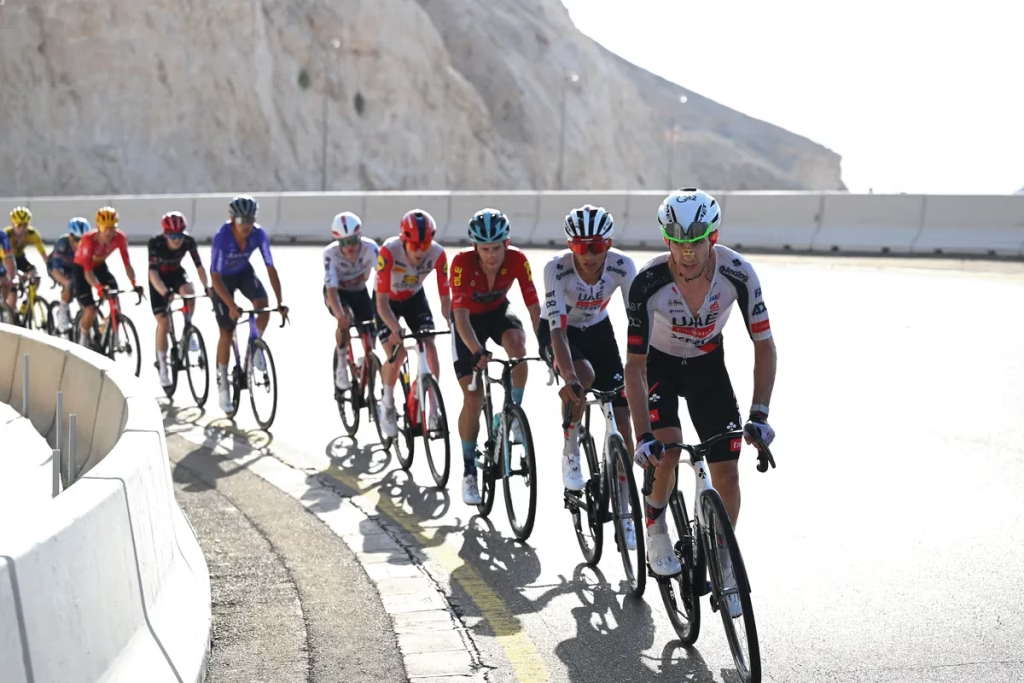
This ranking only uses riders currently confirmed on the working start list. That means no speculative names, no absent sprinters and no assumptions around riders who are not on the list. The focus is on the fast men who are actually down to start for now: Jasper Philipsen, Tim Merlier, Olav Kooij, Arnaud De Lie, Mads Pedersen, Biniam Girmay, Pascal Ackermann, Michael Matthews, Søren Wærenskjold and the wider group of reduced-bunch or hard-day finishers.

The route makes this a more complicated sprint race than a simple flat-stage count suggests. Stage 5 to Pau, stage 7 to Bordeaux, stage 8 to Bergerac, stage 11 to Nevers and stage 12 to Châlons-sur-Saône are the clearest sprint targets. Stage 17 to Voiron is officially flat but carries enough climbing to make it dangerous. Stage 21 in Paris is no longer a guaranteed classic Champs-Élysées bunch sprint because the Montmartre climbs create space for late attacks.

For the wider race picture, see our Tour de France 2026 full route guide, Tour de France 2026 sprint stages ranked and Tour de France 2026 route: best days for sprinters.

Jasper Philipsen Stage 19 2025 Vuelta Espana (Getty)

Best sprinters at the Tour de France 2026 at a glance

RankRiderTeamSprint profile
1Jasper PhilipsenAlpecin-Premier TechFastest pure sprinter and best lead-out support
2Tim MerlierSoudal Quick-StepElite top-speed sprinter and major bunch-finish threat
3Olav KooijDecathlon CMA CGM TeamPure sprinter with strong acceleration and route opportunity
4Mads PedersenLidl-TrekPower sprinter, hard-day specialist and green jersey threat
5Arnaud De LieLotto-IntermarchéPowerful finisher who can handle harder sprint stages
6Biniam GirmayNSN Cycling TeamDurable fast man and reduced-bunch danger
7Pascal AckermannTeam Jayco-AlUlaExperienced bunch sprinter with Grand Tour pedigree
8Michael MatthewsTeam Jayco-AlUlaReduced-bunch specialist and points-stage threat
9Søren WærenskjoldUno-X MobilityPowerful fast finisher and strong lead-out/stage option
10Jake StewartNSN Cycling TeamFast, durable and useful in messy sprint finishes
11Mathieu van der PoelAlpecin-Premier TechNot a pure sprinter, but dangerous on hard sprint days
12Alex AranburuCofidisPunchy finisher for uphill or reduced sprints
13Dorian GodonNetcompany INEOSStrong reduced-bunch finisher
14Jasper StuyvenSoudal Quick-StepPowerful Classics-type finisher
15Lewis AskeyNSN Cycling TeamFast support rider with outside sprint chances

How this ranking works

This is not only a top-speed ranking. If it were, Jasper Philipsen and Tim Merlier would sit clearly at the top, with Olav Kooij close behind. But the Tour is not a laboratory sprint. It is three weeks of positioning, heat, crashes, mountains, lead-out pressure, fatigue and tactical compromise.

The key factors are:

FactorWhy it matters
Top speedStill decisive on the clearest bunch-sprint days
Lead-out qualityThe Tour’s sprint finishes are rarely calm
DurabilityThe mountains can remove or blunt pure sprinters
PositioningA fast rider boxed in is not a contender
Green jersey potentialIntermediate sprints and hard stages matter
Route fitSome stages suit pure sprinters, others suit power sprinters
Team priorityA sprinter needs commitment, not just ability

The 2026 sprint field is also shaped by absence. Several major sprint names are not in the confirmed list being used here, so this guide deliberately stays within the current start-list picture. That makes Philipsen, Merlier, Kooij, De Lie, Pedersen and Girmay even more important to the sprint narrative.

For the wider points-classification picture, see our Tour de France 2026 sprinters guide and Tour de France 2026 jerseys explained.

Nokere-Koerse-Men-Jasper-Philipsen-closes-breakaway-attempt-in-final-metres-for-first-victory-of-the-season-1

1. Jasper Philipsen

Jasper Philipsen starts as the strongest sprint reference on the confirmed list. He combines top speed, experience, confidence and the best dedicated sprint structure in the race. Alpecin-Premier Tech have built many of their biggest Tour sprint wins around the Philipsen and Mathieu van der Poel combination, and that remains one of the most dangerous lead-out pairings in cycling.

Philipsen’s biggest strength is that he can win different kinds of bunch sprint. He is not only fast in a straight line. He is aggressive in positioning, comfortable in chaos and experienced enough to use other teams’ lead-outs when needed. That matters at the Tour, where the final 5km can be more important than the final 200 metres.

The confirmed Alpecin-Premier Tech support also works in his favour. Jonas Rickaert gives him a familiar lead-out presence, while Van der Poel can change an entire sprint finish just by being in front of him. If Van der Poel is available in the final kilometre, Philipsen has a launch platform that few rivals can match.

The challenge is route difficulty. Philipsen should be one of the favourites on the flatter days, especially Bordeaux, Bergerac, Nevers and Châlons-sur-Saône. But the early mountains and later fatigue will test the pure sprinters. He needs to survive the race, manage the hard days and make sure he is still fresh enough when the clearest chances arrive.

If the Tour produces clean bunch sprints, Philipsen is the man to beat.

divThey-want-more-excitement-–-Tim-Merlier-laments-lack-of-sprint-opportunities-in-2026-Tour-de-Francediv-1Photo Credit: Getty

2. Tim Merlier

Tim Merlier is the other obvious elite pure sprinter in the confirmed field. If the finish is flat, fast and controlled, he has the top-end speed to beat anyone. On raw finishing power alone, he belongs right beside Philipsen.

Soudal Quick-Step’s line-up gives him a good base too. Bert Van Lerberghe is a key part of the sprint support, while Jasper Stuyven gives the team extra strength on harder days and in the run-in. Merlier does not necessarily need a full long lead-out train if he is positioned well, but the Tour makes that positioning difficult. Every team wants the same piece of road.

Merlier’s route question is durability. The 2026 Tour is not designed only for pure sprinters. The race hits mountains early and includes several tiring blocks before the final week. Merlier’s best chances should come before the race becomes too attritional, especially stages 5, 7, 8, 11 and 12.

The green jersey may be more complicated. Merlier can win stages, but he may not be as naturally suited as Pedersen or Girmay to scoring on harder days. If he is chasing green, he needs to be consistent in every sprint stage and take big points when the pure bunch finishes arrive.

As a stage-win pick, he is one of the clearest names in the race. If he gets two clean opportunities, he could easily win one of them.

Baloise-Belgium-Tour-Olav-Kooij-wins-stage-4-in-photo-finish-ahead-of-Tim-MerlierPhoto Credit: Getty

3. Olav Kooij

Olav Kooij is one of the most interesting sprinters on the confirmed list because he combines pure speed with the sense that the 2026 Tour could be a major stage in his Grand Tour development. With Decathlon CMA CGM Team, he should have a clear sprint role alongside the team’s wider GC interest in Paul Seixas.

Kooij’s acceleration is his key weapon. He is quick enough to win a straight sprint and polished enough to handle a high-pressure finish. He may not yet have the same Tour sprint authority as Philipsen or Merlier, but his ceiling is high.

The main question is support and race control. Decathlon CMA CGM have Daan Hoole and Tiesj Benoot listed, which helps in positioning and lead-out structure, but the team will also have wider ambitions. Seixas is an important GC project, and that could split priorities on some days. Kooij needs enough commitment on the flat stages to make his speed count.

The route gives him genuine chances. The flatter mid-race stages are obvious targets, and he should be one of the sprinters most capable of turning a slightly messy finish into a win. He may also be a more reliable green jersey scorer than some pure sprinters if he survives the harder stages well.

Kooij is not the biggest name in the Tour sprint field yet, but he is good enough to leave as one of its winners.

divWe-try-to-push-the-limits-to-be-ready-–-Mads-Pedersen-in-a-battle-against-time-to-return-for-Spring-Classics-still-not-training-fully-on-road-after-horrible-crashdiv-1Photo Credit: Getty

4. Mads Pedersen

Mads Pedersen is not the fastest pure sprinter in the race, but he may be one of the most important riders in the points classification. The 2026 route gives him a strong platform because not every sprint stage is a pure bunch sprint, and not every points opportunity will suit the fastest men.

Pedersen’s advantage is durability. He can survive hard days, score from reduced groups, contest intermediate sprints and still finish quickly after climbs. That makes him a different kind of threat from Philipsen, Merlier and Kooij. He does not need the perfect flat sprint stage to matter.

Lidl-Trek also have a powerful line-up around him. Quinn Simmons, Mathias Vacek and Mattias Skjelmose give the team strength across different terrain, while Juan Ayuso changes the team’s GC dimension. That means Pedersen may not always have an entire squad dedicated to sprinting, but he has enough strong riders around him to survive the harder days and stay in the points game.

The best stages for Pedersen may be the ones where the pure sprinters are under pressure. Stage 17 to Voiron, the Paris stage with Montmartre, and any rolling sprint day where the pace has been hard could all move towards him. He can also win a conventional sprint if the finale is messy enough.

If the green jersey battle becomes about consistency rather than just top speed, Pedersen may be the most dangerous rider in the race.

For more on his Tour fit, see our Mads Pedersen at the Tour de France 2026.

Tour-de-Wallonie-Relief-for-Arnaud-De-Lie-with-hard-fought-victory-on-stage-4-1Photo Credit: Getty

5. Arnaud De Lie

Arnaud De Lie is a major sprint threat because he sits between categories. He has the power to win bunch sprints, but he is also tough enough to handle harder finales. That should make him one of the most dangerous riders on the less straightforward sprint stages.

His biggest strength is raw power. De Lie can launch hard, hold speed and survive contact in chaotic finishes. He is not always as polished as the very best Tour sprinters, but when he gets the timing right, he has the strength to beat almost anyone.

Lotto-Intermarché’s confirmed list gives him clear importance. Lennert Van Eetvelt gives the team a climbing and GC dimension, but De Lie should be their obvious sprint-stage leader. That clarity helps. A sprinter who knows the team is working for him can commit fully.

The route is not perfect, but it gives him chances. The cleanest flat stages will be hard because Philipsen, Merlier and Kooij may have sharper pure-sprint setups. But on stages where the final is rough, the run-in is physical, or the peloton is reduced by climbing, De Lie’s chances rise.

He is also a credible green jersey outsider. He may not be as consistent as Pedersen yet across every type of stage, but his mix of power and durability makes him more than just a stage-win sprinter.

For the stage types that should suit riders like De Lie, see our Tour de France 2026 sprint stages ranked.

Binian-Girmay-sprints-to-second-win-of-the-season-after-flawless-leadout-in-chaotic-finish-1Photo Credit: Getty

6. Biniam Girmay

Biniam Girmay is one of the most important names in the sprint and points conversation because he can win when the race is too hard for some pure sprinters. On this confirmed list, he is one of the clearest reduced-bunch threats.

Girmay’s route fit is good. The Tour has several stages where durability matters: rolling flat days, hilly run-ins, fatigue-heavy third-week opportunities and the final Paris circuit. He may not be the fastest rider in a perfectly clean drag race against Philipsen or Merlier, but the Tour rarely offers perfect conditions.

NSN Cycling Team’s confirmed selection gives him useful support. Jake Stewart and Lewis Askey are both quick and durable, while Tom Van Asbroeck brings experience. That gives Girmay options in the run-in, although the team will need clarity. If Stewart and Askey are also chasing chances, the hierarchy has to be clean when the biggest sprint days arrive.

Girmay’s best route to success is consistency. He can score on stages where pure sprinters struggle and still contest flatter finishes if positioned well. That makes him a strong points-classification rider even if he does not win the most stages.

The key will be staying fresh through the mountains. If he reaches the second half of the Tour with good legs, stages 17 and 21 could suit him very well.

Jayco-AlUla-sign-Pascal-Ackermann-to-replace-Dylan-Groenewegen-in-2026-sprint-lineup-1Photo Credit: Getty

7. Pascal Ackermann

Pascal Ackermann brings experience, power and Grand Tour sprint pedigree. He may not be the automatic favourite he once was in every bunch finish, but he remains a rider who can win if the timing, lead-out and positioning come together.

Team Jayco-AlUla have an interesting sprint balance. Ackermann is the more obvious pure sprinter, while Michael Matthews gives the team a harder-day finishing option. That can work well if the team clearly separates targets. Ackermann takes the flattest stages, Matthews takes the reduced or uphill finishes.

Ackermann’s biggest opportunity may come in the cleaner sprint stages where the pure fast men control the day. Stages 7, 8, 11 and 12 are the types of days where he should be involved. If the finish becomes messy, he has the experience to surf wheels and find a gap.

The challenge is whether he can consistently beat Philipsen, Merlier and Kooij. That is a high bar. Ackermann may not be the top favourite on many stages, but he is the sort of sprinter who only needs one moment of hesitation from the bigger names.

A stage win would not be a shock. Multiple stage wins would require a clear step above expectations.

Classics-wiped-out-as-Michael-Matthews-breaks-both-wrists-in-training-crash-1Photo Credit: Getty

8. Michael Matthews

Michael Matthews is not a pure bunch sprinter at this point, but he remains one of the most dangerous fast finishers on hard days. His value at the 2026 Tour is route-dependent, and there are several stages where that could work in his favour.

Matthews is at his best when the finish comes after climbing, stress and attrition. If the peloton is reduced, if the pure sprinters are missing, or if the final has enough difficulty to blunt the fastest riders, he becomes a serious contender.

That makes him especially interesting for stage 17 to Voiron and stage 21 in Paris. The Montmartre climbs on the final stage could turn the finish into something closer to a Classics-style sprint than a normal Champs-Élysées drag race. Matthews would be much more comfortable there than many pure sprinters.

The internal dynamic with Ackermann matters. Jayco have two different sprint options, and that can be a strength if managed well. Ackermann can chase the flat bunch finishes, Matthews can target the harder days. If the roles blur, the team risks losing clarity.

Matthews may not win a standard Tour bunch sprint, but he absolutely belongs in the wider sprint guide because several 2026 finishes could move towards his strengths.

For more on the harder opportunities across the route, see our Tour de France 2026 route: best days for breakaways and Tour de France 2026 stage hunters to watch.

Deutschland-Tour-prologue-Soren-Waerenskjolkd-powers-to-opening-stage-victoryPhoto Credit: Getty

9. Søren Wærenskjold

Søren Wærenskjold gives Uno-X Mobility a powerful finishing option. He is not just a lead-out rider or a rouleur. He has the speed, strength and time-trial power to become a genuine contender on the right Tour stage.

The challenge is opportunity. Uno-X arrive with Tobias Halland Johannessen leading the GC project and Magnus Cort chasing stage chances in his final season. Wærenskjold may therefore need to balance lead-out work, team duties and his own sprint opportunities.

On the right day, he is dangerous. He is powerful enough for flatter finishes, but also strong enough to survive stages where the race has been hard. That matters on a route where the sprint days are not all identical. He may be better suited to messy, power-based finishes than a perfectly organised pure bunch sprint.

His ranking here reflects upside and versatility rather than guaranteed sprint hierarchy. Against Philipsen, Merlier and Kooij, he may need a disrupted finish or a reduced group. But those situations happen at the Tour, especially late in the race.

Wærenskjold is one of the best outside picks for a surprise sprint-stage result.

Jake Stewart Win (Sprint Cycling Agency)Photo Credit: Sprint Cycling Agency

10. Jake Stewart

Jake Stewart is a useful name in this sprint field because he can finish quickly after hard racing. He is not the main sprint reference for NSN Cycling Team if Girmay is protected, but he gives the team another option and valuable support in the final kilometres.

Stewart’s best chance would come on a stage where Girmay is not the obvious choice or where the race splits enough to create a reduced finish. He has the durability to survive difficult terrain and the speed to contest from smaller groups.

The challenge is hierarchy. With Girmay in the same squad, Stewart is more likely to be part of the support structure than the primary sprinter. Lewis Askey also adds another fast, durable option. That gives NSN depth, but it also means sprint roles need to be clear.

Stewart’s value may be highest in the stages that are not clean bunch sprints. If the race gets messy, if crosswinds or climbs split the field, or if Girmay is not in position, Stewart can become more than a helper.

He is not a top-tier Tour sprint favourite, but he is worth including because his route fit is better than many pure fast men who might struggle on harder days.

For more on Stewart and the wider British group, see our best British riders to watch at the Tour de France 2026.

divA-few-so-called-experts-had-an-opinion-–-Mathieu-van-der-Poel-defends-Flanders-power-numbers-and-working-with-Tadej-Pogacar-ahead-of-Paris-Roubaix-rematchdiv-1Photo Credit: Getty

11. Mathieu van der Poel

Mathieu van der Poel is not a sprinter in the conventional Tour de France sense, but he has to be included because he changes sprint stages for Alpecin-Premier Tech. He is Philipsen’s most important tactical weapon and a stage threat in his own right if the finish becomes too hard or chaotic for the pure sprinters.

Van der Poel’s main sprint value is lead-out quality. When he takes Philipsen into position, he can decide the final kilometre before the sprint properly starts. His power, timing and fearlessness make him one of the best lead-out riders in the peloton when he commits to that role.

He can also win from reduced groups. Stage 21 in Paris, with repeated Montmartre climbs, looks like the kind of day where he could be more than a lead-out rider. If the final becomes aggressive and less controlled, Van der Poel immediately becomes one of the most dangerous riders in the race.

The question is how Alpecin balance his ambitions with Philipsen’s sprint chances. On the flattest days, he is likely to be the launchpad. On the harder days, he may become the finisher.

That dual role is exactly why Alpecin have the strongest sprint structure in the race.

Itzulia-Basque-Country-Alex-Aranburu-blasts-ahead-of-Tobias-Halland-Johannessen-on-final-uphill-section-for-stage-4-win-1Photo Credit: Getty

12. Alex Aranburu

Alex Aranburu is a reduced-bunch finisher rather than a pure sprinter, but the 2026 Tour gives riders like him a reason to believe. Cofidis do not have a top-tier pure sprinter on the confirmed list, so Aranburu should be one of their best options on selective sprint days.

His strength is finishing after difficulty. If a stage has late climbs, a technical run-in or a reduced group, Aranburu can be dangerous. He is not likely to beat Philipsen or Merlier in a flat drag race, but that is not the only kind of sprint this Tour may produce.

The stages that suit him are the awkward ones: hilly days where the break might come back, sprint stages where the pure fast men are tired, or finales where positioning and punch matter more than a full lead-out.

Cofidis will need to be opportunistic. They are unlikely to control a full stage for Aranburu, so his chances may come from reading the race, following the right move and using his finish from a smaller group.

He is an outsider, but a credible one on the harder sprint days.

Tour-de-Romandie-Dorian-Godon-denies-Tadej-Pogacar-a-hat-trick-with-vengeful-sprint-on-stage-3-1Photo Credit: Getty

13. Dorian Godon

Dorian Godon gives Netcompany INEOS a fast finish option on days where the race is too difficult for the pure sprinters. He is not a conventional Tour sprint favourite, but he is a strong reduced-bunch rider with the kind of engine that suits awkward terrain.

INEOS’ main Tour priorities are likely to sit around Carlos Rodríguez, Kévin Vauquelin and broader GC or mountain-stage ambitions. That means Godon may not have a full sprint train, but he may get chances on days where the team is not controlling for GC.

His best opportunities are selective. If a stage becomes too hard for Philipsen, Merlier or Kooij, but still ends in a sprint from a reduced bunch, Godon can be involved. He is also useful on transition days where INEOS want a rider in the move.

Godon’s issue is not ability, but route precision. He needs the right kind of stage. Too flat, and the pure sprinters are faster. Too mountainous, and the climbers take over. But in the middle ground, he has value.

He is a long-shot stage winner rather than a daily sprint contender.

divIf-it-rains-its-not-going-to-be-funny-–-Jasper-Stuyven-warns-of-potential-danger-of-cobbled-sprint-finish-in-Naples-at-Giro-dItaliadiv-1Photo Credit: Getty

14. Jasper Stuyven

Jasper Stuyven is another rider who belongs in the wider sprint conversation because he can finish fast after hard racing. At Soudal Quick-Step, his main role may be linked to Merlier support and broader team strength, but he is too good to ignore on reduced-bunch days.

Stuyven’s best sprint chances come when the race is attritional. He can handle distance, positioning and harder roads. He is not going to be the team’s first option in a pure bunch sprint with Merlier present, but on a day where Merlier is dropped or the race breaks apart, Stuyven becomes useful.

The Paris stage could be interesting for a rider like him. Montmartre changes the final stage dynamic, and a Classics-type rider with a fast finish could find an opening if the sprint teams lose control.

Stuyven’s value may also be indirect. He strengthens Merlier’s support on the flat days, gives Soudal Quick-Step another card on the harder days and makes the team less one-dimensional.

He is unlikely to dominate the sprint headlines, but he could matter in the more tactical finishes.

divBoucles-de-lAulne-Lewis-Askey-earns-his-first-pro-victory-with-long-sprint-in-ChateaulindivPhoto Credit: Getty

15. Lewis Askey

Lewis Askey is not one of the headline sprinters of the race, but he is a fast and durable rider in a team that should be active across multiple sprint and breakaway scenarios. With Girmay, Stewart and Van Asbroeck also listed, NSN Cycling Team have a useful group of riders for fast finishes and hard transitional days.

Askey’s own chances depend on freedom. If Girmay is the clear leader, Askey may work heavily in support. But if the race splits, if a smaller group goes clear, or if the team wants options across different stage types, he can become more prominent.

His best fit is not a pure bunch sprint against the fastest names. It is the kind of Tour day where the pace is high, the peloton is reduced and the finish is less predictable. That is where a rider with his combination of speed and strength can get involved.

He is included here because the confirmed list narrows the sprint field, and because his team’s sprint depth should give him chances to influence the race even if he is not the protected finisher every day.

For more on the British contingent, see our best British riders to watch at the Tour de France 2026.

Best pure sprinter at the Tour de France 2026

The best pure sprinter in the confirmed field is Jasper Philipsen. Tim Merlier is close, and on top speed alone the gap may be very small, but Philipsen’s Tour record, positioning, lead-out strength and Van der Poel support make him the strongest overall sprint package.

Merlier may be just as dangerous if he gets a clean launch. Kooij is the rising threat who could leave the race with a major breakthrough. De Lie has the power to beat anyone on the right day. But Philipsen looks like the safest stage-win pick across the available bunch-sprint opportunities.

The main thing that could change this is fatigue. If Philipsen survives the mountains poorly or Alpecin focus more heavily on Van der Poel later in the race, the balance could shift. But before the race starts, Philipsen is the clearest number one.

Best green jersey contenders from the confirmed list

The green jersey battle is more open than the pure sprint ranking because points do not only reward flat-stage wins. Intermediate sprints, harder days and consistency matter.

RankRiderGreen jersey profile
1Mads PedersenBest all-round points profile
2Jasper PhilipsenMost likely to win multiple bunch sprints
3Biniam GirmayDurable, consistent and strong on harder finishes
4Arnaud De LiePowerful and capable across different sprint types
5Tim MerlierBig points if he wins flat stages
6Olav KooijStrong stage-win threat, consistency question
7Michael MatthewsDangerous if harder stages pay well
8Mathieu van der PoelCould score heavily if given freedom

Pedersen may be the most complete green jersey candidate from this confirmed list because he can score on more types of stages. Philipsen and Merlier may win more pure sprints, but Pedersen can collect points when the race is too hard for them. Girmay sits in a similar space, especially if NSN Cycling Team fully commit to his points campaign.

For the classification context, see our Tour de France 2026 jerseys explained and Tour de France 2026 sprinters guide.

Best lead-out structures

The best sprint train is not only about the number of riders. It is about trust, timing and having the right final kilometre pieces.

TeamMain sprinterKey support from confirmed listVerdict
Alpecin-Premier TechJasper PhilipsenMathieu van der Poel, Jonas RickaertBest lead-out structure
Soudal Quick-StepTim MerlierBert Van Lerberghe, Jasper StuyvenStrong pure sprint support
Decathlon CMA CGM TeamOlav KooijDaan Hoole, Tiesj BenootUseful but split team priorities
NSN Cycling TeamBiniam GirmayJake Stewart, Lewis Askey, Tom Van AsbroeckStrong depth and durability
Team Jayco-AlUlaPascal Ackermann / Michael MatthewsLuke Durbridge, Kelland O’Brien, Mauro SchmidFlexible rather than pure lead-out
Uno-X MobilitySøren WærenskjoldMagnus Cort, Anders Skaarseth, Jonas AbrahamsenPowerful but mixed objectives

Alpecin-Premier Tech stand out because Philipsen and Van der Poel are a proven combination. Soudal Quick-Step should also be strong around Merlier. NSN Cycling Team are particularly interesting because they have multiple fast riders who can survive hard stages.

For wider squad context, see our full start list for Tour de France 2026 and Tour de France 2026 team-by-team guide.

Best sprint stages for the confirmed riders

The key sprint stages are not all the same. Some should suit the pure speed riders, while others could open the door for tougher finishers.

StageFinishBest-suited riders
Stage 5PauPhilipsen, Merlier, Kooij, De Lie
Stage 7BordeauxPhilipsen, Merlier, Kooij, Ackermann
Stage 8BergeracPhilipsen, Merlier, Kooij, De Lie
Stage 11NeversPhilipsen, Merlier, Kooij, Ackermann
Stage 12Châlons-sur-SaônePhilipsen, Merlier, Kooij, De Lie
Stage 17VoironPedersen, Girmay, Matthews, De Lie, Van der Poel
Stage 21Paris Champs-ÉlyséesPedersen, Girmay, Matthews, Van der Poel, Philipsen

The purest bunch sprints should favour Philipsen, Merlier and Kooij. The harder sprint days should favour Pedersen, Girmay, De Lie, Matthews and Van der Poel. That split is what makes the 2026 sprint field interesting.

For the full stage breakdown, see our Tour de France 2026 sprint stages ranked and Tour de France 2026 route: best days for sprinters.

Riders who are fast but not pure sprinters

Several confirmed riders are fast enough to matter, even if they are not classic bunch sprinters.

Mathieu van der Poel is the most obvious. He can lead out Philipsen, attack late or win from a reduced group. Michael Matthews has built much of his career around hard sprint finishes. Alex Aranburu, Dorian Godon, Jasper Stuyven and Matteo Trentin all sit in that same wider category of riders who need a selective day rather than a full bunch sprint.

Maxim Van Gils also belongs in the uphill or punchy finisher conversation, although he is more likely to be dangerous on hilly stages than in a flat sprint. Filippo Ganna is not a sprinter, but he can be relevant in powerful reduced groups, late attacks or fast finishes where the race has already split.

These riders are unlikely to beat the best pure sprinters in a flat drag race, but the Tour creates enough unusual finishes for them to matter. The harder the stage, the more their chances rise.

For more on the stages where the race can break open, see our Tour de France 2026 route: best days for breakaways and Tour de France 2026 breakaway stages ranked.

Final ranking: best sprinters at the Tour de France 2026

RankRiderVerdict
1Jasper PhilipsenBest overall sprint package
2Tim MerlierElite pure sprinter and stage-win favourite
3Olav KooijMajor sprint talent with real Tour opportunity
4Mads PedersenBest hard-day sprinter and green jersey threat
5Arnaud De LiePowerful finisher with route versatility
6Biniam GirmayDurable fast man and points contender
7Pascal AckermannExperienced bunch sprinter
8Michael MatthewsReduced-bunch specialist
9Søren WærenskjoldPowerful outside sprint pick
10Jake StewartFast support rider and hard-day option
11Mathieu van der PoelLead-out weapon and selective-stage finisher
12Alex AranburuPunchy reduced-bunch option
13Dorian GodonStrong finisher on hard days
14Jasper StuyvenClassics-type sprint option
15Lewis AskeyDurable fast finisher with support value

Final verdict: who is the best sprinter at the Tour de France 2026?

Jasper Philipsen is the best sprinter at the Tour de France 2026 from the confirmed start-list names. He has the top speed, Tour experience, lead-out support and tactical sharpness to win more than one stage if the bunch sprints come together.

Tim Merlier is the clearest direct rival in pure speed. Olav Kooij is the rider with the biggest breakthrough potential. Mads Pedersen may be the strongest green jersey candidate because the route gives him more scoring routes than the flat stages alone. Arnaud De Lie and Biniam Girmay sit just behind as powerful, durable sprinters who could benefit if the race becomes harder than the pure fast men want.

The 2026 Tour will not be decided only by clean bunch sprints. That is why the sprint hierarchy is more layered than usual. Philipsen and Merlier may be the fastest, but Pedersen, Girmay, Matthews and Van der Poel could become just as important when the route starts to bite.

For more Tour de France 2026 coverage, visit our Tour de France hub, Tour de France 2026 full route guide and how to watch Tour de France 2026 in the UK.